
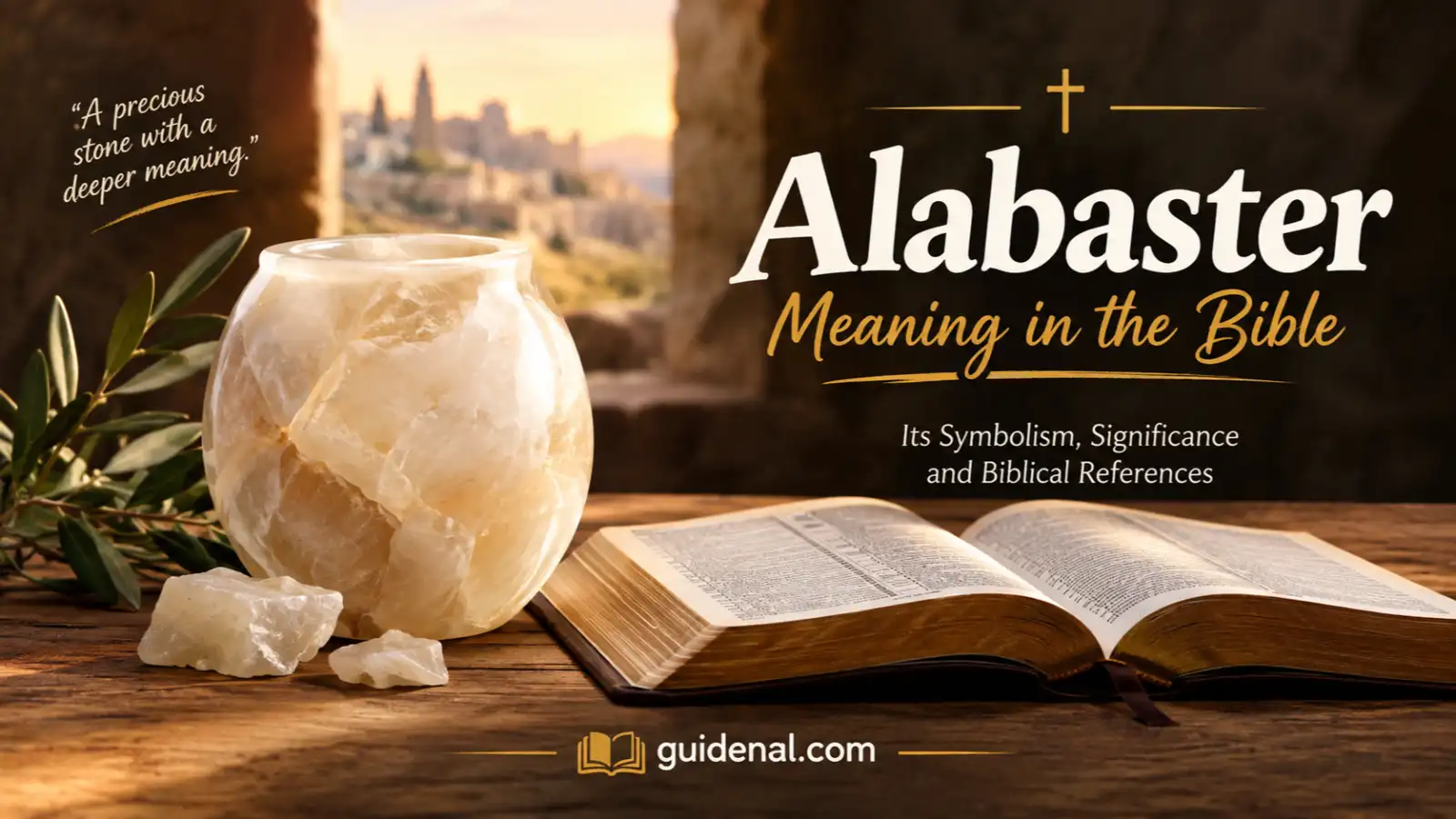
Have you ever owned something valuable that you were afraid to give away? Maybe it was a gift, a family treasure, or something you had saved for a special moment. Giving it up can feel costly.
That helps us understand the powerful picture of alabaster in the Bible.
The New Testament mentions an alabaster flask in several accounts of women bringing expensive perfume to Jesus. The container itself was valuable, but the greater meaning was found in what the women were willing to give. Their actions showed honor, love, humility, sacrifice, and devotion to Christ.
So, what does alabaster mean in the Bible? Is it a symbol of purity? Does it represent the human heart? Does breaking an alabaster jar have a hidden spiritual meaning?
Scripture gives us a better answer than speculation. Alabaster was a vessel used for precious perfume or ointment. In the Gospel accounts, it becomes part of a beautiful picture of wholehearted devotion to Jesus.
Understanding Alabaster in the Bible
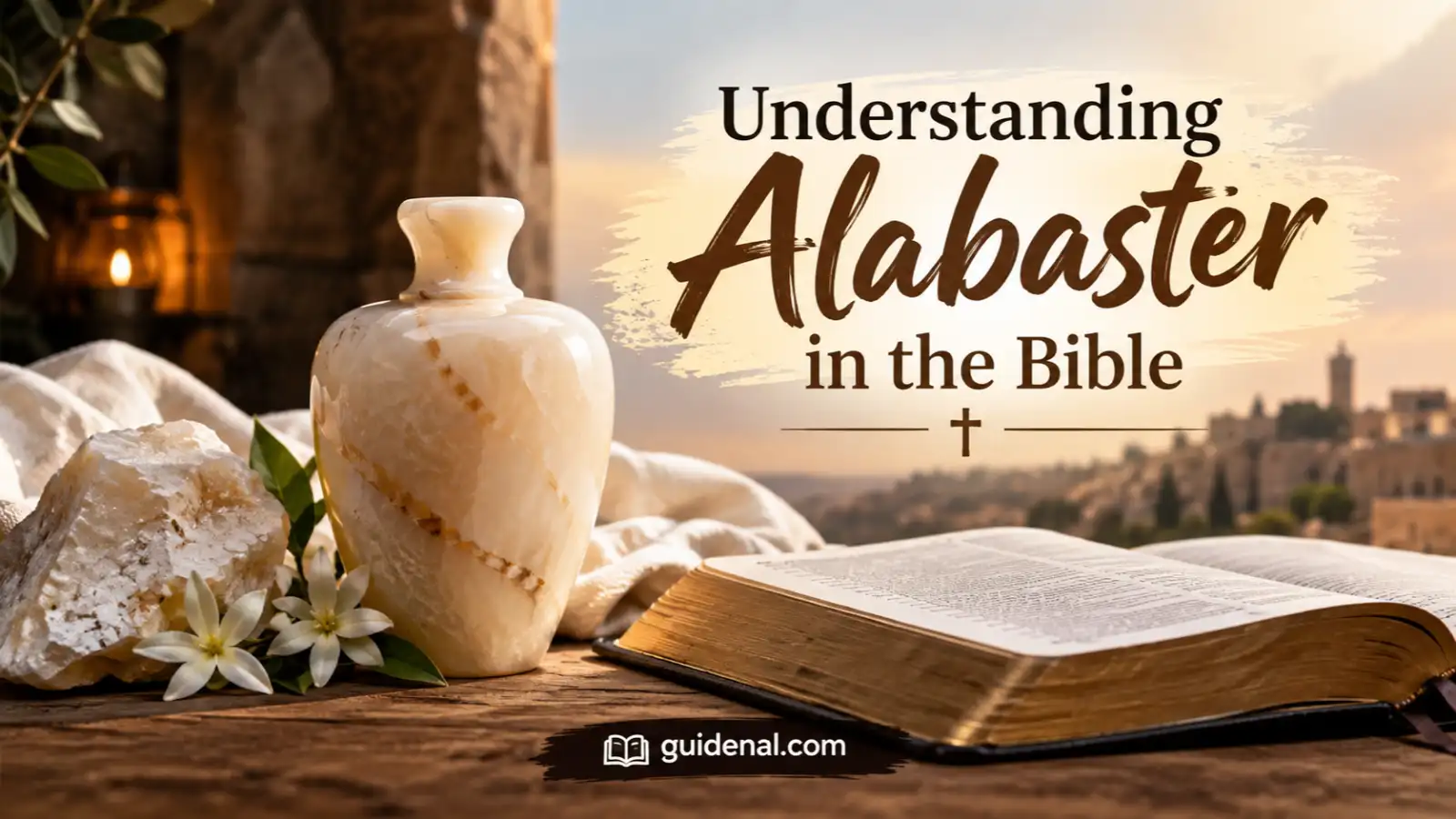
The word alabaster appears in the New Testament in connection with a small container or flask holding valuable perfume. The Greek word is alabastron (ἀλάβαστρον). It referred to an alabaster box or, more broadly, a perfume vessel. Strong’s Greek Lexicon notes that the word could refer to a perfume vase even when the vessel was made from another material.
Historically, alabastra were small perfume containers. Archaeological examples show that they were made from alabaster, stone, and glass and were used for perfumes and scented oils. The Metropolitan Museum of Art preserves examples from the ancient Mediterranean world, including alabaster perfume vases and glass alabastra.
The Bible mentions alabaster specifically in Matthew 26:7, Mark 14:3, and Luke 7:37.
There are two Gospel settings that should not be carelessly blended together.
In Matthew 26 and Mark 14, Jesus is in Bethany, at the house of Simon the leper. A woman brings expensive perfume in an alabaster flask and pours it on Jesus. Mark says the perfume was pure nard and extremely costly. Jesus explains that her action was connected with His coming burial.
John 12 describes a closely related Bethany event and identifies the woman as Mary, who anoints Jesus’ feet with expensive nard. John also connects the act with Jesus’ burial.
Luke 7 describes a different setting. Jesus is eating at the home of Simon the Pharisee, and a woman known in the city as a sinner brings an alabaster flask of perfume. She weeps at Jesus’ feet, wipes them with her hair, and anoints Him. The Gospel accounts should therefore be studied carefully rather than assuming every anointing story describes the same woman or occasion.
The central biblical lesson is not that alabaster has magical spiritual power. The lesson comes from the devotion expressed through the vessel and its costly contents.
What Does Alabaster Mean in the Bible?
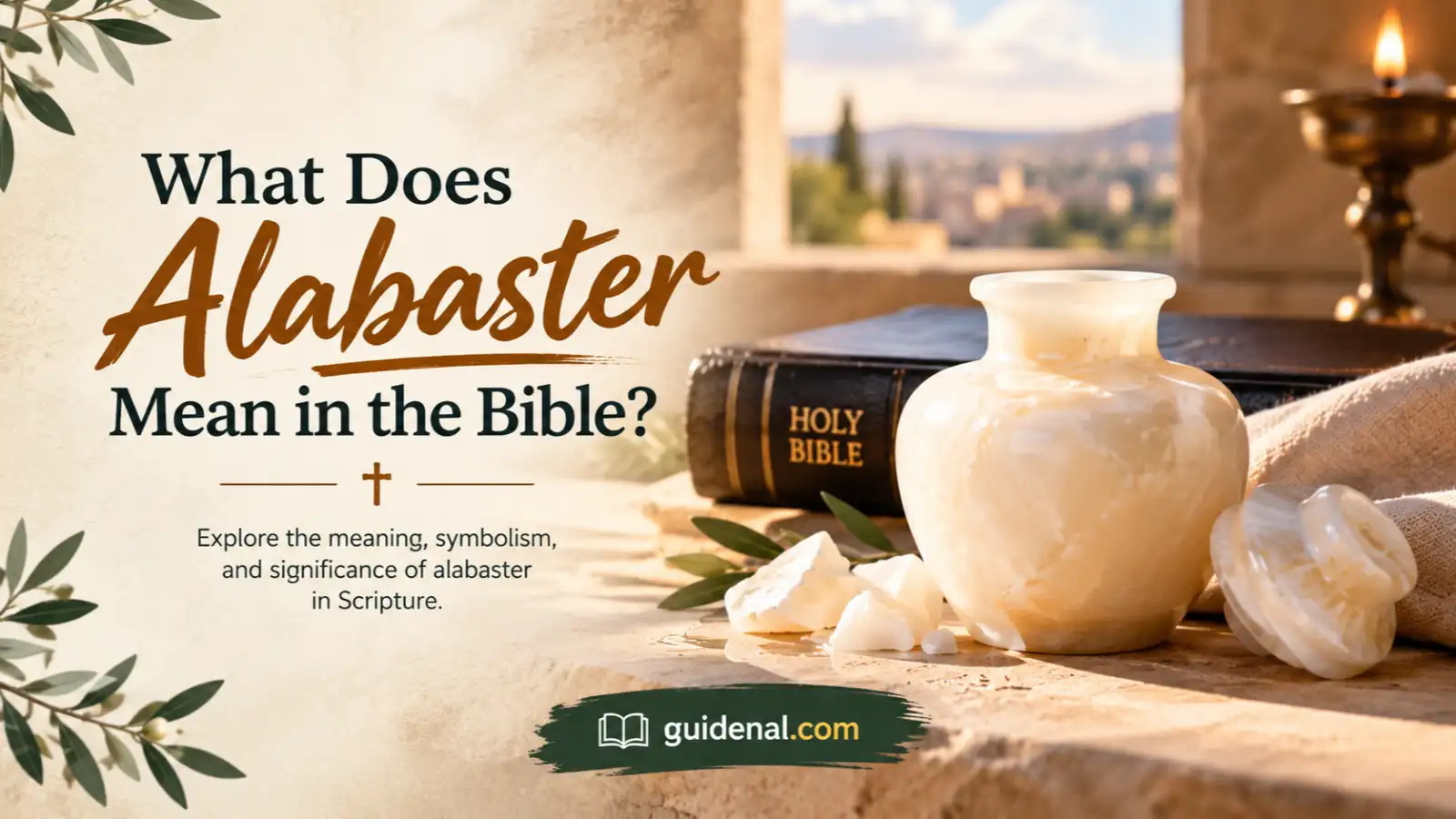
In the Bible, alabaster refers primarily to a vessel used to hold valuable perfume or ointment.
It does not have one secret spiritual meaning that Scripture directly defines.
However, the biblical stories involving alabaster teach several powerful spiritual truths.
1. Alabaster can picture costly devotion
The perfume carried in these vessels could be extremely valuable. Mark says the perfume used to anoint Jesus could have been sold for more than three hundred denarii. A denarius was commonly associated with a laborer’s daily wage.
The woman’s action therefore involved real sacrifice.
Biblical devotion is not merely about words. Love for Christ affects what we value, what we give, and what we are willing to surrender.
2. Alabaster can remind us of wholehearted worship
The women did not merely speak respectfully about Jesus. They acted.
Mary poured expensive perfume on Jesus’ feet. The woman in Luke washed Jesus’ feet with her tears and anointed them with perfume.
Their worship involved humility, love, and personal cost.
3. Alabaster points us toward the value of Jesus
The people around Jesus saw the perfume as something that could have been sold.
Jesus saw the woman’s act differently.
He called it a beautiful thing.
This teaches an important lesson: something that looks wasteful from a worldly perspective may be precious when offered to Christ in sincere faith.
4. Alabaster is connected with burial and preparation
Matthew, Mark, and John connect the anointing at Bethany with Jesus’ approaching death and burial. Jesus specifically interpreted the woman’s action in relation to His burial.
The alabaster story therefore sits very close to the heart of the Gospel.
Jesus was moving toward the cross.
The woman’s costly act became a quiet testimony to the significance of His death.
Best Bible Verses About Alabaster
Because alabaster is mentioned directly in only a few New Testament verses, a good Bible study should include both the direct references and the passages that explain the themes surrounding them.
The following verses are presented from the English Standard Version (ESV).
1. Matthew 26:7
“a woman came up to him with an alabaster flask of very expensive ointment, and she poured it on his head as he reclined at table.”
This is one of the clearest biblical references to alabaster.
The woman did not bring an ordinary gift. She brought something precious and poured it out for Jesus.
Life Application
Ask yourself what you consider too valuable to surrender to God. Your time, comfort, resources, reputation, or plans may sometimes become tests of where your heart truly rests.
2. Mark 14:3
“a woman came with an alabaster flask of ointment of pure nard, very costly, and she broke the flask and poured it over his head.”
Mark gives additional detail. The perfume was pure nard and very costly. The act was public and deliberate.
Her worship was not cheap.
Life Application
True devotion sometimes costs us something. Christian obedience may require giving up comfort, pride, convenience, or personal control.
3. Luke 7:37
“she brought an alabaster flask of ointment.”
Luke introduces a woman who was known publicly as a sinner. Yet she came to Jesus.
The alabaster flask was valuable, but the woman’s posture was even more significant. She approached Jesus with humility.
Life Application
Your past does not make you unworthy of coming to Christ. Jesus welcomes repentant sinners who come to Him in faith.
4. Luke 7:38
“and anointed them with the ointment.”
The woman stood behind Jesus, wept, washed His feet with her tears, dried them with her hair, kissed them, and anointed them.
Her actions demonstrated deep humility and affection.
Life Application
Faith is not merely intellectual agreement. Genuine faith changes how we approach Jesus.
5. Luke 7:47
“Therefore I tell you, her sins, which are many, are forgiven—for she loved much.”
Jesus explained the woman’s actions through the lens of forgiveness.
Her love did not purchase forgiveness. Rather, her love revealed the reality of a heart that had received grace.
Life Application
Remember what Christ has forgiven you. Gratitude for grace should produce love, humility, and obedience.
6. Luke 7:50
“Your faith has saved you; go in peace.”
Jesus ended the encounter with words of assurance.
The woman’s hope was not ultimately in her perfume. It was in Jesus.
Life Application
Do not place your confidence in religious actions alone. Salvation rests in God’s grace received through faith.
7. Mark 14:6
“She has done a beautiful thing to me.”
Jesus defended the woman when others criticized her.
He understood the heart behind her action.
Life Application
God sees motives that other people cannot see. Do what is right before Him even when others misunderstand your obedience.
8. Mark 14:8
“She has done what she could; she has anointed my body beforehand for burial.”
This verse gives the alabaster story a deeper Gospel connection.
The woman could not stop the cross. She could not change the coming events. But she could honor Jesus with what she had.
Life Application
You do not have to do everything to serve God faithfully. Do what God has placed in front of you with the abilities and resources He has given you.
9. Mark 14:9
“what she has done will be told in memory of her.”
Jesus said her act would be remembered wherever the gospel was proclaimed.
Her name is not given in Mark’s account, but her faith-filled action was not forgotten.
Life Application
Faithfulness does not require public recognition. God can use quiet acts of obedience in ways you may never see.
10. Matthew 26:12
“she has done it to prepare my body for burial.”
The act of anointing carried cultural meaning, but Jesus gave it a deeper place within the story of redemption.
His death was approaching.
Life Application
Christian hope rests on the death and resurrection of Jesus Christ. When life is uncertain, remember that God’s saving work is bigger than your present circumstances.
11. John 12:3
“Mary therefore took a pound of expensive ointment made from pure nard, and anointed the feet of Jesus.”
John identifies Mary and describes her anointing Jesus’ feet.
The fragrance filled the house.
Life Application
A sincere act of love can affect more people than you realize. Faithfulness may quietly encourage an entire family, church, or community.
12. John 12:7
“Leave her alone, so that she may keep it for the day of my burial.”
Jesus connected Mary’s action with His burial.
The disciples did not fully understand everything that was coming, but Jesus did.
Life Application
God understands the full story when you only see one chapter. Trust Him when His purposes are clearer to Him than they are to you.
13. Ephesians 5:2
“walk in love, as Christ loved us and gave himself up for us, a fragrant offering and sacrifice to God.”
Paul uses the language of fragrance to describe Christ’s sacrificial love.
The deepest biblical picture of costly devotion is not the alabaster vessel. It is Jesus giving Himself for sinners.
Life Application
Let Christ’s sacrificial love shape your love for others. Christian living means learning to give, serve, forgive, and love because Christ first loved us.
14. Psalm 141:2
“Let my prayer be counted as incense before you, and the lifting up of my hands as the evening sacrifice!”
David uses the imagery of incense to describe prayer.
The Bible often connects pleasing fragrance with worship offered to God.
Life Application
Your prayers matter to God. You do not need expensive possessions to worship Him. A sincere heart turned toward God is precious.
15. Philippians 4:18
“a fragrant offering, a sacrifice acceptable and pleasing to God.”
Paul describes generous Christian giving with sacrificial and fragrant language.
The connection is important. Scripture does not teach that perfume itself makes worship acceptable. God looks at faithful hearts and obedient lives.
Life Application
Generosity can become an act of worship when it flows from love for God and concern for others.
16. 2 Corinthians 2:15
“For we are the aroma of Christ to God among those who are being saved and among those who are perishing.”
Paul moves the imagery from physical fragrance to Christian witness.
Believers are called to represent Christ in the world.
Life Application
Your character is part of your testimony. People should be able to see something of Christ’s love, truth, humility, and grace in the way you live.
17. John 19:39
“Nicodemus also, who earlier had come to Jesus by night, came bringing a mixture of myrrh and aloes.”
Perfume and spices also appear in the burial of Jesus.
John’s account helps us understand why the language of anointing and fragrance appears around the final days of Jesus’ earthly ministry.
Life Application
The cross was not an accident. Jesus willingly entered the path of suffering that Scripture had prepared for Him.
18. Song of Solomon 1:3
“your anointing oils are fragrant; your name is oil poured out.”
This verse belongs to the poetry of the Song of Solomon, where fragrance is part of the language of love.
It should not be treated as a direct prophecy about every alabaster story. Yet it shows how perfume could naturally communicate beauty, affection, and attraction in biblical poetry.
Life Application
God cares about love that is sincere and faithful. Our relationship with Him should not be cold or merely outward.
What Did the Alabaster Flask Contain?
The Bible identifies the contents as ointment, perfume, and in Mark’s account, pure nard.
Nard was a valuable aromatic substance. Mark emphasizes that the perfume was extremely costly. The disciples questioned why such an expensive substance was not sold and the money given to the threshold.
John gives a striking measurement for Mary’s perfume: about a Roman pound, or roughly 327 grams. John also records that its value was associated with three hundred denarii.
This detail helps modern readers understand the seriousness of the woman’s sacrifice.
She was not pouring out something cheap.
She was giving something valuable to Jesus.
What Does Breaking the Alabaster Jar Mean?
This is one of the most common questions about alabaster in the Bible.
Mark says that the woman broke the flask before pouring out the perfume.
Some historical explanations suggest that perfume containers could have narrow necks or seals that were broken to access the contents. Ancient perfume vessels varied in shape and material, so we should be cautious about turning one particular reconstruction into a biblical certainty.
Spiritually, the passage clearly emphasizes complete and costly giving.
But there is an important distinction.
The Bible does not say, “The broken alabaster jar symbolizes a broken heart.”
That may be a meaningful sermon illustration, but it should not be presented as a direct biblical definition.
The strongest interpretation comes from what Jesus Himself says.
The woman did a beautiful thing.
She gave what she had.
She honored Jesus.
👌She anointed Him before His burial.
She demonstrated love.
So Christians can apply the story without inventing a secret code.
Is Alabaster a Symbol of Purity in the Bible?
Alabaster is sometimes described in Christian teaching as a symbol of purity because alabaster can appear white and beautiful.
However, Scripture does not explicitly say that alabaster symbolizes purity.
That distinction matters.
Biblical symbolism should come from the biblical text rather than from assumptions about an object’s appearance.
The Bible’s emphasis is on the perfume, the costly gift, the act of anointing, the recipient, and the timing.
If someone uses white alabaster as an illustration of purity, that can be a helpful devotional picture. But it should be described as an application or illustration, not as a doctrine taught directly by Scripture.
Is Alabaster a Symbol of a Broken Heart?
The Bible does not directly teach that an alabaster jar represents a broken heart.
However, Luke 7 gives us a powerful picture of humility and repentance.
The woman comes to Jesus weeping. She stands at His feet. She wipes His feet with her hair. And she kisses His feet and anoints them with perfume.
Jesus connects her actions with forgiveness and faith.
So while “broken alabaster equals broken heart” is not a biblical formula, the story certainly teaches that a humble heart can come openly to Christ.
That is a much stronger biblical lesson.
The Difference Between the Bethany Woman and the Woman in Luke 7
This is an important point that many Bible studies overlook.
Matthew 26 and Mark 14
Jesus is in Bethany.
He is at the house of Simon the leper.
A woman brings an alabaster flask containing very expensive perfume.
She pours it on Jesus’ head.
Jesus connects the act with His burial.
John 12
Jesus is also in Bethany.
Mary anoints Jesus’ feet with expensive nard.
John connects the event with Jesus’ approaching burial.
Because John names Mary and the setting closely matches Matthew and Mark, these accounts are commonly understood as describing the same Bethany anointing tradition.
Luke 7
Luke’s account has a different setting.
Jesus is dining at the house of Simon the Pharisee.
The woman is described as a sinner known in the city.
She anoints Jesus’ feet and receives Jesus’ teaching about forgiveness and faith.
The differences in setting and details are significant.
The Bible does not require us to combine every alabaster story into one event.
Recognizing those differences actually gives us a clearer understanding of each Gospel.
Biblical Themes Connected to Alabaster
Costly Worship
The women demonstrate that worship can involve sacrifice.
Christian worship is not merely singing songs on Sunday. It includes offering our lives, resources, time, obedience, and love to God.
Romans 12:1 develops this broader idea by calling believers to present themselves to God as living sacrifices.
Grace and Forgiveness
Luke’s story connects the woman’s love with forgiveness.
She did not buy forgiveness with perfume.
Rather, her response revealed the work of grace in her life.
This protects us from a dangerous misunderstanding: Christianity is not a system where expensive gifts purchase God’s favor.
Salvation is God’s gift of grace.
Humility
The woman in Luke 7 placed herself at Jesus’ feet.
Her position communicated humility.
Christian discipleship begins with recognizing that we need Christ.
Sacrifice
The perfume in the Bethany accounts was costly.
Jesus Himself was moving toward the greatest sacrifice of all: His death on the cross.
The woman’s gift points us toward a larger truth. Jesus would soon give Himself for the salvation of His people.
Love
The alabaster accounts show love expressed through action.
Love is not merely a feeling.
It becomes visible through what we do.
Fragrance and Christian Witness
The New Testament later uses fragrance as a picture of Christ’s sacrifice and Christian witness.
Ephesians 5:2 calls Christ’s sacrifice a fragrant offering to God. Paul also describes believers as the aroma of Christ in 2 Corinthians 2:15.
This gives modern Christians a beautiful application.
Our lives should point people toward Jesus.
Biblical Symbolism of Perfume and Fragrance
Perfume had practical and cultural importance in the ancient world.
It could be used for personal care, hospitality, celebration, and burial practices. Archaeological examples of ancient perfume vessels show how widespread these containers were in the Mediterranean world.
Scripture also uses fragrance as a theological image.
Fragrance Can Picture Worship
Psalm 141 connects prayer with incense.
The image communicates something offered upward to God.
Fragrance Can Picture Sacrifice
Paul describes Christ’s self-giving as a fragrant offering.
This points to the pleasing nature of Christ’s obedient sacrifice.
Fragrance Can Picture Christian Witness
Believers are called the aroma of Christ.
Our lives should make Christ known through truth and love.
Fragrance Can Picture Love
The Song of Solomon uses perfume imagery in poetic descriptions of love.
This reminds us that fragrance had emotional and relational associations in biblical culture.
What Can Christians Learn From the Alabaster Story?
1. Give Jesus Your Best
The woman did not offer what was convenient.
She offered something valuable.
That does not mean every Christian must give away everything they own. Scripture teaches both generosity and wise stewardship.
The lesson is deeper: Jesus deserves our wholehearted devotion.
2. Do Not Measure Worship Only by Cost
The widow’s offering in Mark 12 shows that God measures giving differently from human beings.
People may look at the amount.
God sees the heart.
A simple act of obedience can be deeply meaningful when it is offered in faith.
3. Do Not Let Other People’s Opinions Control Your Obedience
The woman was criticized.
Jesus defended her.
Christian obedience will sometimes be misunderstood.
That does not mean we should ignore wise correction. It means our final desire should be to please God rather than gain human approval.
4. Remember That Grace Produces Gratitude
Luke 7 teaches that forgiveness produces love.
When you remember what Christ has done for you, gratitude should grow.
Grace should make us more humble, not more proud.
5. Worship Jesus While You Have the Opportunity
Jesus told the disciples that they would not always have Him with them in the same way.
His earthly ministry was moving toward the cross.
This reminds us that opportunities to serve are gifts.
If God gives you an opportunity to encourage someone, serve someone, give generously, pray, or share the Gospel, do not always assume you can postpone it.
6. Your Faithfulness May Outlive Your Name
The woman in Mark’s account is not named.
Yet Jesus said her act would be remembered wherever the Gospel was preached.
You may never become famous.
You may never receive public recognition.
But God sees faithful obedience.
That is enough.
Common Misconceptions About Alabaster in the Bible
Misconception 1: Alabaster has a secret spiritual code
Scripture does not give alabaster a hidden numerical or mystical meaning.
It is primarily a vessel associated with perfume.
Misconception 2: Every alabaster story is the same event
The Gospel accounts contain important differences.
Luke 7 should not automatically be merged with the Bethany accounts.
Misconception 3: Breaking the jar always means breaking your heart
This is a popular devotional illustration, but it is not a direct biblical definition.
We should distinguish illustration from Scripture.
Misconception 4: The perfume purchased forgiveness
It did not.
Jesus explicitly tells the woman in Luke 7 that her faith has saved her.
The gift was an expression of devotion, not payment for salvation.
Misconception 5: God only values expensive offerings
The Bible repeatedly shows that God cares about the heart behind the gift.
The point of the alabaster story is not that Christians must give expensive things.
The point is that Jesus is worthy of wholehearted love.
FAQs:
What does alabaster mean in the Bible?
Alabaster refers to a vessel or flask used for valuable perfume or ointment. In the New Testament, it appears in accounts of women anointing Jesus. The stories emphasize devotion, sacrifice, humility, love, forgiveness, and Jesus’ coming death.
What does an alabaster jar symbolize?
The Bible does not assign one official symbolic meaning to the jar itself. In context, it can illustrate costly devotion because women used valuable perfume to honor Jesus. Its meaning comes from the action and the Gospel context.
What was inside the alabaster jar?
The Gospel accounts describe perfume or ointment. Mark specifically identifies the substance as pure nard and says it was very costly. John also describes Mary’s expensive nard being used to anoint Jesus.
Who broke the alabaster jar in the Bible?
A woman at Bethany broke an alabaster flask in Mark 14:3 and poured the perfume over Jesus’ head. John identifies Mary as the woman who anointed Jesus’ feet in the related Bethany account.
Is alabaster a symbol of purity?
Not explicitly. Scripture does not say that alabaster represents purity. Its biblical use centers on perfume, anointing, costly devotion, and the events surrounding Jesus’ death.
What does breaking the alabaster jar mean spiritually?
It can illustrate wholehearted and costly devotion to Jesus. However, the Bible does not give a symbolic formula saying that breaking the jar always represents a broken heart or complete surrender.
How many times is alabaster mentioned in the Bible?
The Greek word translated “alabaster” occurs in three New Testament verses: Matthew 26:7, Mark 14:3, and Luke 7:37. Mark uses the word within the same verse more than once.
Why was alabaster perfume so valuable?
Perfumed oils were luxury goods, and nard was particularly valuable. Ancient alabaster vessels were commonly associated with perfumes and scented oils. Archaeological collections contain examples of such vessels from the ancient Mediterranean world.
Conclusion:
The alabaster meaning in the Bible is not found in a secret code hidden inside the stone.
It is found in the Gospel story.
A valuable vessel carried valuable perfume. A woman willingly poured that perfume out for Jesus. Others saw waste. Jesus saw beauty.
That should cause us to pause.
What do we consider too valuable to place in God’s hands?
👌Our time?
Our plans?
Our money?
👌Our reputation?
Our comfort?
Our future?
The alabaster stories do not teach us to earn God’s love through costly gifts. They teach us to respond to God’s grace with wholehearted love.
The greatest sacrifice in these passages is ultimately not the woman’s perfume.
It is Christ Himself.
Jesus willingly went to the cross for sinners. His sacrifice was not an empty religious act. It was the loving work of redemption.
So give God your best—not because you are trying to purchase His favor, but because you have already received grace through Jesus Christ.
Your offering may seem small.
😊Your obedience may go unnoticed.
Your name may never be remembered by the world.
But God sees.
And faithful love offered to Christ is never wasted.
As Paul reminds us, believers are called to walk in love because Christ loved us and gave Himself for us as a fragrant offering and sacrifice to God.
The question is not simply, “What does alabaster symbolize?”
A better question is:
“What am I willing to pour out in love for Jesus?”

I am a content writer at Guidenal, where I create easy-to-understand, well-researched, and reader-focused guides inspired by biblical teachings. Working alongside Naqash Ayub, I strive to deliver trustworthy content that helps readers grow in faith and find practical answers from Scripture.