
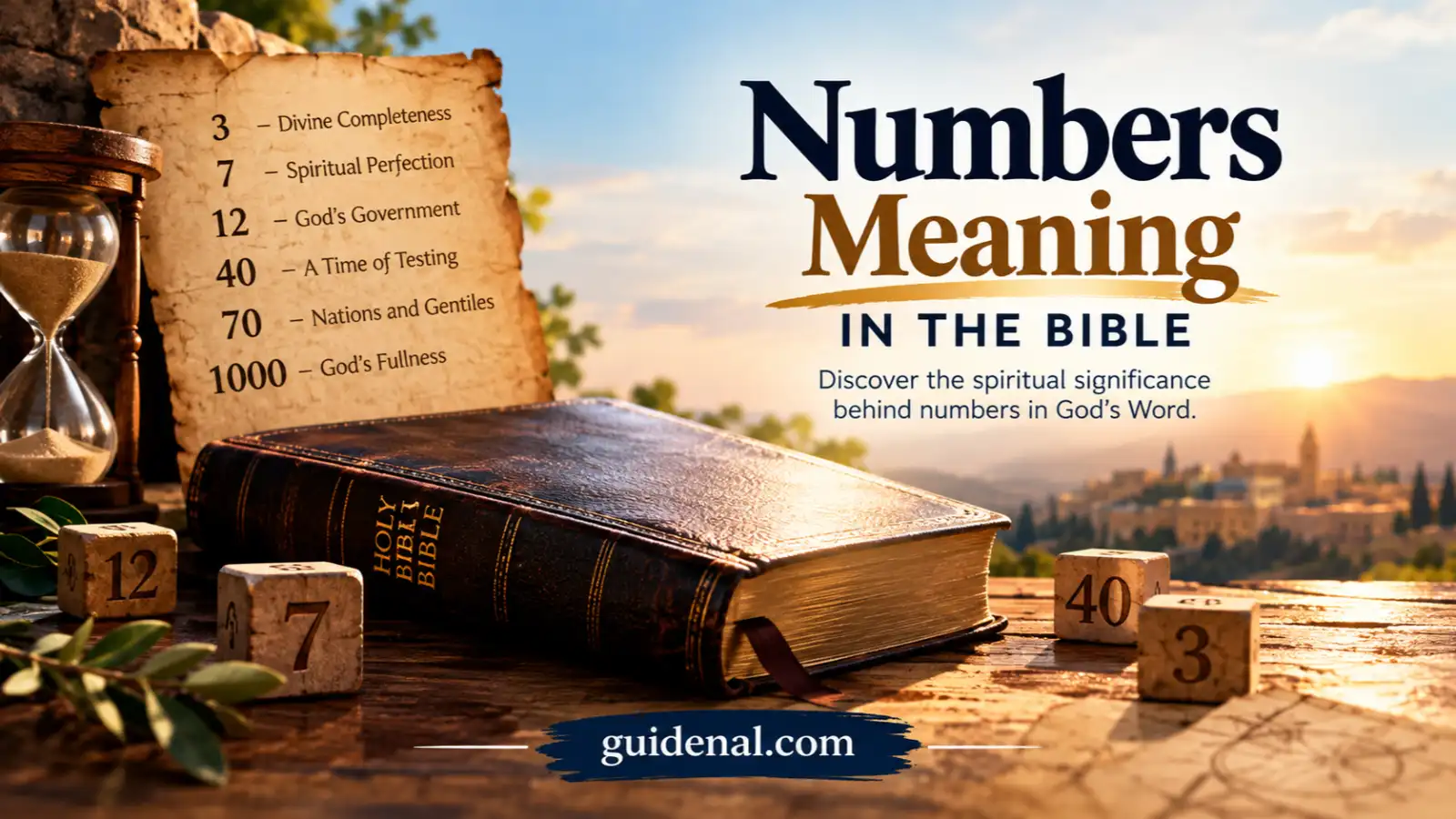
Have you ever noticed a number appearing again and again in the Bible and wondered if it means something more?
Maybe you have seen the number seven connected with creation and rest. Perhaps you have noticed twelve leagues, twelve apostles, forty days, or the mysterious number 666. These patterns can make us curious about how God uses numbers in His Word.
The Bible certainly gives numbers importance in many passages. But there is an important difference between biblical number patterns and trying to turn every number in our lives into a secret message from God.
Scripture does not teach Christians to practice numerology. Instead, it shows us how numbers sometimes serve a clear purpose within God’s story. Some numbers describe real events. Others appear in repeated patterns, symbolic visions, measurements, or commands.
Understanding those contexts helps us read Scripture with wisdom rather than speculation.
In this study, we will explore numbers commonly associated with biblical meaning, examine key Bible verses, consider symbolism carefully, and look at what these patterns can teach us about God, Jesus Christ, faith, obedience, redemption, and Christian living.
Understanding Numbers in the Bible
Numbers appear throughout both the Old Testament and New Testament because biblical writers often recorded real measurements, ages, quantities, periods of time, leagues, people, offerings, and events.
From the beginning, God established times and seasons. Genesis says that the lights in the heavens were given for “signs, and for seasons, and for days, and years” (Genesis 1:14). The biblical use of numbers is therefore often connected with God’s created order rather than secret codes.
Numbers also helped Israel understand its worship and community life. Israel had twelve leagues. The priestly and sacrificial systems contained specific measurements and quantities. The Sabbath followed a seven-day pattern. The Jubilee came after seven cycles of seven years.
Jesus also used numbers in His teaching. He spoke about one lost sheep, two servants with different debts, five loaves, twelve apostles, and forgiveness “seventy times seven.”
The book of Revelation contains some of Scripture’s most famous numbers, including 144,000 and 666. These passages require special care because Revelation uses visions, signs, symbols, and Old Testament imagery.
The safest approach is simple:
Let Scripture explain Scripture.
A number should not be given a meaning merely because a modern Christian book, website, dream interpretation, or social media post assigns one to it.
Sometimes a number has an obvious biblical function. Sometimes it may contribute to a symbolic pattern. And sometimes it is simply a number describing something that happened.
That distinction protects us from reading meanings into Scripture that God never intended.
Best Bible Verses About Numbers and Their Meaning
1. Genesis 1:14 — Numbers Help Mark God’s Order
Genesis 1:14
“And God said, Let there be lights in the firmament of the heaven to divide the day from the night; and let them be for signs, and for seasons, and for days, and years:”
What This Verse Means
This verse introduces one of the first biblical connections between heavenly signs and measurable time.
The sun, moon, and stars help establish days, seasons, and years. The purpose is not to encourage astrology. Scripture presents the heavenly bodies as part of God’s created order.
Numbers therefore help us recognize that God is a God of order.
Life Application
Your days are not meaningless. Time itself is part of God’s creation.
Use your time wisely, but do not become obsessed with trying to decode every date or number. Trust the God who holds your times in His hands.
2. Genesis 7:12 — Forty Days of Rain
Genesis 7:12
“And the rain was upon the earth forty days and forty nights.”
What This Verse Means
The number forty appears repeatedly in Scripture during significant periods of testing, transition, judgment, preparation, or waiting.
Here, Noah experienced forty days and nights of rain during the flood.
The number itself does not magically cause the event. The story is about God’s judgment, Noah’s obedience, and God’s preservation of those inside the ark.
Life Application
Long seasons can feel overwhelming.
Noah’s story reminds us that obedience may require trusting God through circumstances we cannot control.
3. Exodus 20:9–11 — Six Days and the Seventh Day
Exodus 20:9–11
“Six days shalt thou labour, and do all thy work:
But the seventh day is the sabbath of the Lord thy God: in it thou shalt not do any work…
For in six days the Lord made heaven and earth, the sea, and all that in them is, and rested the seventh day:”
What This Verse Means
The seven-day pattern is deeply connected with creation and Sabbath rest.
The important point is not simply that seven is a special number. Scripture connects the seventh day with God’s work of creation, blessing, holiness, and rest.
Life Application
God cares about both faithful work and meaningful rest.
Christian living should not become endless activity. We need rhythms that remind us that God is the Creator and that our worth does not depend on constant productivity.
4. Joshua 6:4 — Seven and the Fall of Jericho
Joshua 6:4
“And seven priests shall bear before the ark seven trumpets of rams’ horns: and the seventh day ye shall compass the city seven times, and the priests shall blow with the trumpets.”
What This Verse Means
Seven appears repeatedly in the instructions surrounding Jericho.
The Israelites did not conquer Jericho because seven was a magical number. They followed God’s unusual instructions.
The repeated sevenfold pattern emphasizes God’s command and Israel’s obedience.
Life Application
Sometimes faith means obeying God even when His instructions do not look like the strategy we would have chosen.
The power belonged to God, not to the number.
5. Leviticus 25:10 — Fifty and Jubilee
Leviticus 25:10
“And ye shall hallow the fiftieth year, and proclaim liberty throughout all the land unto all the inhabitants thereof: it shall be a jubile unto you; and ye shall return every man unto his possession, and ye shall return every man unto his family.”
What This Verse Means
The fiftieth year was the Year of Jubilee.
It followed seven cycles of seven years. It was associated with liberty, restoration, return of property, and release.
This gives the number fifty a clear place in Israel’s covenant life.
The concept also helps us understand God’s concern for restoration and freedom.
Life Application
God cares about people who are trapped by poverty, debt, loss, and broken circumstances.
The Jubilee points toward a God who values restoration rather than permanent oppression.
6. Matthew 10:2 — Twelve Apostles
Matthew 10:2
“Now the names of the twelve apostles are these; The first, Simon, who is called Peter, and Andrew his brother; James the son of Zebedee, and John his brother;”
What This Verse Means
Jesus chose twelve apostles.
The number twelve is significant because it connects naturally with the twelve leagues of Israel. Jesus was not creating a random group of followers. His ministry stood within God’s continuing story of redemption.
The twelve apostles became foundational witnesses to Jesus and His resurrection.
Life Application
God works through people within His larger purpose.
Your role may seem small, but faithful service can become part of something much bigger than yourself.
7. Matthew 14:17 — Five Loaves and Two Fish
Matthew 14:17
“And they say unto him, We have here but five loaves, and two fishes.”
What This Verse Means
The disciples saw a very small amount of food compared with the size of the crowd.
Jesus used what they had and multiplied it.
The important lesson is not that five and two are magic numbers. The point is that Jesus can accomplish what human resources cannot accomplish on their own.
Life Application
You may feel that you have too little.
Too little money.
Too little ability.
😊Too little strength.
Too little experience.
Bring what you have to Christ. Faith begins by recognizing that our resources are limited but God’s power is not.
8. Matthew 18:21–22 — Seventy Times Seven
Matthew 18:21–22
“Then came Peter to him, and said, Lord, how oft shall my brother sin against me, and I forgive him? till seven times?
Jesus saith unto him, I say not unto thee, Until seven times: but, Until seventy times seven.”
What This Verse Means
Jesus was not giving His disciples a mathematical forgiveness limit.
He was teaching a heart of continual forgiveness.
The number communicates the enormous extent of forgiveness Jesus expects from His followers.
The surrounding parable makes the point even stronger: people who have received God’s mercy should extend mercy to others.
Life Application
Forgiveness does not mean pretending that evil never happened.
It means refusing to make personal revenge the center of your life.
Christ’s mercy toward you becomes the foundation for showing mercy to others.
9. Luke 15:4 — The One Lost Sheep
Luke 15:4
“What man of you, having an hundred sheep, if he lose one of them, doth not leave the ninety and nine in the wilderness, and go after that which is lost, until he find it?”
What This Verse Means
Jesus uses the numbers ninety-nine and one to make a powerful point about God’s concern for the lost.
The one sheep matters.
This is not a lesson about a secret meaning attached to the number 100. It is a picture of God’s pursuing love.
Life Application
Never assume that you are too insignificant for God to care about.
Jesus repeatedly welcomed people whom others ignored.
If you feel spiritually distant, this parable reminds you that God cares about the lost.
10. Luke 24:7 — The Third Day
Luke 24:7
“Saying, The Son of man must be delivered into the hands of sinful men, and be crucified, and the third day rise again.”
What This Verse Means
The third day is central to the Christian message because Jesus rose from the dead on the third day.
The resurrection was not an afterthought. Jesus had foretold it, and the apostles proclaimed it as the foundation of Christian faith.
Life Application
Christian hope is not based on positive thinking.
It is based on the risen Christ.
Because Jesus conquered death, suffering and death do not have the final word for those who belong to Him.
11. Genesis 41:29–30 — Seven Years of Plenty and Famine
Genesis 41 describes Joseph interpreting Pharaoh’s dream concerning seven years of great abundance followed by seven years of severe famine.
What This Verse Means
The repeated seven-year pattern is connected to God’s revelation of what was coming and Joseph’s preparation for it.
The story also demonstrates that wisdom includes preparing faithfully for future difficulties.
Life Application
Faith does not mean ignoring practical responsibility.
Joseph trusted God while also making wise plans.
Christians can pray for provision while working diligently, saving responsibly, and caring for others.
12. Deuteronomy 8:2 — Forty Years in the Wilderness
Deuteronomy 8:2
“And thou shalt remember all the way which the Lord thy God led thee these forty years in the wilderness, to humble thee, and to prove thee, to know what was in thine heart, whether thou wouldest keep his commandments, or no.”
What This Verse Means
Israel’s forty years in the wilderness were a long period of testing, dependence, discipline, and preparation.
The verse itself explains the purpose: God was teaching His people humility and obedience.
Life Application
A difficult season does not automatically mean that God has abandoned you.
Some seasons teach patience, dependence, obedience, and trust.
Do not waste a wilderness season by only asking when it will end. Ask what God is teaching you while you walk through it.
13. Acts 2:41 — About Three Thousand Believers
Acts 2:41
“Then they that gladly received his word were baptized: and the same day there were added unto them about three thousand souls.”
What This Verse Means
After Peter preached at Pentecost, about three thousand people received the message and were baptized.
The number records the remarkable growth of the early Christian community.
It shows that the gospel was not intended to remain with a small group. The message of Jesus was spreading publicly through the work of the Holy Spirit.
Life Application
God can use one faithful witness to reach many people.
You do not need to know exactly how God will use your obedience. Share the truth of Christ faithfully and leave the results with Him.
14. John 21:11 — 153 Fish
John 21:11
“Simon Peter went up, and drew the net to land full of great fishes, an hundred and fifty and three: and for all there were so many, yet was not the net broken.”
What This Verse Means
The Bible gives the exact number of fish: 153.
Many theories have been proposed about a hidden symbolic meaning of this number.
But Scripture itself does not explain 153 as a secret code.
The safest interpretation is to focus on the event: Jesus provided an extraordinary catch of fish and demonstrated His authority to His disciples after His resurrection.
Life Application
Not every biblical number requires a hidden interpretation.
Sometimes the wisest thing we can do is simply receive the story as Scripture gives it.
15. Revelation 7:4 — 144,000
Revelation 7:4
“And I heard the number of them which were sealed: and there were sealed an hundred and forty and four thousand of all the leagues of the children of Israel.”
What This Verse Means
The 144,000 is one of the most discussed numbers in Revelation.
The number is connected with the twelve leagues of Israel and appears within a highly symbolic apocalyptic vision.
Christians differ over how precisely this number should be understood. Some read it as a literal number; others understand it symbolically.
What Scripture clearly emphasizes is God’s knowledge and protection of His servants.
Life Application
When the world feels chaotic, God’s people are not forgotten.
God knows those who belong to Him.
16. Revelation 21:16 — Twelve Thousand Furlongs
Revelation 21:16
“And the city lieth foursquare, and the length is as large as the breadth: and he measured the city with the reed, twelve thousand furlongs. The length and the breadth and the height of it are equal.”
What This Verse Means
John describes the New Jerusalem with measurements involving twelve.
The city is presented as perfectly ordered and complete.
The surrounding passage also mentions twelve gates, twelve pearls, and twelve foundations.
These details connect the final dwelling of God’s people with the larger biblical story of God’s covenant people.
Life Application
Christian hope ends not with escape from God’s creation, but with God’s presence with His people.
Revelation points believers toward a future where God dwells with His people and makes all things new.
17. Revelation 21:17 — 144 Cubits
Revelation 21:17
“And he measured the wall thereof, an hundred and forty and four cubits, according to the measure of a man, that is, of the angel.”
What This Verse Means
Again, the number 144 appears in the description of the New Jerusalem.
Because 144 is twelve multiplied by twelve, many interpreters see a connection with God’s covenant people and completeness.
Still, we should avoid claiming more than Scripture says.
The larger context clearly emphasizes God’s holy city and the glorious future awaiting His people.
Life Application
God’s promises are not vague wishes.
The biblical vision of the future gives Christians a reason to persevere faithfully in the present.
18. Revelation 13:18 — The Number 666
Revelation 13:18
“Here is wisdom. Let him that hath understanding count the number of the beast: for it is the number of a man; and his number is Six hundred threescore and six.”
What This Verse Means
The number 666 is perhaps the most famous number in the Bible.
Unlike many numbers, Scripture directly connects this number with the beast.
The verse also says that understanding is required to “count” the number.
Throughout Christian history, interpreters have proposed different explanations, including connections between names and numerical values. The important point is that Revelation itself connects 666 with the beast and calls believers to wisdom.
We should not randomly assign 666 to people, dates, products, barcodes, or modern events without strong biblical evidence.
Life Application
Biblical wisdom requires discernment.
Christians should not live in constant fear of mysterious numbers. Revelation ultimately calls God’s people to remain faithful to Christ.
Common Biblical Numbers and Their Significance
The Bible contains many numbers, but several appear often enough to deserve special attention.
The Number 1
One often emphasizes singularity or unity.
Scripture teaches that there is one God. Christianity is centered on one Lord and one saving purpose in Christ.
The important lesson is not mystical mathematics. It is God’s uniqueness and sovereignty.
The Number 2
Two can appear in contexts involving testimony, partnership, agreement, or confirmation.
For example, biblical law often established important matters through multiple witnesses.
This teaches us that biblical truth was not designed to depend on one unsupported accusation.
The Number 3
Three appears in important events throughout Scripture.
Jesus rose on the third day. Peter denied Jesus three times. Jesus later asked Peter three times about his love.
These repeated patterns can be meaningful within their immediate contexts, but Christians should avoid creating a universal rule that every appearance of three means exactly the same thing.
The Number 4
Four frequently appears in descriptions of the created world or worldwide directions.
Revelation speaks of four corners of the earth and four winds.
In biblical visions, four can therefore appear in contexts associated with the earth or creation.
The Number 5
Five sometimes appears simply as a quantity, such as the five loaves in Jesus’ feeding miracle.
There is no need to assign a universal spiritual definition to every appearance of five.
The context determines its significance.
The Number 6
Six appears in the creation account before the seventh day of rest.
It also appears prominently in the number 666.
Because Revelation connects 666 with the beast, six should not automatically be treated as evil whenever it appears in Scripture.
The Number 7
Seven is one of the most prominent recurring numbers in Scripture.
It appears in creation, Sabbath, festivals, visions, judgments, and Revelation.
The biblical pattern often connects seven with completion, fullness, or a completed cycle, but the exact meaning depends on context.
The Number 10
Ten appears in several important biblical settings, including the Ten Commandments.
It can also occur as a practical counting number.
The Ten Commandments demonstrate that numbers can help structure God’s covenant instructions without becoming mystical objects.
The Number 12
Twelve has a strong connection with God’s covenant people.
Israel had twelve leagues, and Jesus appointed twelve apostles.
Revelation continues this pattern with twelve gates and twelve foundations in the New Jerusalem.
The Number 40
Forty repeatedly appears during significant periods of testing, preparation, transition, or judgment.
Examples include:
- Forty days of rain during the flood
- Forty years in the wilderness
- Moses’ forty days on Mount Sinai
- Jesus’ forty days of fasting in the wilderness
The context matters more than simply memorizing “40 means testing.”
The Number 50
Fifty is especially important in the Year of Jubilee.
Leviticus 25 connects the fiftieth year with liberty, restoration, and return.
This gives fifty a clear covenant and social meaning within Israel’s life.
The Number 70
Seventy appears in several important biblical contexts, including the seventy elders and Jesus’ sending of seventy disciples in Luke 10.
It can represent a significant or complete group in some contexts, but its meaning should not be forced into every appearance.
The Number 144,000
The number 144,000 appears in Revelation and is connected with the leagues of Israel.
It should be interpreted within Revelation’s symbolic and apocalyptic context rather than through modern numerology.
The Number 666
666 is specifically identified as the number of the beast in Revelation 13:18.
It is not a general biblical number meaning that Christians should attach to ordinary people or everyday events.
Biblical Themes Connected to Numbers
God’s Order
Numbers often remind us that God works with order and purpose.
Creation follows rhythms of days and seasons. Israel’s worship included appointed times. The biblical calendar had structure.
God is not the author of confusion.
Faith and Obedience
The story of Jericho demonstrates that biblical numbers often appear within commands.
The Israelites were not asked to understand every detail before obeying God.
Faith means trusting God enough to follow His Word.
God’s Provision
The five loaves and two fish remind us that God is able to provide beyond human expectations.
The disciples saw scarcity.
Jesus demonstrated abundance.
Spiritual Growth
The number forty often appears during periods when God’s people are being prepared, tested, humbled, or redirected.
Christian growth also takes time.
Spiritual maturity rarely happens overnight.
Redemption and Restoration
The number fifty in the Year of Jubilee points toward restoration.
God cares about freedom, family, inheritance, justice, and restoration.
These themes ultimately find their fullest hope in God’s redemptive work.
God’s People
Twelve is strongly connected with God’s covenant community.
The twelve leagues and twelve apostles show continuity between God’s work in Israel and the mission of the early church.
Wisdom and Discernment
Revelation 13:18 does not encourage careless speculation about 666.
It says, “Here is wisdom.”
That is an important reminder.
Biblical interpretation requires wisdom.
😊Biblical Symbolism and Numbers
Biblical symbolism is real, but it must be handled carefully.
A symbol is not something we invent. It is something Scripture uses to communicate meaning.
For example, Revelation uses numbers alongside beasts, lamps, horns, crowns, stars, seals, and other images.
The book expects readers to understand its imagery through the Old Testament and the rest of Scripture.
This is why context matters so much.
Consider the number seven.
It appears in Genesis in the creation week. It appears in Israel’s Sabbath pattern. And it appears repeatedly in Revelation.
Because Scripture repeatedly uses seven in meaningful patterns, interpreters can reasonably discuss its symbolic importance.
But that does not mean every number seven found in a Christian’s daily life is a personal message from God.
That distinction is important.
Biblical symbolism is not the same as numerology
Numerology attempts to discover hidden spiritual information through numbers.
The Bible does not instruct Christians to calculate numbers in their names, birthdays, phone numbers, addresses, or daily experiences to discover God’s secret will.
Instead, Christians are called to seek wisdom through God’s revealed Word, prayer, the Holy Spirit, wise counsel, and faithful obedience.
Numbers can help us understand Scripture.
They should never replace Scripture.
FAQs:
What is the most important number in the Bible?
There is no single number that Scripture declares to be the “most important.” Numbers such as one, three, seven, twelve, forty, fifty, seventy, and others appear in important contexts.
Their significance depends on the passage.
What does the number 7 mean in the Bible?
Seven frequently appears in contexts involving completion, fullness, sacred cycles, and God’s ordered work. Creation and Sabbath provide an important foundation for understanding its recurring use.
However, seven does not automatically have the same meaning every time it appears.
What does the number 12 mean in the Bible?
Twelve is strongly associated with God’s covenant people. Israel had twelve leagues, and Jesus chose twelve apostles.
Revelation also uses twelve repeatedly when describing the New Jerusalem.
What does 40 mean in the Bible?
Forty frequently appears during extended periods of testing, preparation, transition, judgment, or dependence on God.
Examples include Noah’s forty days of rain, Israel’s forty years in the wilderness, and Jesus’ forty days in the wilderness.
What does 666 mean in the Bible?
Revelation 13:18 identifies 666 as the number of the beast.
The passage calls for wisdom and understanding. Christians should therefore interpret it carefully within Revelation rather than attaching the number casually to modern people or objects.
Does every number in the Bible have a hidden meaning?
No.
Some numbers simply record quantities, ages, measurements, or periods of time.
Other numbers participate in clear biblical patterns.
The context should determine whether a number carries symbolic significance.
Does God use numbers to send personal messages?
The Bible does not teach Christians to decode random numbers as personal messages from God.
God has given believers His written Word, and Christians should test spiritual claims against Scripture rather than relying on numerology.
Is biblical numerology the same as biblical symbolism?
No.
Biblical symbolism is based on how Scripture itself uses an image, number, object, or pattern.
Numerology seeks hidden spiritual messages through numerical calculations or recurring numbers.
Christians should not confuse the two.
Practical Lessons for Christians Today
1. Read numbers in context
Do not start with a number’s supposed meaning.
Start with the passage.
Ask:
What is happening?
Who is speaking?
Who is being addressed?
Why is this number mentioned?
How does the surrounding passage explain it?
Context protects us from speculation.
2. Do not turn Christianity into a code
The Bible contains mystery, but it is not merely a secret code.
Its central message is remarkably clear.
God created us.
Humanity sinned.
God promised redemption.
Jesus Christ came into the world.
😊Jesus died for sinners.
Jesus rose again.
The Holy Spirit empowers believers.
Christ will return.
God will make all things new.
Numbers support this story. They do not replace it.
3. Let numbers point you toward God’s character
When you see seven connected with God’s ordered creation, remember His wisdom.
When you see twelve connected with God’s people, remember His faithfulness.
😊When you see forty connected with wilderness experiences, remember God’s sustaining grace.
When you see the five loaves and two fish, remember Christ’s power to provide.
When you see the third day, remember the resurrection.
The goal is not fascination with mathematics.
The goal is knowing God better.
4. Do not fear mysterious numbers
Some people become anxious when they repeatedly see a particular number.
A number appearing on a clock, receipt, license plate, or document does not automatically mean that God is warning you about something.
Bring your concerns to God in prayer.
Open Scripture.
Seek wise Christian counsel.
Do not let superstition control your faith.
5. Trust God’s Word more than internet interpretations
Online articles and social media posts often present numerical meanings with great confidence.
But confidence does not make an interpretation biblical.
Ask whether the interpretation can actually be demonstrated from Scripture.
If it cannot, hold it loosely.
6. Remember that wisdom matters more than curiosity
Revelation 13:18 specifically connects the number of the beast with wisdom.
That is a useful principle for the whole subject.
Biblical study should make us wiser, not merely more curious.
A good Bible study changes the way we think, worship, pray, and live.
7. Use biblical patterns to strengthen faith
The repeated patterns in Scripture can encourage us.
God is consistent.
His promises are trustworthy.
His purposes unfold across generations.
The Old Testament prepares the way for Christ.
The New Testament announces the fulfillment found in Him.
Numbers are one small part of this much larger story.
Conclusion:
Numbers in the Bible can be fascinating.
Seven, twelve, forty, fifty, seventy, 144,000, and 666 all appear in important passages. Some numbers clearly contribute to biblical patterns. Others simply record quantities, measurements, or events.
The key is to avoid two extremes.
We should not ignore meaningful biblical patterns.
But we should also not turn every number into a secret spiritual message.
God has given us something better than numerology.
He has given us His Word.
Through Scripture, we see His holiness, wisdom, justice, mercy, grace, and love. We see the story of redemption unfolding from creation to the cross and resurrection of Jesus Christ, and ultimately toward the restoration of all things.
So when you encounter an important number in Scripture, pause and ask what the passage actually teaches.
Let the context guide you.
Let Scripture interpret Scripture.
And let every genuine biblical insight lead you closer to God rather than deeper into speculation.
The most important message of the Bible is not hidden inside a number.
It is revealed in Jesus Christ.
“But seek ye first the kingdom of God, and his righteousness; and all these things shall be added unto you.”
Matthew 6:33
When curiosity leads you into Scripture, let that curiosity become worship, wisdom, obedience, and faith.
That is where biblical study becomes truly valuable.

I am a content writer at Guidenal, where I create easy-to-understand, well-researched, and reader-focused guides inspired by biblical teachings. Working alongside Naqash Ayub, I strive to deliver trustworthy content that helps readers grow in faith and find practical answers from Scripture.