
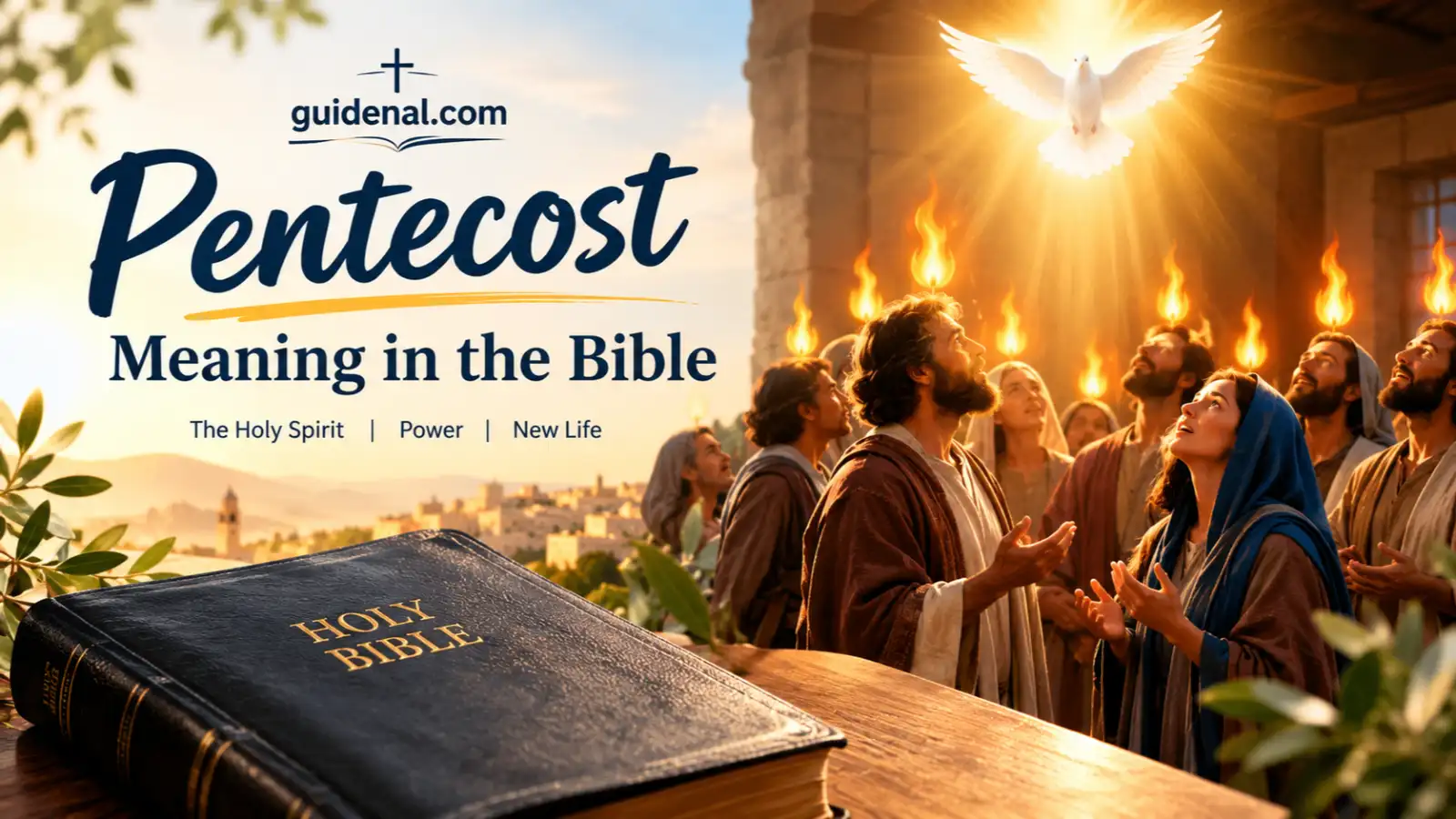
Pentecost is one of the most important events in the New Testament. It marks the day the Holy Spirit came upon Jesus’ followers in a powerful way, just as Jesus had promised. The disciples began speaking in other languages, people from many nations heard the message of God, and thousands were moved to respond to the gospel.
But what does Pentecost mean in the Bible? Why did it happen on this particular day? And what can Christians learn from it today?
Pentecost is more than a remarkable event involving wind, fire, and different languages. It connects God’s promises in the Old Testament with the mission of Jesus Christ and the growth of the early church. It also helps us understand the work of the Holy Spirit in giving believers courage, guiding the church, and helping people hear the good news of salvation.
If you have ever wondered how Pentecost fits into God’s plan, this guide will walk you through the biblical story, key verses, historical background, spiritual lessons, and common questions. Most importantly, we will look at what Scripture actually says and how its message can strengthen your faith today.
Understanding Pentecost in the Bible
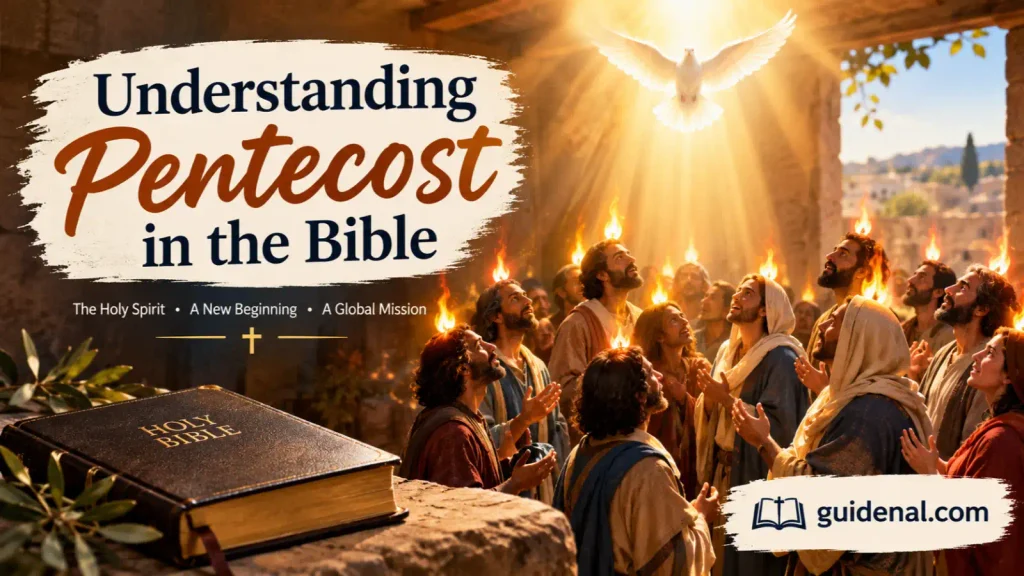
Pentecost is a Christian name for the event described in Acts 2, when the Holy Spirit came upon Jesus’ followers in Jerusalem. The word Pentecost comes from a Greek word meaning “fiftieth.” In the Jewish calendar, this festival took place fifty days after the Passover-related offering that began the counting period.
In the Old Testament, the festival was known as the Feast of Weeks. It was a time to thank God for the harvest and bring an offering to Him. Leviticus 23:15–21 gives instructions for counting the days and observing the feast. Deuteronomy 16:9–12 also connects it with joyful worship, generosity, and remembering Israel’s deliverance from slavery.
This background matters because the events in Acts 2 took place during a Jewish feast when visitors from many regions had gathered in Jerusalem. God’s message could reach people from different languages and lands at one time.
Before His ascension, Jesus told His disciples to wait for the promised Holy Spirit. In Acts 1:8, He explained that they would receive power to become His witnesses. Then, on the day of Pentecost, the Spirit came, the disciples spoke in languages they had not learned, and Peter preached about Jesus’ death and resurrection.
Many people believed, and Acts 2:41 reports that about three thousand were baptized that day.
Pentecost therefore connects several major biblical themes: God’s faithfulness to His promises, the work of the Holy Spirit, the spread of the gospel, and the formation of the church as a community of believers. Christians differ on some details about how the Spirit’s gifts operate today, but the central message of Acts 2 is clear: God empowered Jesus’ followers to bear witness to Christ.
Best Bible Verses About Pentecost
The clearest way to understand Pentecost is to read the passages that explain it. These verses show the promise of the Holy Spirit, the events in Jerusalem, and the mission Jesus gave His followers.
The quotations below use the World English Bible (WEB). Read each verse in its biblical context, because Pentecost is part of a larger story about Jesus, the Holy Spirit, and God’s work among people.
1. Acts 2:1–4 — The Holy Spirit Comes at Pentecost
Bible verse:
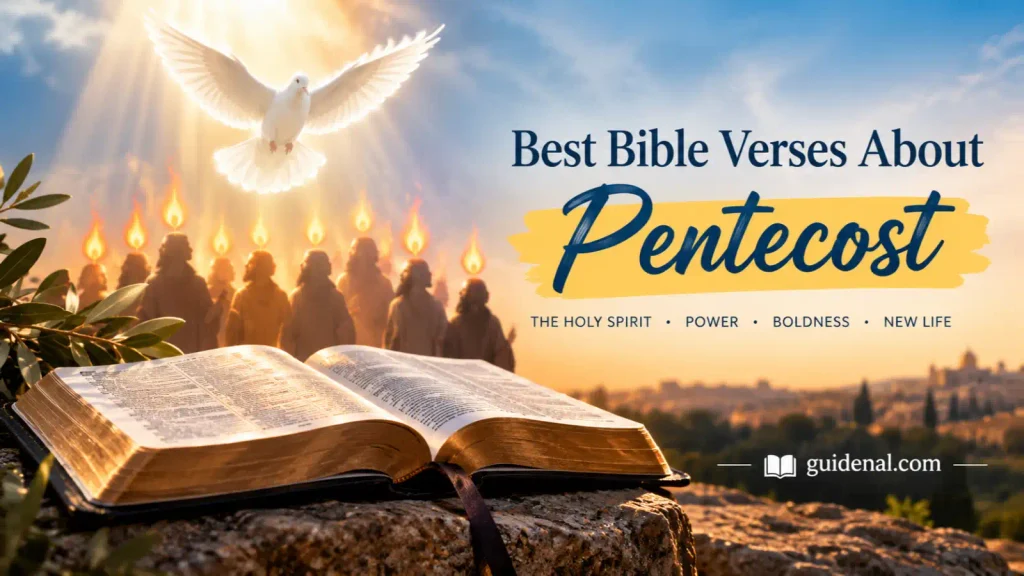
When the day of Pentecost had come, they were all with one accord in one place. Suddenly there came from the sky a sound like the rushing of a mighty wind, and it filled all the house where they were sitting. Tongues like fire appeared and were distributed to them, and one sat on each of them. They were all filled with the Holy Spirit, and began to speak with other languages, as the Spirit gave them the ability to speak.
What this verse means
This passage describes the central event of Pentecost. Jesus’ followers were gathered together when the Holy Spirit came upon them. The sound like wind and the tongues like fire were signs of a remarkable act of God. The disciples spoke in other languages as the Spirit enabled them.
Notice that the passage says the sound was like a mighty wind and the tongues were like fire. Luke describes what the event looked and sounded like rather than saying an ordinary storm or a natural fire caused it.
Life application
God calls His people to depend on Him rather than relying only on their own ability. When you feel unprepared to serve, pray for wisdom and courage. Then take the faithful next step God has placed before you.
2. Acts 1:8 — Power to Be Witnesses
Bible verse:
But you will receive power when the Holy Spirit has come upon you. You will be witnesses to me in Jerusalem, in all Judea and Samaria, and to the uttermost parts of the earth.
What this verse means
Before Pentecost, Jesus told His disciples what the Holy Spirit would enable them to do. The purpose of this power was to make them witnesses to Jesus. The mission would begin in Jerusalem and spread outward to other regions and nations.
This verse helps explain why Pentecost matters. The Spirit’s coming was not only a private spiritual experience. It equipped the disciples for the public mission of sharing the message of Jesus Christ.
Life application
You do not have to be a preacher to bear witness to Jesus. You can show patience, speak honestly, serve someone in need, and explain your faith with kindness when an opportunity arises.
3. John 14:16–17 — Jesus Promises the Helper
Bible verse:
I will pray to the Father, and he will give you another Counselor, that he may be with you forever: the Spirit of truth, whom the world can’t receive; for it doesn’t see him, neither knows him. You know him, for he lives with you, and will be in you.
What this verse means
Jesus spoke these words to His disciples before His death. He promised that they would not be left alone. The Holy Spirit would be with them and in them, helping them continue in the truth.
Pentecost did not come as an unexpected change of plan. It fulfilled Jesus’ promise that God would send the Helper.
Life application
When you feel alone or uncertain, remember that Christian faith is not meant to depend on human strength alone. Ask God to help you understand Scripture, obey Jesus, and remain faithful through difficult seasons.
4. John 14:26 — The Holy Spirit Teaches and Reminds
Bible verse:
But the Counselor, the Holy Spirit, whom the Father will send in my name, he will teach you all things, and will remind you of all that I said to you.
What this verse means
Jesus explained that the Holy Spirit would help His disciples remember and understand His teaching. This was especially important as they carried His message into the world.
The verse does not mean that Christians can ignore Scripture and expect every thought to be a message from God. The Spirit’s work is connected to the truth Jesus taught.
Life application
Read the Bible carefully and pray for understanding. When you face a choice, compare your thoughts with Jesus’ teaching rather than assuming every strong feeling is divine guidance.
5. Joel 2:28–29 — God Promises to Pour Out His Spirit
Bible verse:
It will happen afterward, that I will pour out my Spirit on all flesh; and your sons and your daughters will prophesy, your old men will dream dreams, your young men will see visions. And also on the servants and on the handmaids in those days, I will pour out my Spirit.
What this verse means
Centuries before Pentecost, the prophet Joel spoke of a time when God would pour out His Spirit. In Acts 2, Peter referred to Joel’s prophecy to explain what the crowd was seeing.
The words emphasize a broad work of God among His people. Sons and daughters, young and old, and people of different social positions are included. God’s work is not limited to one small group of people.
Life application
Do not assume that age, social position, or a lack of public recognition makes you useless to God. Serve faithfully where you are, and encourage others to use their gifts to build up the church.
6. Acts 2:5–8 — People Hear the Message in Their Own Languages
Bible verse:
Now there were dwelling in Jerusalem Jews, devout men, from every nation under the sky. When this sound was heard, the multitude came together, and were bewildered, because everyone heard them speaking in his own language. They were all amazed and marveled, saying to one another, “Behold, aren’t all these who speak Galileans? How do we hear, everyone in our own native language?
What this verse means
Jerusalem held visitors from many lands during the festival. The people recognized that the speakers were Galileans, yet they heard the message in their own languages. This made the event extraordinary and drew attention to the mighty works of God.
The passage highlights communication across language barriers. God’s message was not meant to remain within one region or culture.
Life application
Make the message of Christ understandable to the people around you. Listen carefully, avoid needless jargon, and show respect for people whose language or background differs from yours.
7. Acts 2:11 — Declaring the Mighty Works of God
Bible verse:
Cretans and Arabians: we hear them speaking in our languages the mighty works of God!
What this verse means
The crowd heard the disciples declaring the mighty works of God. The attention was not supposed to rest on the disciples’ abilities. The message pointed people toward God.
Pentecost shows that spiritual gifts should serve a purpose beyond personal fame or status. In this case, the gift of languages helped people hear about God’s works.
Life application
When you have a talent or opportunity, use it to serve others and honor God. Whether you teach, encourage, organize, give, or help quietly, let your service point beyond yourself.
8. Acts 2:16–18 — Peter Connects Pentecost With Joel’s Prophecy
Bible verse:
But this is what has been spoken through the prophet Joel: “It will be in the last days, says God, that I will pour out my Spirit on all flesh. Your sons and your daughters will prophesy. Your young men will see visions. Your old men will dream dreams. Yes, and on my servants and on my handmaidens in those days, I will pour out my Spirit, and they will prophesy.”
What this verse means
Peter used Joel’s prophecy to explain Pentecost to the crowd. He did not present the event as meaningless excitement. He showed how it connected with God’s earlier promises.
Christians interpret some details of Joel’s prophecy and the phrase “the last days” in different ways. Still, Peter’s point is clear: the coming of the Spirit was part of God’s saving work, not an isolated spectacle.
Life application
When you encounter an unusual religious claim, test it against Scripture and its context. Faith welcomes the work of God while also seeking understanding and truth.
9. Acts 2:32–33 — The Risen Jesus Pours Out the Spirit
Bible verse:
This Jesus God raised up, to which we all are witnesses. Being therefore exalted by the right hand of God, and having received from the Father the promise of the Holy Spirit, he has poured out this which you now see and hear.
What this verse means
Peter connected Pentecost directly to Jesus’ resurrection and exaltation. The Spirit’s coming was evidence of God’s continuing work through the risen Christ.
This is an important part of the meaning of Pentecost: it is not only about the Holy Spirit, but also about who Jesus is and what God has done through Him.
Life application
Keep Jesus at the center of your faith. Spiritual experiences, church activities, and gifts matter in Christian life, but they should lead you toward Christ and the message of His death and resurrection.
10. Acts 2:37–38 — Repentance and Baptism
Bible verse:
Now when they heard this, they were cut to the heart, and said to Peter and the rest of the apostles, “Brothers, what shall we do?” Peter said to them, “Repent, and be baptized, every one of you, in the name of Jesus Christ for the forgiveness of sins, and you will receive the gift of the Holy Spirit.”
What this verse means
After hearing Peter preach about Jesus, members of the crowd asked how they should respond. Peter called them to repent and be baptized in the name of Jesus Christ.
Pentecost was therefore not only a dramatic sign. It led people to confront the message of Jesus and respond to it. Repentance means turning from sin toward God; baptism publicly identifies a believer with the Christian faith.
Different Christian traditions explain the relationship between baptism, forgiveness, and receiving the Holy Spirit in different ways. The passage itself clearly calls the hearers to respond to Jesus with repentance and baptism.
Life application
Do not stop at being interested in the Bible. Ask what its message calls you to change, believe, or do. If you are exploring Christianity, speak with a trusted pastor or mature Christian about repentance, faith, and baptism.
11. Acts 2:41 — Many People Receive the Message
Bible verse:
Then those who gladly received his word were baptized. There were added that day about three thousand souls.
What this verse means
Luke records a remarkable response to Peter’s preaching. About three thousand people were baptized that day. This was a major moment in the growth of the early Christian community.
The verse does not say that every day of Christian ministry will produce the same number of responses. Instead, it records what God did at this particular point in the story.
Life application
Be faithful in sharing the truth, but leave the results to God. You may not see an immediate response when you encourage someone or explain your faith. Faithful service still matters.
12. Acts 2:42 — A Community Built on Teaching, Fellowship, and Prayer
Bible verse:
They continued steadfastly in the apostles’ teaching and fellowship, in the breaking of bread, and prayer.
What this verse means
The new believers did not treat Pentecost as a one-day event and then return to life as usual. They devoted themselves to learning, fellowship, shared meals, and prayer.
This shows that spiritual growth takes place in community. The early church was shaped by the apostles’ teaching and by practical relationships among believers.
Life application
Build steady habits into your Christian life. Read Scripture, pray, gather with other believers, and look for ways to support people in your church. Spiritual growth is more than a single emotional experience.
13. Acts 2:44–45 — Believers Care for One Another
Bible verse:
All who believed were together, and had all things in common. They sold their possessions and goods, and distributed them to all, according as anyone had need.
What this verse means
The early believers responded to their shared faith with practical generosity. They noticed people in need and used their resources to help.
This passage describes the response of the Jerusalem church. It should not be used to claim that every Christian community must follow one identical financial arrangement. The enduring principle is that love for fellow believers should affect how people use what they have.
Life application
Look for a practical way to care for someone. You might share food, give to a trustworthy relief effort, offer your time, or help a person facing a difficult season. Generosity makes Christian love visible.
14. Acts 4:31 — The Believers Receive Courage to Speak
Bible verse:
When they had prayed, the place was shaken where they were gathered together. They were all filled with the Holy Spirit, and they spoke the word of God with boldness.
What this verse means
This event happened after Pentecost. The believers faced opposition and prayed together for courage. They were filled with the Holy Spirit and continued speaking God’s word boldly.
It shows that the early church continued to depend on the Spirit after the first Pentecost. The Spirit’s work helped believers remain faithful when their mission became difficult.
Life application
When fear makes it hard to speak truthfully or do what is right, pray for courage. Boldness does not require rudeness. You can speak with conviction while remaining gentle and respectful.
15. John 15:26 — The Spirit Testifies About Jesus
Bible verse:
When the Counselor has come, whom I will send to you from the Father, the Spirit of truth, who proceeds from the Father, he will testify about me.
What this verse means
Jesus said the Spirit of truth would testify about Him. This helps explain why Pentecost and the Christian mission are closely connected.
The Holy Spirit does not draw attention away from Jesus. The Spirit’s work supports the truth about Christ and equips His followers to bear witness.
Life application
When considering spiritual teaching, ask whether it agrees with the biblical witness about Jesus. A Christian life should grow in truth, love, humility, and faithfulness rather than a desire to impress others.
16. 1 Corinthians 12:4–7 — Different Gifts, One Spirit
Bible verse:
Now there are various kinds of gifts, but the same Spirit. There are various kinds of service, and the same Lord. There are various kinds of workings, but the same God, who works all things in all. But to each one is given the manifestation of the Spirit for the profit of all.
What this verse means
Paul explains that the Spirit gives different gifts and that those gifts are meant to benefit the community. Not everyone has the same role, and no one gift is the whole purpose of the church.
This passage helps Christians think about Pentecost beyond the events of Acts 2. The Spirit empowers believers to serve one another and strengthen the church.
Life application
Do not compare your gifts with someone else’s. Find ways to serve faithfully with the abilities and opportunities you have. The goal is to help others, not to compete for attention.
17. Galatians 5:22–23 — The Fruit of the Spirit
Bible verse:
But the fruit of the Spirit is love, joy, peace, patience, kindness, goodness, faith, gentleness, and self-control. Against such things there is no law.
What this verse means
Paul describes the character that grows through the Spirit’s work in a believer’s life. The list includes love, patience, gentleness, and self-control.
This passage is not the account of Pentecost itself, but it helps readers consider the Spirit’s work in daily Christian living. Spiritual maturity involves more than dramatic experiences; it also involves a life increasingly shaped by Christlike character.
Life application
Ask yourself whether your faith is helping you become more patient, loving, and truthful. When you fail, turn back to God and keep growing. The fruit of the Spirit is a guide for Christian character, not a reason to pretend you never struggle.
18. Ephesians 4:3–4 — Unity in the Spirit
Bible verse:
Being eager to keep the unity of the Spirit in the bond of peace. There is one body, and one Spirit, even as you also were called in one hope of your calling.
What this verse means
The early Christian message reached people from many regions and languages. Later, Paul reminded the church that believers are called to preserve unity through peace.
Unity does not mean that every Christian must agree on every secondary issue. It means believers should treat one another as members of Christ’s body and work to protect the fellowship God has given them.
Life application
Do not let every disagreement become a reason for division. Listen carefully, speak with grace, and seek peace where possible. Unity grows when believers put love and truth ahead of pride.
19. Matthew 28:19–20 — The Mission to All Nations
Bible verse:
Go, and make disciples of all nations, baptizing them in the name of the Father and of the Son and of the Holy Spirit, teaching them to observe all things that I commanded you. Behold, I am with you always, even to the end of the age.
What this verse means
Before His ascension, Jesus sent His followers to make disciples among all nations. Pentecost helped equip them for the mission Jesus had given.
The mission involves more than getting people to hear a message once. Jesus told His followers to baptize and teach people to obey His commands. Discipleship includes faith, learning, community, and a changed way of life.
Life application
Look for ways to help others learn about Jesus with patience and respect. You can share Scripture, answer honest questions, invite someone to church, or support those who serve people from different cultures.
20. Romans 8:14 — Led by the Spirit of God
Bible verse:
For as many as are led by the Spirit of God, these are children of God.
What this verse means
Paul describes the Spirit’s role in the life of God’s children. In the surrounding chapter, he contrasts life shaped by the Spirit with life ruled by sinful desires.
Being led by the Spirit should not be reduced to following every impulse or interpreting every coincidence as a message. The broader context points to a life shaped by God’s Spirit, marked by trust, obedience, and a new relationship with God.
Life application
Seek God’s guidance through prayer, Scripture, wise counsel, and obedient action. You may not always know what lies ahead, but you can keep choosing what reflects the character and teaching of Jesus.
These passages show that Pentecost was a turning point in the story of the early church. The Holy Spirit empowered witness, brought people to hear the gospel, and helped form a community devoted to teaching, prayer, generosity, and discipleship.
Biblical Themes Connected to Pentecost
Pentecost connects several important themes throughout the Bible. Understanding these connections helps us see why Acts 2 is central to the Christian story.
1. God Keeps His Promises
Before Pentecost, Jesus told His disciples to wait for the Holy Spirit. The event in Acts 2 showed that His promise was trustworthy.
Joel had also spoken about God pouring out His Spirit. Peter used that prophecy to explain what the people were witnessing. Pentecost reminds Christians that God’s plans unfold within the larger story of Scripture.
Related verses: Joel 2:28–29; Acts 1:4–5; Acts 2:16–18.
Lesson for today: Waiting can be difficult. Yet the Bible encourages believers to trust God while continuing to pray, obey, and prepare to do what is right.
2. The Holy Spirit Empowers Christian Witness
Jesus said His followers would receive power to be His witnesses. At Pentecost, the disciples began speaking about God’s mighty works, and Peter preached about Jesus.
The purpose of this power was connected to the mission of the gospel. The Spirit helped the disciples speak boldly and communicate across language barriers.
Related verses: Acts 1:8; Acts 2:4–11; Acts 4:31.
Lesson for today: Sharing your faith does not require a perfect speech. Ask God for courage, speak honestly, and treat others with kindness. Your conduct should support the message you share.
3. God’s Message Reaches Different Peoples
The crowd at Pentecost included people from many places. They heard the disciples speaking in their own languages. The event showed that the good news about Jesus was not meant to remain limited to one local group.
This does not mean that every culture must become the same. Rather, the gospel can be communicated across cultures and languages while calling people to follow Jesus.
Related verses: Acts 2:5–11; Matthew 28:19–20; Revelation 7:9.
Lesson for today: Respect people whose language, culture, or background differs from yours. Make room for others, listen well, and help remove barriers that keep people from hearing the message of Christ.
4. The Church Is a Community, Not Just a Crowd
Acts 2 describes people who devoted themselves to the apostles’ teaching, fellowship, shared meals, and prayer. Their faith shaped how they spent time and cared for one another.
The early church was not simply a gathering of people who had witnessed an unusual event. It became a community formed by the message of Jesus.
Related verses: Acts 2:42–47; 1 Corinthians 12:12–27; Hebrews 10:24–25.
Lesson for today: Faith grows through regular worship, learning, prayer, and relationships. If you feel disconnected, consider taking one small step toward a healthy Christian community.
5. Spiritual Gifts Should Serve Others
The New Testament teaches that the Holy Spirit gives gifts for the good of the church. Paul describes different gifts and forms of service, while emphasizing that the same Spirit is at work.
The purpose is not to make one believer appear more important than another. Spiritual gifts are meant to build up the body of Christ.
Related verses: Romans 12:4–8; 1 Corinthians 12:4–7; 1 Peter 4:10.
Lesson for today: Do not measure your value by how visible your service is. Teaching, helping, giving, encouraging, and showing mercy can all strengthen a Christian community.
6. The Spirit’s Work Includes Character
The Bible describes the fruit of the Spirit as love, joy, peace, patience, kindness, goodness, faith, gentleness, and self-control. These qualities matter in ordinary life.
Pentecost included a public and powerful event, but the New Testament also emphasizes ongoing spiritual growth. A believer’s life should increasingly reflect the character of Jesus.
Related verses: Galatians 5:22–25; Ephesians 4:1–3; Colossians 3:12–15.
Lesson for today: Ask not only whether your faith feels strong, but also whether it is shaping how you treat people. Patience in a tense conversation and kindness toward someone in need are meaningful parts of Christian living.
Pentecost Symbolism: Wind, Fire, Languages, and Harvest
The account in Acts 2 includes several striking details. These details matter because Luke records what happened, and the wider Bible helps readers understand some of the images. Still, it is wise not to assign a hidden meaning to every detail beyond what Scripture supports.
1. Wind: God’s Powerful Work
In Acts 2:2, a sound like a mighty rushing wind filled the place where the disciples were gathered. The verse compares the sound to wind; it does not say that an ordinary windstorm caused the event.
Wind is also associated with God’s life-giving work in other biblical passages, such as Ezekiel 37:9–14. In John 3:8, Jesus uses wind as an image while teaching about the Spirit.
Spiritual lesson: The Holy Spirit’s work comes from God, not from human control. Christians can pray for God’s help without pretending they can command or control the Spirit.
2. Fire: A Sign in the Pentecost Account
Acts 2:3 says that tongues like fire appeared and rested on the disciples. The description is part of the sign accompanying the Spirit’s coming.
Fire has different roles across Scripture. It can be connected with God’s presence, judgment, purification, or testing, depending on the passage. For example, Exodus 3:2 describes the burning bush, while Malachi 3:2–3 uses a refiner’s fire as an image of purification.
Spiritual lesson: Do not assume that every biblical image of fire has one fixed meaning. In Acts 2, focus first on what Luke says: the sign accompanied the coming of the Holy Spirit.
3. Languages: The Message Crosses Barriers
The crowd heard the disciples speaking in languages the listeners understood. Acts 2:6–11 emphasizes this remarkable communication.
The passage does not present language differences as a reason to exclude people from God’s message. Instead, people from many regions heard the mighty works of God proclaimed.
Some Christians connect this event with the story of Babel in Genesis 11:1–9. That connection can be a useful theological comparison: Babel describes human division, while Pentecost shows people from different languages hearing one message. However, Acts does not explicitly call Pentecost a reversal of Babel, so it is best treated as a comparison rather than a direct statement of the text.
Spiritual lesson: Speak about faith in ways people can understand. Listen before you speak, and respect the differences God’s message reaches across.
4. Harvest: The Festival’s Old Testament Background
Pentecost is linked to the Jewish Feast of Weeks, a festival associated with the grain harvest and thanksgiving to God. Leviticus 23:15–21 and Deuteronomy 16:9–12 describe the observance.
Acts 2 does not explicitly say that the harvest festival itself symbolizes the number of people who believed. Still, the setting offers a meaningful connection: during a time of gathering and gratitude, many people heard the gospel, and about three thousand were baptized.
Spiritual lesson: Thank God for what He provides, and be willing to share what you have. The Bible connects worship with gratitude, generosity, and care for others.
Was Pentecost the Birth of the Church?
Christians commonly describe Pentecost as the birth of the church because Acts 2 marks the public beginning of the Spirit-empowered community that grew from Jesus’ disciples and spread the gospel. The chapter describes preaching, baptism, shared worship, fellowship, and the growth of the believers’ community.
However, the Bible’s story of God’s people began long before Acts 2. Jesus had already gathered disciples, taught them, and commissioned them. So “birth of the church” is a useful way to describe Pentecost’s importance, not a claim that God had no people or community before that day.
Does Pentecost Mean Every Christian Must Speak in Tongues?
Christians disagree about how the gifts described in Acts and 1 Corinthians should operate today. Some traditions believe speaking in tongues remains a gift that may be given to believers. Other traditions emphasize that the specific sign in Acts 2 served a unique role in the founding mission of the church.
The New Testament itself shows that spiritual gifts differ. In 1 Corinthians 12:29–30, Paul asks a series of questions that expect negative answers, including whether all speak in tongues. His wider point is that believers have different gifts and need one another.
For that reason, Acts 2 should not be used to shame Christians who do not speak in tongues. The central message is that the Holy Spirit empowered the disciples to witness to Jesus and that God’s work should be understood through the whole of Scripture.
Practical Lessons From Pentecost for Christians Today
Pentecost happened in a specific time and place, but its message continues to shape Christian faith and practice. Here are practical ways to respond to its teaching.
1. Depend on God Rather Than Your Own Strength
The disciples received power from the Holy Spirit to carry out the mission Jesus gave them. They were not expected to fulfill it through confidence or skill alone.
When you feel weak or uncertain, pray for God’s help. Prepare carefully, seek wise counsel, and take the next faithful step. Depending on God does not mean refusing to work; it means recognizing that you need His help.
Read: Acts 1:8; John 14:26.
2. Share Your Faith With Courage and Kindness
Peter, who had once denied knowing Jesus, stood before a crowd and spoke openly about Him. Acts 2 shows that the disciples’ witness became public and bold.
Christian courage should not become aggression. You can speak clearly about your beliefs while listening to others and respecting their questions. A gentle, honest answer often serves people better than an argument meant to win.
Read: Acts 2:14–36; 1 Peter 3:15–16.
3. Build a Consistent Life of Prayer and Scripture
After Pentecost, the believers devoted themselves to the apostles’ teaching and prayer. Their faith was supported by steady habits rather than a single event.
Set aside a regular time to read the Bible and pray. You do not need to begin with a long routine. Read a short passage, ask what it teaches about God, and consider how to put it into practice.
Read: Acts 2:42; Psalm 119:105.
4. Use Your Gifts to Help Others
The New Testament teaches that spiritual gifts are given for the good of the church. You may teach, encourage, give, serve, organize, show hospitality, or offer practical help.
Do not assume that only public gifts matter. Quiet service can be deeply valuable. Ask trusted Christians where your abilities might meet a real need.
Read: Romans 12:6–8; 1 Peter 4:10.
5. Welcome People From Different Backgrounds
At Pentecost, people from different lands heard the message in their own languages. The event reminds the church that the gospel crosses human boundaries.
You can apply this by welcoming newcomers, learning to listen across cultural differences, and making church life more accessible to people who may feel like outsiders. Respectful inclusion does not require abandoning biblical truth; it requires treating people with dignity.
Read: Acts 2:5–11; Galatians 3:28.
6. Let the Spirit Shape Your Character
The fruit of the Spirit includes love, patience, gentleness, and self-control. These qualities matter at home, at work, in church, and in difficult conversations.
Choose one area where you need growth. Perhaps you need to listen without interrupting, apologize when wrong, or show patience with a family member. Pray for help, then practice the change in daily life.
Read: Galatians 5:22–23; Colossians 3:12–14.
7. Care for People in Practical Ways
Acts 2:44–45 describes believers sharing resources so that people in need received help. Their faith moved them toward generous action.
You may not be able to solve every problem, but you can respond to a need in front of you. Share a meal, give within your means, visit someone who is lonely, or help connect a person with trustworthy support.
Read: Acts 2:44–45; James 2:14–17.
8. Keep Jesus at the Center
Pentecost points to the risen Jesus. Peter’s sermon explained what God had done through Christ, and the disciples’ mission was to bear witness to Him.
Keep your faith centered on Jesus’ teaching, death, and resurrection. Do not measure spiritual life only by emotional experiences, public attention, or outward signs. Look for faith that leads to truth, love, obedience, and hope.
Read: Acts 2:32–36; Hebrews 12:1–2.
FAQs:
1. What Does Pentecost Mean in the Bible?
Pentecost refers to the day described in Acts 2 when the Holy Spirit came upon Jesus’ followers in Jerusalem. The name comes from a Greek word meaning “fiftieth.” The event empowered the disciples to witness to Jesus and marked a major turning point in the growth of the early church.
2. Why Is Pentecost Important to Christians?
Pentecost is important because it shows God fulfilling Jesus’ promise to send the Holy Spirit. It also marks the beginning of the disciples’ public witness with new boldness. The event connects Jesus’ resurrection, the Spirit’s work, and the spread of the gospel to people from many nations.
3. What Happened on the Day of Pentecost?
According to Acts 2, Jesus’ followers were gathered in one place when they heard a sound like a mighty wind. Tongues like fire appeared and rested on them. They were filled with the Holy Spirit and spoke in other languages. Peter then preached about Jesus, and about three thousand people were baptized.
4. What Does the Word Pentecost Mean?
The word Pentecost comes from the Greek pentēkostē, meaning “fiftieth.” It refers to the festival observed fifty days after the beginning of the counting period associated with the Passover season. In the Jewish Scriptures, the related festival is called the Feast of Weeks.
5. What Is the Feast of Weeks?
The Feast of Weeks was an Old Testament festival that celebrated the harvest and included offerings to God. Instructions appear in Leviticus 23:15–21 and Deuteronomy 16:9–12. It provides the Jewish festival background for the Pentecost event described in Acts 2.
6. What Do the Wind and Fire Mean at Pentecost?
Acts 2 describes a sound like a mighty wind and tongues like fire. These signs accompanied the coming of the Holy Spirit. The Bible uses wind and fire in other settings, too, but their meaning depends on the passage. It is safest to focus on the clear message of Acts 2 rather than assigning unsupported meanings to every detail.
7. Is Pentecost the Same as the Baptism of the Holy Spirit?
The terms are related in Christian teaching, but traditions understand their relationship differently. Acts 2 describes the disciples receiving the Holy Spirit at Pentecost. Some Christians understand this as a foundational event for the whole church; others also use “baptism of the Holy Spirit” to describe a distinct experience in a believer’s life. It helps to compare Acts 1–2 with 1 Corinthians 12 and to consider how your church tradition interprets these passages.
8. How Can Christians Celebrate Pentecost Today?
Christians may celebrate Pentecost through worship, prayer, reading Acts 2, thanking God for the Holy Spirit, and reflecting on the church’s mission. Some churches use red decorations to recall the tongues like fire in Acts 2, although that is a later Christian custom rather than a command in the passage. A meaningful celebration can also include serving neighbors, welcoming people from different backgrounds, and supporting the sharing of the gospel.
Conclusion:
The meaning of Pentecost in the Bible reaches far beyond the wind, fire, and languages described in Acts 2. It tells the story of God keeping His promise, the Holy Spirit empowering Jesus’ followers, and the gospel reaching people from many nations.
Pentecost also reminds us that Christian faith is meant to shape everyday life. The early believers learned Scripture, prayed together, cared for people in need, and shared the message of Jesus. Their story encourages us to trust God, serve faithfully, and grow in love.
You may sometimes feel unqualified to serve God or unsure how to speak about your faith. Remember that the disciples also needed God’s help. Jesus promised the Holy Spirit, and the Spirit empowered them to carry out their mission.
You do not need to manufacture a dramatic experience or interpret every unusual event as a sign. Instead, remain rooted in Scripture, pray for wisdom, follow Jesus faithfully, and serve the people around you.
Pentecost points us toward the risen Christ and the work God began through His followers. Its message offers hope: God’s mission is greater than any one person, and believers are called to take part through faith, love, and faithful witness.
As Paul writes in Romans 15:13, may the God of hope fill you with joy and peace as you trust in Him, so that you may overflow with hope through the power of the Holy Spirit.

I am a content writer at Guidenal, where I create easy-to-understand, well-researched, and reader-focused guides inspired by biblical teachings. Working alongside Naqash Ayub, I strive to deliver trustworthy content that helps readers grow in faith and find practical answers from Scripture.
2 thoughts on “Pentecost Meaning in the Bible: The Holy Spirit Power and the Birth of the Church”