

Have you ever looked at someone else’s house, marriage, career, money, family, or success and thought, “I wish I had what they have”?
There is nothing wrong with noticing that someone has something good. The problem begins when desire grows into discontentment. We stop thanking God for what He has given us and begin to long for what belongs to someone else.
This is where the biblical meaning of covet becomes important.
In the Bible, coveting is more than simply wanting something. It can describe a strong desire to possess what belongs to another person or an unhealthy longing for more. Scripture connects coveting with greed, envy, selfish desire, discontentment, and even idolatry.
The ninth and tenth commandments address this problem directly. Jesus also warned His followers to guard their hearts against covetousness because a person’s life is not measured by possessions.
The good news is that Scripture does not merely tell us what is wrong with coveting. It also shows us a better way: contentment, gratitude, trust in God, generosity, love for others, and a heart centered on Christ.
In this article, we will examine what coveting means in the Bible, where the idea appears in Scripture, important Bible verses about coveting, biblical examples, common misconceptions, and practical ways Christians can overcome a covetous heart.
What Does “Covet” Mean in the Bible?
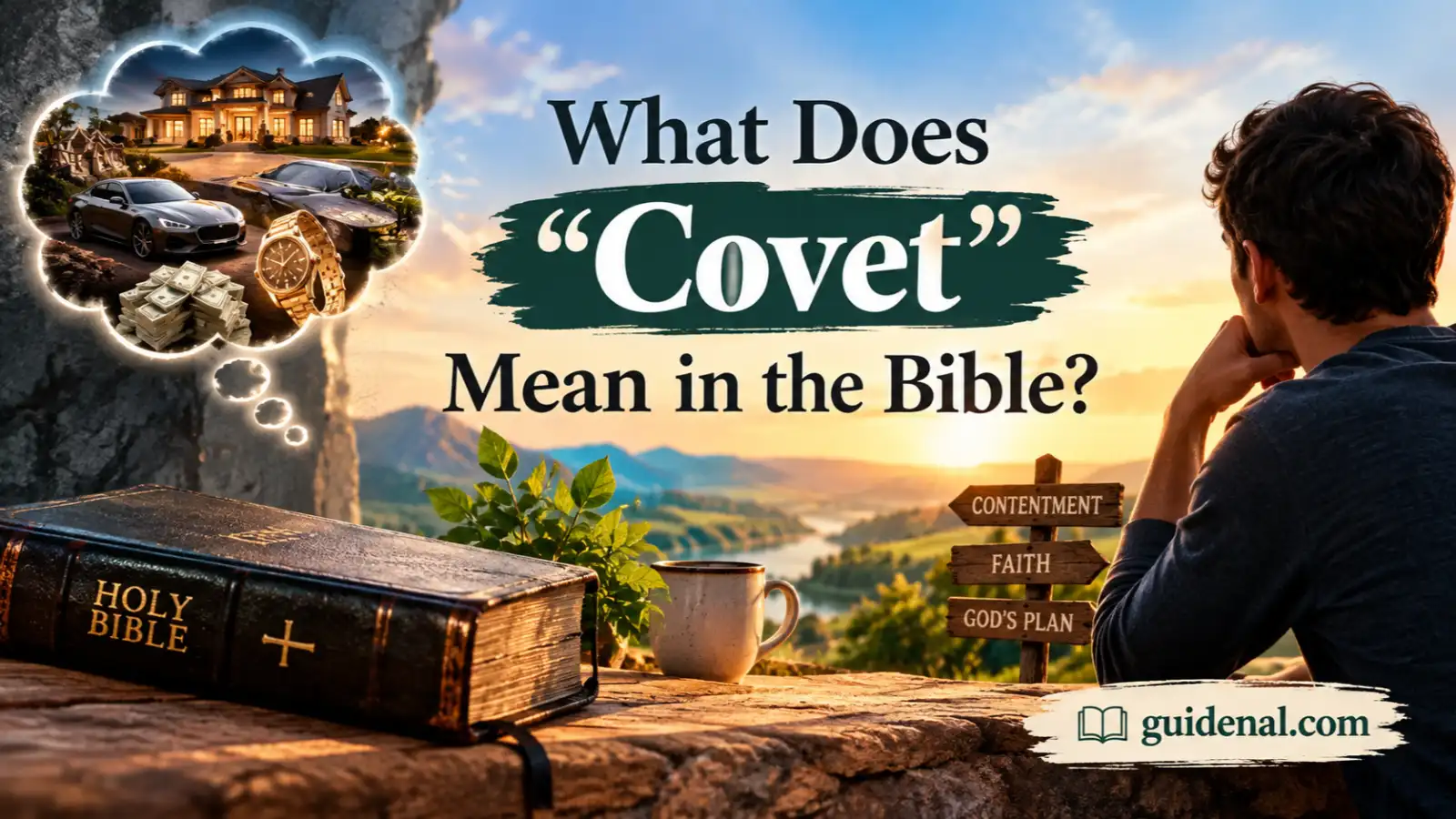
To covet means to have an intense or improper desire for something, especially something that belongs to another person.
The Bible most clearly presents coveting in the tenth commandment:
“Thou shalt not covet thy neighbour’s house, thou shalt not covet thy neighbour’s wife, nor his manservant, nor his maidservant, nor his ox, nor his ass, nor any thing that is thy neighbour’s.”
Exodus 20:17, KJV
Notice how broad the command is.
God did not only forbid stealing another person’s possessions. He addressed the desire behind the action.
A person could avoid physically stealing a neighbor’s house while still becoming consumed with wanting it. The tenth commandment reaches into the heart.
This is one reason coveting is so important in biblical teaching. Many sins become visible through outward actions, but coveting can begin quietly inside a person’s thoughts.
The New Testament continues this theme. Paul describes covetousness as idolatry, showing how serious uncontrolled desire can become:
“Mortify therefore your members which are upon the earth; fornication, uncleanness, inordinate affection, evil concupiscence, and covetousness, which is idolatry.”
Colossians 3:5, KJV
Biblically, then, coveting is not simply ambition. It is a disordered desire that places created things above faithful obedience to God.
What Is the Difference Between Wanting and Coveting?

This is an important distinction.
The Bible does not teach that every desire is sinful.
You can desire a better job, pray for a spouse, work toward financial stability, hope to own a home, or seek to improve your life without automatically coveting.
The problem is the heart’s relationship to the desire.
Healthy desire says:
- “I would be grateful for this.”
- “I can pray about this.”
- “I will work honestly for it.”
- “I trust God with the outcome.”
- “I can still rejoice if someone else has it.”
Coveting says:
- “I must have what they have.”
- “God has not given me enough.”
- “Their blessing makes my life feel smaller.”
- “I cannot be satisfied until I possess this.”
- “I am willing to compromise what is right to get it.”
Coveting moves the heart from gratitude toward entitlement.
That is why Scripture focuses so much attention on contentment.
Understanding Coveting in the Bible
Coveting appears throughout both the Old and New Testaments.
In the Old Testament, the tenth commandment forbids coveting a neighbor’s household, spouse, servants, animals, or possessions. The command teaches Israel that obedience to God is not merely about visible behavior. God also cares about the heart.
Deuteronomy repeats the command in a slightly different form:
“Neither shalt thou desire thy neighbour’s wife, neither shalt thou covet thy neighbour’s house, his field, or his manservant, or his maidservant, his ox, or his ass, or any thing that is thy neighbour’s.”
Deuteronomy 5:21, KJV
This was especially meaningful in ancient Israel because land and family inheritance were closely connected to a person’s economic security and place within the community.
The prophet Micah later condemned powerful people who desired the fields and houses of others and then took them:
“They covet fields, and take them; and houses, and take them away: so they oppress a man and his house, even a man and his heritage.”
Micah 2:2, KJV
Coveting can therefore move from an internal desire to external injustice.
The New Testament takes the subject deeper. Jesus warned His listeners:
“And he said unto them, Take heed, and beware of covetousness: for a man’s life consisteth not in the abundance of the things which he possesseth.”
Luke 12:15, KJV
Jesus spoke these words in the context of a dispute over an inheritance. His point was not that possessions are automatically evil. Instead, He warned that possessions can become a false measure of life.
That warning still speaks clearly today.
Best Bible Verses About Coveting
1. Exodus 20:17 — The Tenth Commandment
“Thou shalt not covet thy neighbour’s house, thou shalt not covet thy neighbour’s wife, nor his manservant, nor his maidservant, nor his ox, nor his ass, nor any thing that is thy neighbour’s.”
Exodus 20:17, KJV
What This Verse Means
This is the clearest biblical command concerning coveting.
God addresses the inner desire for what belongs to another person. The command shows that God’s law reaches beyond outward behavior and addresses the condition of the heart.
Life Application
Ask yourself what you repeatedly compare yourself with.
Is it another person’s money? Marriage? House? Career? Appearance? Ministry? Success?
Bring that desire honestly before God instead of allowing comparison to control your heart.
2. Deuteronomy 5:21 — Do Not Desire Your Neighbor’s Possessions
“Neither shalt thou desire thy neighbour’s wife, neither shalt thou covet thy neighbour’s house, his field, or his manservant, or his maidservant, his ox, or his ass, or any thing that is thy neighbour’s.”
Deuteronomy 5:21, KJV
What This Verse Means
Moses repeats the commandment as Israel prepares to live in the Promised Land.
The command reminds God’s people that receiving blessings from God does not give them permission to desire or take the blessings He has given to others.
Life Application
Do not measure God’s goodness by comparing your life with someone else’s.
God’s plan for your life does not need to look identical to His plan for another Christian.
3. Joshua 7:21 — Achan’s Covetous Desire
“When I saw among the spoils a goodly Babylonish garment, and two hundred shekels of silver, and a wedge of gold of fifty shekels weight, then I coveted them, and took them.”
Joshua 7:21, KJV
What This Verse Means
Achan provides one of the clearest biblical examples of coveting.
He saw something attractive, desired it, took it, and then hid it.
The story demonstrates how sin can develop through a sequence:
seeing → desiring → taking → hiding.
The problem was not simply that Achan noticed valuable objects. His desire overcame his obedience to God.
Life Application
Pay attention to the first stage of temptation.
It is often easier to surrender an unhealthy desire to God when it is still a thought than after it has become an action.
4. Micah 2:2 — Coveting Can Produce Injustice
“And they covet fields, and take them by violence; and houses, and take them away: so they oppress a man and his house, even a man and his heritage.”
Micah 2:2, KJV
What This Verse Means
Micah condemned people who used their power to take property from others.
Here coveting is not merely an internal struggle. It produces oppression.
The desire for more becomes so strong that other people’s rights no longer matter.
Life Application
Christian living requires more than asking, “What can I get?”
Ask instead, “How does my desire affect other people?”
Love for our neighbor places limits on selfish ambition.
5. Psalm 10:3 — Boasting About Wrong Desires
“For the wicked boasteth of his heart’s desire, and blesseth the covetous, whom the Lord abhorreth.”
Psalm 10:3, KJV
What This Verse Means
Psalm 10 describes people who are proud of desires that oppose God’s ways.
Coveting can become especially dangerous when a person stops seeing it as something that needs correction.
Life Application
Do not celebrate every desire simply because you feel strongly about it.
Feelings are real, but they are not always reliable guides to righteousness.
Bring your desires under the wisdom of God’s Word.
6. Proverbs 15:27 — Greed Hurts the Household
“He that is greedy of gain troubleth his own house; but he that hateth gifts shall live.”
Proverbs 15:27, KJV
What This Verse Means
Proverbs connects greedy gain with trouble.
The desire for wealth can affect more than the individual. It can damage family relationships, honesty, peace, and trust.
Life Application
Never sacrifice your family, integrity, or relationship with God simply to gain more money.
Material success cannot compensate for a damaged soul or broken relationships.
7. Proverbs 23:4 — Do Not Make Wealth Your Master
“Labour not to be rich: cease from thine own wisdom.”
Proverbs 23:4, KJV
What This Verse Means
The proverb warns against making the pursuit of wealth the controlling purpose of life.
Scripture does not condemn honest work. It warns against allowing wealth to become the ultimate goal.
Life Application
Work faithfully, but do not let money define your worth.
Your identity comes from God, not your income.
8. Proverbs 28:25 — Greed Creates Conflict
“He that is of a proud heart stirreth up strife: but he that putteth his trust in the Lord shall be made fat.”
Proverbs 28:25, KJV
What This Verse Means
Greed and pride often travel together.
When people believe they must have more, they can become competitive, impatient, and willing to create conflict.
The contrast is trust in God.
Life Application
When you feel anxious because someone else has more, practice trust instead of comparison.
God is not limited by another person’s blessing.
9. Luke 12:15 — Jesus Warns Against Covetousness
“And he said unto them, Take heed, and beware of covetousness: for a man’s life consisteth not in the abundance of the things which he possesseth.”
Luke 12:15, KJV
What This Verse Means
Jesus spoke these words when someone asked Him to settle an inheritance dispute.
Instead of focusing only on the property, Jesus exposed the deeper spiritual danger: the belief that having more things makes life better or more valuable.
Life Application
Your possessions are not your identity.
A Christian’s value comes from being known by God and belonging to Christ.
10. Romans 7:7 — The Law Reveals Coveting
“What shall we say then? Is the law sin? God forbid. Nay, I had not known lust, except the law had said, Thou shalt not covet.”
Romans 7:7, KJV
What This Verse Means
Paul explains that God’s law exposes sin.
Coveting is especially revealing because it shows that sin is not limited to outward actions. A person may appear respectable while struggling with sinful desires internally.
Life Application
Let Scripture examine your heart.
Do not use outward behavior alone as the measure of spiritual health.
11. Romans 13:9 — Love Is the Opposite of Coveting
“For this, Thou shalt not commit adultery, Thou shalt not kill, Thou shalt not steal, Thou shalt not bear false witness, Thou shalt not covet; and if there be any other commandment, it is briefly comprehended in this saying, namely, Thou shalt love thy neighbour as thyself.”
Romans 13:9, KJV
What This Verse Means
Paul connects the commandments with love for one’s neighbor.
Coveting treats another person’s possessions as something that should satisfy me.
Love takes the opposite position. It seeks the good of the other person.
Life Application
One powerful way to fight coveting is to practice genuine love.
Instead of asking, “Why don’t I have what they have?” ask, “How can I bless them?”
12. Ephesians 5:3 — Covetousness Does Not Fit Christian Living
“But fornication, and all uncleanness, or covetousness, let it not be once named among you, as becometh saints.”
Ephesians 5:3, KJV
What This Verse Means
Paul calls Christians to a different way of life.
Covetousness is not presented as a harmless personality trait. It belongs to the old pattern of life from which believers are being transformed.
Life Application
Ask whether your desires fit the character of someone following Jesus.
Christian growth includes learning not only what to do but also what to desire.
13. Ephesians 5:5 — Covetousness and Idolatry
“For this ye know, that no whoremonger, nor unclean person, nor covetous man, who is an idolater, hath any inheritance in the kingdom of Christ and of God.”
Ephesians 5:5, KJV
What This Verse Means
Paul directly connects covetousness with idolatry.
Why?
Because the thing we continually crave can begin to take the place that belongs to God.
Life Application
Ask yourself:
What do I believe I must have in order to be happy?
That question can reveal where your heart is placing its deepest trust.
14. Colossians 3:5 — Covetousness Is Idolatry
“Mortify therefore your members which are upon the earth; fornication, uncleanness, inordinate affection, evil concupiscence, and covetousness, which is idolatry.”
Colossians 3:5, KJV
What This Verse Means
Paul tells believers to put sinful desires to death.
The Greek word translated “covetousness” here is pleonexia, a word associated with greed, covetousness, and the desire for more.
The striking part is Paul’s final description: “which is idolatry.”
Coveting becomes idolatrous when something created becomes more important to us than the Creator.
Life Application
Do not simply ask God to give you what you want.
Also ask Him to shape what you want.
15. 1 Timothy 6:6–10 — Contentment Is the Biblical Alternative
“But godliness with contentment is great gain.
For we brought nothing into this world, and it is certain we can carry nothing out.
And having food and raiment let us be therewith content.
But they that will be rich fall into temptation and a snare, and into many foolish and hurtful lusts, which drown men in destruction and perdition.
For the love of money is the root of all evil: which while some coveted after, they have erred from the faith, and pierced themselves through with many sorrows.”
1 Timothy 6:6–10, KJV
What This Passage Means
Paul gives a powerful contrast between godliness with contentment and an uncontrolled desire for wealth.
Notice that the problem is not simply possessing money. The warning concerns the heart’s desire to become rich and the spiritual dangers that can follow.
Life Application
Learn to thank God for what you already have.
Contentment does not mean refusing to grow or work. It means refusing to make “more” the condition for peace.
16. Hebrews 13:5 — Be Content With What You Have
“Let your conversation be without covetousness; and be content with such things as ye have: for he hath said, I will never leave thee, nor forsake thee.”
Hebrews 13:5, KJV
What This Verse Means
The answer to covetousness is not simply trying harder not to want things.
The deeper answer is trust.
Why can Christians become content?
Because God has promised His presence.
Life Application
When comparison makes you feel that your life is incomplete, remember God’s promise:
“I will never leave thee, nor forsake thee.”
God’s presence is greater than anything you could possess.
17. James 4:1–3 — Coveting Can Create Conflict
“From whence come wars and fightings among you? come they not hence, even of your lusts that war in your members?
Ye lust, and have not: ye kill, and desire to have, and cannot obtain: ye fight and war, yet ye have not, because ye ask not.
Ye ask, and receive not, because ye ask amiss, that ye may consume it upon your lusts.”
James 4:1–3, KJV
What This Passage Means
James traces conflict back to desires that are fighting within people.
The passage shows that uncontrolled desire can damage relationships.
James does not say that every request to God is wrong. He exposes requests driven by selfish motives.
Life Application
Before asking God for something, examine your motive.
Ask:
“Do I want this so I can serve God, or so I can satisfy myself?”
That question can transform your prayer life.
Biblical Themes Connected to Coveting
Contentment
Contentment is one of Scripture’s strongest answers to coveting.
Paul learned contentment in different circumstances. Christian contentment does not mean pretending difficulties are pleasant. It means trusting God’s sufficiency regardless of circumstances.
A content heart can receive blessings with gratitude without making those blessings into gods.
Gratitude
Gratitude changes the direction of our attention.
Coveting says:
“Look at what I don’t have.”
Gratitude says:
“Look at what God has already given.”
This does not mean ignoring genuine needs. It means refusing to let comparison blind us to God’s faithfulness.
A simple practice can help: regularly thank God for specific people, provisions, opportunities, and spiritual blessings.
Trust
Coveting often grows from the fear that God has not given us enough.
Trust responds differently.
God’s timing may be different from ours. His gifts may look different from what we expected. His purposes may be different from our plans.
But Christian faith rests on His character.
Trust does not require knowing everything God will do next.
It means knowing who God is while you wait.
Love for Others
Coveting makes another person’s blessing feel like our loss.
Biblical love allows us to rejoice when others receive good things.
This is difficult when comparison is strong, but it is part of Christian maturity.
Instead of resenting another person’s success, pray for them.
Instead of comparing marriages, careers, ministries, or possessions, thank God for His work in their life.
Love turns comparison into fellowship.
Idolatry
The Bible’s strongest warning about coveting is its connection to idolatry.
An idol is not only a physical statue.
Anything that takes God’s rightful place in our hearts can become an idol.
Money can become an idol.
Status can become an idol.
Relationships can become an idol.
Comfort can become an idol.
Even success can become an idol.
Coveting reveals what we believe we need in order to feel secure, important, or satisfied.
That is why overcoming coveting requires more than changing behavior. It requires turning the heart back toward God.
Biblical Examples of Coveting
Achan
Achan saw valuable items and wanted them.
His story demonstrates how coveting can move from desire to action and then secrecy.
His example teaches us to take temptation seriously before it grows.
King Ahab
In 1 Kings 21, King Ahab wanted Naboth’s vineyard.
Naboth refused to give up the inheritance of his ancestors. Ahab became distressed because he could not have what he wanted.
Jezebel then arranged circumstances that resulted in Naboth’s death and the seizure of his vineyard.
The story shows how covetous desire can become connected with abuse of power, deception, injustice, and violence.
The Rich Fool
Jesus’ parable in Luke 12 follows His warning about covetousness.
The rich man focused on accumulating more possessions and building larger storage places. But he failed to consider the condition of his soul before God.
Jesus’ lesson is powerful: having more possessions cannot guarantee more life.
What Does Coveting Reveal About the Human Heart?
Coveting can reveal several deeper struggles.
1. Discontentment
We believe what God has given us is not enough.
2. Comparison
We measure our lives against someone else’s life.
3. Envy
Another person’s blessing begins to bother us.
4. Entitlement
We begin to think we deserve what another person has.
5. Fear
We worry that we will never have enough.
6. Idolatry
A created thing becomes more important than God.
This is why biblical repentance often involves more than saying, “I should not want that.”
We need to ask:
“What does this desire reveal about what I believe?”
Biblical Symbolism Connected to Coveting
Coveting does not have one fixed biblical symbol like water, bread, or light.
However, Scripture often uses wealth, possessions, treasure, and the heart to teach about desire.
Jesus said:
“For where your treasure is, there will your heart be also.”
Matthew 6:21, KJV
The principle is simple.
What we treasure influences what we desire.
If our greatest treasure is earthly success, our hearts can become consumed by earthly things.
If Christ is our treasure, our desires gradually become ordered around Him.
This connects coveting with Jesus’ teaching about storing treasures in heaven. The issue is not whether possessions exist. The issue is where the heart finds its security.
Is Coveting Always About Money?
No.
Money is one common object of coveting, but Scripture gives a much broader picture.
A person can covet:
- another person’s marriage
- another person’s home
- another person’s appearance
- another person’s career
- another person’s popularity
- another person’s ministry
- another person’s possessions
- another person’s social position
- another person’s opportunities
- another person’s lifestyle
Social media can make this especially difficult.
You may see someone else’s best moments while comparing them with your ordinary moments.
That comparison can create an artificial sense that everyone else has a better life.
The biblical response is not to hate people who are blessed.
It is to remember that another person’s blessing does not cancel God’s goodness toward you.
How Can Christians Overcome Coveting?
1. Confess the Desire to God
Do not hide unhealthy desires.
Bring them into prayer.
You can say:
“Lord, I am jealous of what this person has. Help me trust You and love them sincerely.”
Honest prayer creates room for spiritual transformation.
2. Practice Gratitude
Make gratitude specific.
Instead of saying only, “Thank You, God,” name the gifts you have received.
Thank God for:
- your salvation
- His Word
- people who love you
- daily provision
- opportunities to serve
- forgiveness
- answered prayers
- lessons learned through difficulty
- His presence in suffering
Gratitude trains the heart to notice God’s faithfulness.
3. Stop Feeding Comparison
Sometimes wisdom means changing what we repeatedly consume.
If certain accounts, conversations, or habits continually stir jealousy, take a step back.
Protecting your heart is not weakness.
It is wisdom.
4. Rejoice With Others
When someone receives a blessing, deliberately thank God for it.
This may feel difficult at first.
But it is spiritually healthy.
You are teaching your heart that someone else’s blessing is not your defeat.
5. Give Generously
Generosity fights the instinct to hold tightly to possessions.
Giving reminds us that everything ultimately belongs to God.
It also shifts our attention from “What can I get?” to “How can I bless someone?”
6. Set God-Honoring Goals
Christian contentment does not mean becoming passive.
You can work hard.
You can save money.
😊You can study.
You can start a business.
😊You can improve your skills.
You can pursue a calling.
The key question is:
Who is controlling the goal God or greed?
Ambition becomes dangerous when success becomes more important than obedience.
7. Remember What Lasts
Earthly possessions are temporary.
The Christian’s hope is eternal.
Jesus directs His followers toward treasures that do not decay.
This does not make earthly responsibilities meaningless. Instead, it puts them in their proper place.
FAQs:
What does covet mean in the Bible?
To covet means to have an improper or excessive desire for something, especially something belonging to another person. Scripture treats coveting as a heart-level issue and connects it with greed, discontentment, and idolatry.
Is coveting the same as jealousy?
They are closely related but not identical.
Jealousy can involve fear of losing something or someone. Coveting focuses on an intense desire to possess something, often something another person has.
Both can become sinful when they control the heart and oppose God’s commands.
Why is coveting considered a sin?
Coveting becomes sinful because it rejects contentment and can place created things above God. Scripture connects covetousness with idolatry, showing that uncontrolled desire can become a form of misplaced worship.
Is it wrong to want more?
Not every desire for improvement is sinful.
The Bible does not forbid honest work, wise planning, or responsible ambition.
The problem is when “more” becomes an obsession or when we desire something in a way that violates love, obedience, or contentment.
What is the opposite of coveting?
Biblically, the opposite includes contentment, gratitude, generosity, trust, and love.
Hebrews 13:5 specifically connects freedom from covetousness with being content with what we have.
What Bible verse warns against coveting?
Exodus 20:17 is the clearest direct command:
“Thou shalt not covet thy neighbour’s house…”
Jesus also gives a direct warning in Luke 12:15 against covetousness.
Is coveting a form of idolatry?
Yes, Scripture explicitly makes this connection.
Colossians 3:5 says that covetousness “is idolatry.” Ephesians 5:5 also describes the covetous person as an idolater.
How do I stop coveting what other people have?
Begin by bringing the desire honestly to God. Then practice gratitude, reduce unhealthy comparison, rejoice in other people’s blessings, give generously, and remind yourself that your identity and security come from God rather than possessions.
Conclusion:
The meaning of covet in the Bible reaches much deeper than wanting something nice.
Coveting is a heart problem. It happens when desire becomes so strong that we stop being content with God’s provision, begin comparing ourselves with others, or want what belongs to someone else.
Scripture warns us about this because God loves us.
He knows that uncontrolled desire cannot satisfy the human heart.
Jesus reminds us that life is not measured by possessions. Paul teaches contentment. Hebrews points us toward God’s faithful presence. And Colossians warns that covetousness can become idolatry.
The answer is not to stop having goals.
The answer is to place our goals under God’s authority.
Work faithfully.
Give generously.
Pray honestly.
Celebrate others.
Practice gratitude.
And trust God with what you do not have.
When your heart begins saying, “I need what they have,” return to the truth that God Himself is enough.
You may not have everything you want.
But if you belong to Christ, you have not been forgotten.
God’s presence is not measured by your possessions, your income, your home, your status, or your success.
He has promised to remain with His people.
And that is a treasure no earthly possession can replace.
“Let your conversation be without covetousness; and be content with such things as ye have: for he hath said, I will never leave thee, nor forsake thee.”
Hebrews 13:5, KJV
Contentment does not mean that you will never desire change.
It means that your peace is no longer controlled by what you do not have.
That is the freedom Scripture calls us toward.

I am a content writer at Guidenal, where I create easy-to-understand, well-researched, and reader-focused guides inspired by biblical teachings. Working alongside Naqash Ayub, I strive to deliver trustworthy content that helps readers grow in faith and find practical answers from Scripture.