
If your name is Melissa, or you are thinking about naming a daughter Melissa, you may have wondered: What does Melissa mean in the Bible?
It is a beautiful question because names can carry history, language, and personal meaning. But when we look closely at Scripture, we need to separate what the Bible actually says from later interpretations.
The name Melissa does not appear as a personal name in the Bible. It comes from the ancient Greek word melissa (μέλισσα), meaning “bee” or “honeybee.” The related Greek word meli means “honey.” So Melissa has a genuine Greek meaning, but it is not a Hebrew biblical name or a name that Scripture directly defines.
That does not mean the name has no meaningful connection to Christian faith.
The Bible mentions bees, honey, sweetness, wisdom, diligence, fruitfulness, and God’s provision in many places. Scripture also gives us the name Deborah, a biblical Hebrew name that means “bee.” Deborah was a prophetess and judge who served God faithfully in Israel.
So, while Melissa does not have a direct biblical definition, its meaning can remind a Christian of several beautiful truths found in Scripture.
In this article, we will explore the Melissa meaning in Bible, its Greek origin, the biblical symbolism of bees and honey, relevant Bible verses, spiritual lessons, common misconceptions, and practical ways the name can point toward faith in God.
What Does Melissa Mean in the Bible?
The name Melissa means “bee” or “honeybee” in Greek.
It is derived from the ancient Greek word melissa, which refers to a bee or honeybee. The word is closely connected with meli, the Greek word for honey.
This gives Melissa a natural association with:
- bees
- honey
- sweetness
- work
- fruitfulness
- community
- provision
However, there is an important distinction.
Melissa is not a biblical personal name
The Bible does not introduce a woman named Melissa.
That means it would be inaccurate to say, “The Bible says Melissa means…” as though Scripture directly defines the name.
Instead, a more accurate statement is:
Melissa is a Greek name meaning “bee” or “honeybee,” and its biblical significance comes from the themes Scripture associates with bees and honey.
This distinction matters because Christians should value truth when discussing names and biblical meanings.
There is also an interesting biblical comparison. The Hebrew name Deborah means “bee,” and Deborah appears prominently in the Old Testament.
So although Melissa and Deborah come from different languages, they share a similar literal meaning.
Melissa and the Biblical Connection to Deborah
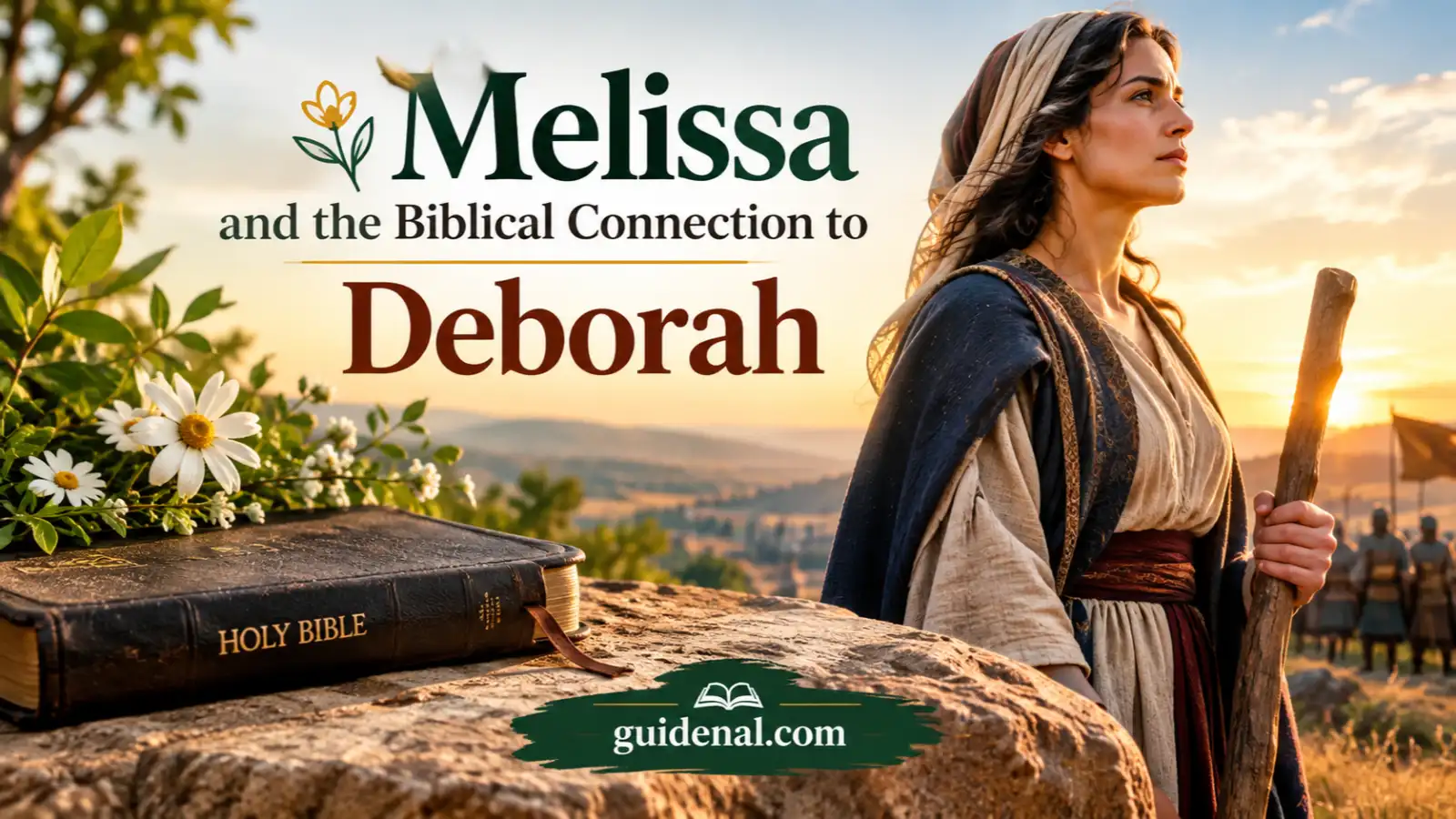
Deborah is one of the strongest biblical connections to the meaning of Melissa.
Judges 4:4 says:
Judges 4:4
“Now Deborah, a prophetess, the wife of Lappidoth, was judging Israel at that time.”
Deborah was not merely mentioned in passing. She was a prophetess and judge who helped lead Israel during a difficult period.
She listened to God, gave wise direction, encouraged Barak, and played an important role in Israel’s deliverance.
Her story gives depth to the simple meaning “bee.”
A bee is small, but a colony can accomplish remarkable work. Scripture’s portrait of Deborah likewise reminds us that God can use one faithful person to influence many others.
This does not mean that every person named Melissa will have Deborah’s calling. A name does not determine someone’s spiritual destiny.
But the connection can provide a meaningful devotional thought:
God can use ordinary people for significant purposes when they faithfully respond to Him.
That is a much stronger biblical lesson than claiming a name predicts someone’s personality.
What Do Bees Symbolize in the Bible?
The Bible does not establish one universal symbolic meaning for bees.
Sometimes bees are simply part of a real-life description. Other passages use bees as imagery.
This is important because biblical symbolism should come from Scripture rather than from modern name-meaning traditions.
1. Bees can remind us of God’s creation
Bees are part of the created world that God sustains.
Genesis teaches that God created living creatures according to His wisdom and purpose. Bees therefore remind us that even small creatures have a place within God’s creation.
Jesus also taught that God pays attention to the details of His creation.
The Christian lesson is simple:
If God cares for His creation, you can trust Him with your life.
2. Bees can represent something numerous and powerful
Isaiah uses bees as an image for the forces coming against Judah.
Isaiah 7:18 says:
“In that day the Lord will whistle for the fly that is at the end of the streams of Egypt, and for the bee that is in the land of Assyria.”
Here, the bee is not presented as a symbol of sweetness or kindness.
It is part of a prophetic picture of invading forces.
That is an important reminder: biblical symbols do not always have one fixed meaning.
A bee can appear in one passage as part of a threatening image and in another context simply as a source of honey.
3. Bees can remind us of diligence
The Bible does not directly say, “Be like a bee.”
Still, the natural activity of bees provides a reasonable illustration of work, order, and fruitfulness.
Proverbs frequently uses observations from everyday life to teach wisdom. Ants, birds, plants, fields, animals, and other parts of creation become lessons for human beings.
So Christians may use the bee as an illustration of diligence, but should not present that illustration as a direct biblical doctrine.
What Does Honey Symbolize in the Bible?
Honey has a much stronger biblical presence than the name Melissa itself.
Scripture frequently mentions honey as something sweet, desirable, nourishing, and associated with abundance.
But honey also teaches moderation and wisdom.
That makes honey a rich biblical image.
Best Bible Verses Connected to the Meaning of Melissa
Because Melissa means “bee” or “honeybee,” the most relevant Bible verses are those involving bees, honey, sweetness, wisdom, God’s provision, and spiritual fruitfulness.
1. Proverbs 16:24 — Gracious Words Are Like Honey
“Gracious words are like a honeycomb, sweetness to the soul and health to the body.”
What This Verse Means
Proverbs connects honey with the blessing of gracious speech.
The image is powerful. Honey is naturally sweet and pleasant. In the same way, wise and kind words can bring encouragement and healing.
The verse is not teaching that every pleasant word is automatically good. Biblical graciousness is connected with wisdom, truth, and love.
Life Application
If the name Melissa reminds you of honey, let it remind you to ask:
Do my words bring sweetness or unnecessary pain to others?
A Christian’s speech should reflect the grace of Christ.
Kind words can strengthen a discouraged person, restore hope, and create peace.
2. Psalm 119:103 — God’s Word Is Sweeter Than Honey
“How sweet are your words to my taste, sweeter than honey to my mouth!”
What This Verse Means
The psalmist is expressing deep delight in God’s Word.
Honey represents sweetness, but God’s instruction is even more valuable.
The point is not physical taste. It is spiritual desire.
The psalmist has learned that God’s truth is good for the soul.
Life Application
A meaningful Christian life requires more than knowing that the Bible is important.
We should learn to desire God’s Word.
When Scripture becomes part of our daily life, it shapes our decisions, corrects our thinking, and strengthens our faith.
3. Psalm 19:10 — God’s Truth Is More Valuable Than Gold
“More to be desired are they than gold, even much fine gold; sweeter also than honey and drippings of the honeycomb.”
What This Verse Means
Psalm 19 celebrates God’s revelation.
The writer compares God’s instructions with two things people naturally value: wealth and sweetness.
God’s truth is worth more than material riches and is sweeter than honey.
Life Application
The world often measures success through money, status, appearance, and possessions.
Scripture gives us another measure.
God’s wisdom is treasure.
If you are making an important decision, do not ask only, “What will benefit me?”
Ask:
What is faithful to God’s Word?
4. Proverbs 24:13–14 — Honey and Wisdom
“My son, eat honey, for it is good, and the drippings of the honeycomb are sweet to your taste.”
The passage continues by comparing wisdom with honey.
What This Verse Means
Honey is used as a picture of something good and desirable.
Then Proverbs makes the deeper connection: wisdom is good for the soul.
Biblical wisdom is not simply intelligence. It means learning to live according to God’s truth.
Life Application
Do not pursue knowledge merely to impress others.
Pursue wisdom that changes how you live.
A wise Christian learns to speak carefully, choose friends wisely, handle money responsibly, forgive others, resist temptation, and trust God.
5. Proverbs 25:16 — Honey Also Teaches Moderation
“If you have found honey, eat only enough for you, lest you have your fill of it and vomit it.”
What This Verse Means
Something good can become harmful when it is consumed without self-control.
Honey is good, but too much honey is not good.
This is a simple example of a larger biblical principle: God’s people are called to practice self-control.
Life Application
Not everything enjoyable is meant to be enjoyed without limits.
Food, entertainment, possessions, work, social media, and even good opportunities require wisdom.
Melissa can remind us of sweetness, but Proverbs reminds us that sweetness needs self-control.
6. Proverbs 25:27 — Do Not Overindulge
“It is not good to eat much honey, nor is it glorious to seek one’s own glory.”
What This Verse Means
The verse connects excessive honey with excessive desire for personal glory.
The underlying lesson is contentment.
Something that begins as good can become unhealthy when it becomes an obsession.
Life Application
Ask God to help you enjoy His blessings without making those blessings your god.
Christians are called to receive good things with gratitude while keeping God first.
7. Exodus 3:8 — A Land Flowing With Milk and Honey
“and to bring them up out of that land to a good and broad land, a land flowing with milk and honey”
What This Verse Means
God promised to bring Israel out of Egypt and into the land He had promised to give them.
The expression “milk and honey” communicates abundance and goodness.
It was part of God’s promise to provide a place where His people could live.
Life Application
This verse reminds us that God is a God of provision.
The Christian life does not mean that every season will be comfortable.
But God’s character remains trustworthy even when circumstances change.
8. Deuteronomy 8:8 — Honey in the Promised Land
Deuteronomy describes the land God was giving Israel as a place associated with agricultural abundance, including honey.
What This Verse Means
Israel was entering a land with natural resources and agricultural potential.
Honey was part of the picture of God’s provision.
The passage also warns Israel not to forget God when they become prosperous.
Life Application
Blessing can create a spiritual danger.
When life becomes easier, we may depend less consciously on God.
The lesson is to remain grateful during both abundance and difficulty.
9. Judges 14:8 — Bees and Honey in the Lion
“After some days he returned to take her. And he turned aside to see the carcass of the lion, and behold, there was a swarm of bees in the body of the lion, and honey.”
What This Verse Means
Samson discovered a swarm of bees and honey inside the carcass of a lion he had previously killed.
This unusual event became part of the riddle Samson later presented to the Philistines.
The Bible is not teaching that bees symbolize victory here.
It is simply describing an unusual event in Samson’s story.
Life Application
This passage can remind us not to force symbolic meanings onto every biblical detail.
Sometimes Scripture records an event because it matters to the story.
Good Bible study asks first:
What did this passage mean in its original context?
Only then should we consider broader application.
10. 1 Samuel 14:27 — Jonathan Tastes Honey
“so he put out the tip of the staff that was in his hand and dipped it in the honeycomb and put his hand to his mouth, and his eyes became bright.”
What This Verse Means
Jonathan had not heard Saul’s command that had restricted the soldiers from eating.
After tasting honey, Jonathan described the physical benefit he experienced.
The passage contrasts Jonathan’s refreshed condition with the weakness of soldiers who had gone without food.
Life Application
Our physical needs matter.
Christian spirituality does not require pretending that human limitations do not exist.
Rest, food, wise work, and proper care of the body can all be part of responsible stewardship.
11. Isaiah 7:18 — The Bee as Prophetic Imagery
“In that day the Lord will whistle for the fly that is at the end of the streams of Egypt, and for the bee that is in the land of Assyria.”
What This Verse Means
Here the bee has a completely different role.
Isaiah uses the bee as imagery for Assyrian forces.
This shows why Christians should be cautious about saying, “The bee always symbolizes sweetness.”
It does not.
Life Application
Read biblical symbolism in context.
Do not build spiritual teachings from isolated symbols.
God’s Word should interpret God’s Word.
12. Matthew 3:4 — John the Baptist and Wild Honey
“Now John wore a garment of camel’s hair and a leather belt around his waist, and his food was locusts and wild honey.”
What This Verse Means
Matthew describes John the Baptist’s unusual lifestyle in the wilderness.
Wild honey was available as a natural food source.
The focus of the passage is John’s prophetic ministry and his call to repentance, not the symbolic meaning of honey.
Life Application
John’s life reminds Christians that faithfulness does not always look impressive by worldly standards.
His calling was to prepare people for Jesus Christ.
Our greatest purpose is not popularity.
It is faithfulness to God.
13. Psalm 34:8 — Taste and See That the Lord Is Good
“Oh, taste and see that the Lord is good! Blessed is the man who takes refuge in him!”
What This Verse Means
David uses the language of tasting to describe personal experience of God’s goodness.
This connects naturally with the biblical imagery of honey and sweetness.
But the ultimate sweetness is not honey.
It is knowing the goodness of God.
Life Application
Christian faith is more than information.
God invites us to trust Him, experience His faithfulness, and take refuge in Him.
When life becomes uncertain, return to God’s character.
14. Galatians 5:22 — The Fruit of the Spirit
“But the fruit of the Spirit is love, joy, peace, patience, kindness, goodness, faithfulness,”
What This Verse Means
The New Testament shifts the focus from physical fruit and honey to spiritual fruit.
The Holy Spirit produces Christlike qualities in believers.
These qualities include love, patience, kindness, goodness, and faithfulness.
Life Application
A name does not make someone spiritually sweet.
The Holy Spirit changes character.
If Melissa reminds you of honey, let the deeper question be:
Is the fruit of the Spirit becoming visible in my life?
15. James 3:17 — Wisdom From Above
“But the wisdom from above is first pure, then peaceable, gentle, open to reason, full of mercy and good fruits, impartial and sincere.”
What This Verse Means
James describes what genuine heavenly wisdom looks like.
It is not merely intellectual.
It produces purity, peace, gentleness, mercy, sincerity, and good fruit.
Life Application
Ask God for this kind of wisdom.
When you face conflict, family decisions, work problems, or uncertainty, seek wisdom that reflects Christ rather than merely seeking to win an argument.
Biblical Themes Connected to Melissa
Although Melissa is not a biblical personal name, several biblical themes connected with bees and honey can provide meaningful spiritual reflection.
Sweetness
Honey is one of Scripture’s clearest images of sweetness.
But biblical sweetness goes beyond pleasant experiences.
God’s Word is described as sweet.
Gracious speech is compared with honey.
God’s goodness is something believers are invited to “taste.”
This gives the name Melissa a beautiful devotional association:
May your life reflect the sweetness of God’s grace.
That does not mean avoiding difficult truth.
Jesus was loving, but He also spoke truth.
Christian sweetness should include both kindness and truth.
Wisdom
Proverbs connects honey with wisdom.
This is one of the strongest spiritual connections for the name.
Wisdom is not simply knowing many facts.
Biblical wisdom means living rightly before God.
A wise person listens.
A wise person accepts correction.
😊A wise person thinks before speaking.
A wise person understands that today’s choices can shape tomorrow’s life.
If the name Melissa reminds someone of honey, it can become a simple reminder to pursue the wisdom that is sweeter and more valuable than earthly treasure.
Diligence
Bees are associated naturally with purposeful activity and productive work.
While Scripture does not create a formal doctrine that bees symbolize diligence, the natural world often encourages us to think about God’s design.
Proverbs 6:6 says:
“Go to the ant, O sluggard; consider her ways, and be wise.”
Notice that Proverbs uses an ordinary creature to teach wisdom.
The Christian lesson is not “be a bee.”
It is:
Pay attention to God’s creation and learn wisdom from it.
Diligence means faithfully doing the work God has placed before us.
Fruitfulness
Honey comes from a larger process involving flowers, bees, and the natural world.
The Bible frequently uses agricultural language to teach spiritual truths.
Jesus spoke about fruitfulness.
Paul spoke about the fruit of the Spirit.
James spoke about a harvest of righteousness.
These images remind us that Christian maturity is not merely about what we say we believe.
Faith should produce visible fruit.
Community
Bees live and work within a highly organized community.
The Bible likewise places strong emphasis on community.
Christians are described as members of one body.
Believers are encouraged to serve one another, bear one another’s burdens, forgive one another, and love one another.
The bee itself is not a Christian symbol of church community in Scripture, but it can serve as a useful illustration.
God did not design believers to live completely isolated lives.
We need one another.
Biblical Symbolism of Bees and Honey
It is helpful to distinguish between biblical symbolism and devotional symbolism.
Biblical symbolism
This is symbolism clearly established by a particular biblical passage.
For example, Isaiah uses a bee in a prophetic image.
Proverbs uses honey to illustrate wisdom and moderation.
Psalm 119 uses honey to describe the sweetness of God’s Word.
Devotional symbolism
This is a personal spiritual reflection that is consistent with Scripture but is not explicitly taught as a biblical symbol.
For example:
“The name Melissa reminds me to live a life that brings sweetness and encouragement to others.”
That can be a meaningful Christian reflection.
But it should not be presented as though the Bible says, “Melissa means a woman who brings sweetness.”
The difference may seem small, but it protects biblical accuracy.
Does Melissa Have a Hebrew Meaning?
No direct Hebrew meaning is established for Melissa.
Melissa is primarily a Greek name meaning “bee” or “honeybee.”
If someone is specifically looking for a Hebrew biblical name with a similar meaning, Deborah is the obvious biblical comparison.
Deborah is a Hebrew name meaning “bee,” and she is a major woman in the Book of Judges.
This does not make Melissa a Hebrew form of Deborah.
They come from different linguistic traditions.
But the shared meaning provides an interesting connection between Greek naming tradition and biblical Hebrew.
Is Melissa a Biblical Name?
Not in the strict sense.
Melissa is not listed as a personal name in the biblical text.
This does not mean Christians cannot use the name.
Many Christian families use names that are not directly found in Scripture.
The important thing is not whether every Christian name appears in the Bible.
The important thing is whether the values and meaning attached to the name are consistent with Christian faith.
Melissa has a positive linguistic meaning associated with a bee or honeybee, and Scripture contains many meaningful references to honey.
Is Melissa a Christian Name?
Melissa can certainly be used as a Christian name, but it is not a biblical name in the same way as Mary, Elizabeth, Deborah, Ruth, Sarah, or Hannah.
Its Greek origin does not make it un-Christian.
Christianity is centered on faith in God through Jesus Christ, not on having a name that appears in Scripture.
If a Christian family chooses the name Melissa, they can attach biblical reminders to it without claiming that Scripture directly defines the name.
For example:
Melissa — “bee/honeybee” — a reminder of God’s creation, wisdom, sweetness, diligence, and fruitful Christian living.
That is a devotional application, not a direct biblical definition.
What Can the Name Melissa Teach Christians Today?
A name can become a reminder.
Every time you hear your name, it can point your heart toward something greater.
For Melissa, consider these five reminders.
1. Let Your Words Bring Sweetness
Proverbs 16:24 compares gracious words to honey.
Your words can either strengthen people or wound them.
Before speaking, ask whether your words are true, necessary, loving, and helpful.
2. Value God’s Word
Psalm 119:103 compares God’s Word with something sweeter than honey.
The Bible should not be treated merely as a reference book.
Read it slowly.
Think about it.
Pray through it.
Allow Scripture to correct you and encourage you.
3. Seek Wisdom
Proverbs connects honey with wisdom.
Ask God for wisdom when you do not know what to do.
James 1:5 teaches that God gives wisdom generously to those who ask.
You do not need to pretend that you have every answer.
You can ask God.
4. Practice Self-Control
Honey is good, but Proverbs warns against consuming too much.
This is a simple picture of self-control.
Christian freedom does not mean unlimited indulgence.
It means learning to enjoy God’s gifts without allowing them to control us.
5. Produce Spiritual Fruit
Galatians 5 points believers toward the fruit of the Holy Spirit.
The goal is not simply to have a meaningful name.
The goal is to become more like Christ.
Love.
Joy.
Peace.
Patience.
Kindness.
Goodness.
Faithfulness.
These qualities matter far more than the meaning of a name.
Common Misconceptions About Melissa’s Biblical Meaning
Misconception 1: “Melissa is a name found in the Bible.”
It is not.
Melissa is a Greek name, but it does not appear as a personal name in Scripture.
Misconception 2: “The Bible says Melissa means sweetness.”
Not exactly.
The Greek name means “bee” or “honeybee.”
Sweetness is a related devotional association because bees produce honey, but it should not be presented as the literal definition.
Misconception 3: “Melissa’s name determines her personality.”
There is no biblical basis for saying a person’s name determines their personality, spiritual gifts, future, or destiny.
God works through people according to His grace and purpose.
Misconception 4: “Every bee reference in the Bible has a positive meaning.”
No.
Isaiah 7:18 uses the bee in a prophetic image connected with Assyria.
Context matters.
Misconception 5: “A beautiful name guarantees a blessed life.”
A name is not a promise of an easy life.
Jesus Himself taught His followers to expect difficulties while trusting Him.
Our hope is found in God, not in the meaning of our names.
FAQs:
What does Melissa mean in the Bible?
Melissa means “bee” or “honeybee” in Greek, but Melissa is not a personal name found in the Bible. Its Christian significance can be explored through biblical themes involving bees, honey, wisdom, sweetness, diligence, and God’s provision.
Is Melissa a biblical name?
Melissa is not a biblical personal name. It is an ancient Greek name. However, Christians can use it as a given name and reflect on biblical themes associated with bees and honey.
What is the Hebrew equivalent of Melissa?
There is no exact Hebrew equivalent of Melissa. The closest biblical name by meaning is Deborah, a Hebrew name meaning “bee.”
Does Melissa mean honey?
More precisely, Melissa means “bee” or “honeybee.” The Greek word meli means “honey,” and Melissa is related to that word.
What does a bee symbolize in the Bible?
The Bible does not give bees one universal symbolic meaning. Bees can appear in different contexts. Honey is often associated with sweetness, nourishment, abundance, and wisdom, while Isaiah also uses the bee in a prophetic image.
What Bible verse is good for someone named Melissa?
Psalm 119:103 is especially fitting because it compares God’s Word with honey:
“How sweet are your words to my taste, sweeter than honey to my mouth!”
It offers a beautiful reminder that God’s truth is more valuable than temporary pleasures.
Does Melissa have a spiritual meaning?
Melissa does not have a direct spiritual definition in Scripture. However, Christians may use its meaning, “honeybee,” as a devotional reminder of God’s creation, wisdom, sweetness, diligence, and spiritual fruitfulness.
Is Melissa a good name for a Christian girl?
A Christian family can certainly choose Melissa. The name has Greek origins and means “bee” or “honeybee.” Its use does not conflict with Christian faith. What matters most is the faith and character of the person who carries the name.
Conclusion:
So, what is the Melissa meaning in Bible?
The most accurate answer is this:
Melissa is a Greek name meaning “bee” or “honeybee.” It is not a personal name found in the Bible, but its meaning connects naturally with biblical references to bees, honey, wisdom, sweetness, God’s provision, and spiritual fruitfulness. The closest biblical name by meaning is Deborah, which also means “bee.”
That distinction does not make the name less meaningful.
In fact, it gives you a more honest and beautiful way to understand it.
When you think of honey, remember that Scripture points beyond physical sweetness to something better: God’s Word.
When you think of a bee, remember God’s creativity in creation.
😊When you think of diligence, remember that God values faithful obedience.
When you think of sweetness, remember gracious speech.
When you think of fruitfulness, remember the work of the Holy Spirit.
And when you think about your name, remember that your deepest identity is not found in a word.
It is found in God.
Your name does not determine your future.
God holds your future.
Your name does not give you spiritual character.
The Holy Spirit forms Christlike character in you.
Your name does not guarantee blessing.
But God’s grace is always worth trusting.
Psalm 34:8 gives a fitting final invitation:
“Oh, taste and see that the Lord is good! Blessed is the man who takes refuge in him!”
May the name Melissa become more than a beautiful word. May it remind you to seek God’s wisdom, speak with grace, walk in faith, and allow the Holy Spirit to produce good fruit in your life.
The sweetest thing Scripture offers is not a name, a possession, or an earthly blessing.
It is the goodness of God Himself.

I am a content writer at Guidenal, where I create easy-to-understand, well-researched, and reader-focused guides inspired by biblical teachings. Working alongside Naqash Ayub, I strive to deliver trustworthy content that helps readers grow in faith and find practical answers from Scripture.