
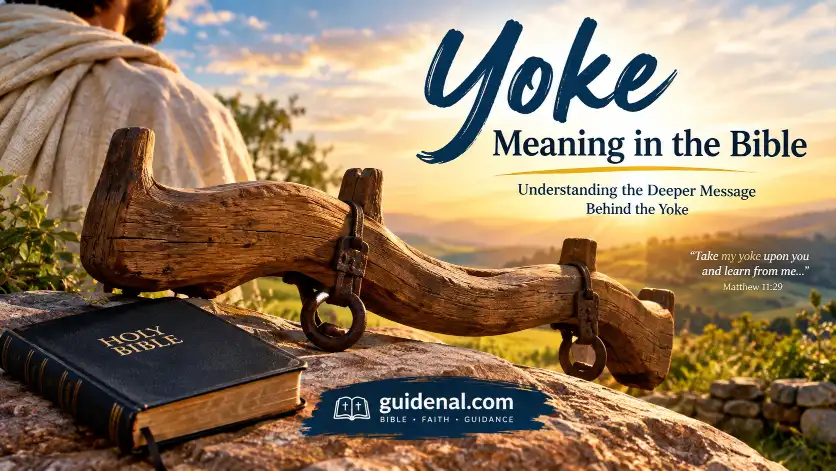
You may have heard someone say, “Take the yoke of Christ,” and wondered what a yoke meaning in the Bible really is. The word can sound strange to modern readers. We do not usually see farmers placing wooden yokes on oxen today.
But to people in biblical times, a yoke was familiar. It was part of daily work. It could guide animals, join them for labor, and place a burden on their necks. Because of this, Scripture uses the yoke as a powerful picture of work, authority, submission, oppression, discipline, and freedom.
The most beautiful use of this picture comes from Jesus. He says, “Take my yoke upon you and learn from me.” He speaks to people who are tired and burdened, yet He does not simply tell them to stop carrying everything. And he invites them to come under His teaching and leadership, where they can find rest for their souls.
The Bible also uses the yoke in other ways. Sometimes it describes political oppression. Sometimes it describes slavery or heavy demands. At other times, it points to discipline or a life of willing obedience.
Understanding these different uses helps us understand what Jesus meant. The Christian life is not freedom from every responsibility. It is freedom from destructive bondage and a new life of faithful discipleship under Christ.
What Does “Yoke” Mean in the Bible?

In the Bible, a yoke is first a real farming tool. It was a wooden beam or frame placed on draft animals so they could pull a plow or load. The Hebrew word commonly translated “yoke” is ʿol (עֹל). It can refer to a literal yoke for animals and, figuratively, to servitude, hardship, or authority.
The New Testament commonly uses the Greek word zygos (ζυγός). It can mean a literal yoke and can also describe a burden, bondage, obligation, or form of submission. In Matthew 11, Jesus uses this word when He invites people to take His yoke and learn from Him.
This gives us a simple biblical definition:
A yoke in the Bible can represent something that places a person under authority, directs their life, or creates a burden they must carry.
The meaning depends on the context.
A yoke can represent oppression, as when a foreign ruler controls a nation. It can represent servitude, as in New Testament passages about slavery. It can describe discipline and hardship, as in Lamentations. And in Jesus’ teaching, it represents submission to Him as Lord and learning His way of life.
That is why we should not assume that every biblical reference to a yoke means exactly the same thing.
Understanding the Yoke in Biblical Culture
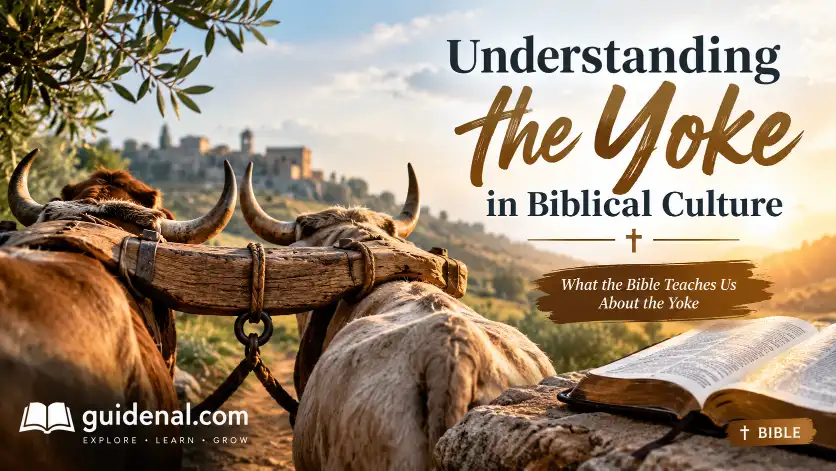
Ancient Israel was largely an agricultural society. Farmers depended on animals for important work, especially plowing and hauling. Biblical descriptions of agriculture regularly mention oxen and other working animals. A typical ancient Israelite plow was pulled by draft animals, commonly oxen, and the yoke connected the animals to the work they were doing.
This physical picture made the yoke an easy metaphor.
If an ox was under a yoke, it was under direction. It was not simply wandering wherever it wanted. It had a task and a master.
That same picture could describe a nation under a powerful king. It could describe a person under slavery. It could describe someone carrying hardship. And it could also describe a disciple willingly placing himself under the instruction of a teacher.
The Old Testament develops this imagery in several directions.
Israel experienced political oppression from powerful nations. Prophets sometimes described that oppression as a yoke. Breaking a yoke therefore became a picture of deliverance.
The New Testament continues this language. Acts 15 uses the image when the apostles discuss whether Gentile believers should be placed under requirements that the apostles regarded as an unbearable burden. Paul later uses the same language when warning Christians not to return to a yoke of slavery.
Then Jesus gives the image a deeply personal meaning.
He says:
“Take my yoke upon you and learn from me, for I am gentle and humble in heart; and you will find rest for your souls.”
The surprising part is that Jesus offers a yoke and rest at the same time.
That is one of the central truths behind the biblical meaning of a yoke.
Spiritual Yoke Meaning
- A spiritual yoke represents a relationship of influence, guidance, or submission.
- In the Bible, a yoke can describe the spiritual direction a person chooses to follow.
- Being under a spiritual yoke may suggest living according to someone’s authority or teaching.
- Scripture uses the image of a yoke to explain both faithful obedience and harmful bondage.
- A godly yoke points believers toward obedience, humility, and dependence on God.
- A wrong spiritual yoke can lead people away from biblical truth and godly wisdom.
- The idea of a yoke reminds Christians that everyone is influenced by something.
- Spiritual freedom in Scripture does not mean living without responsibility or direction.
- God calls His people to follow Him with willing hearts rather than rebellious attitudes.
- A spiritual yoke can also represent the commitments and responsibilities connected with faith.
- The Bible encourages believers to examine what influences their beliefs, choices, and priorities.
- Following Christ means allowing His teachings to shape everyday life.
- A spiritual yoke should be understood in light of God’s character, truth, grace, and holiness.
- Ultimately, the biblical picture of a spiritual yoke points believers toward faithful dependence on God.
Best Bible Verses About the Yoke
1. Matthew 11:28–30 — Jesus Offers a Yoke That Gives Rest
Matthew 11:28–30
“Come to me, all you who labor and are heavily burdened, and I will give you rest. Take my yoke upon you and learn from me, for I am gentle and humble in heart; and you will find rest for your souls. For my yoke is easy, and my burden is light.”
What This Verse Means
This is the most important passage for understanding the yoke meaning in the Bible.
Jesus speaks to people who are weary and heavily burdened. His answer is not merely, “Try harder.” He begins with an invitation: come to me.
Then He says, “Take my yoke upon you and learn from me.”
The word “learn” is important. Jesus’ yoke involves becoming His disciple. It means accepting His authority, learning His teaching, and following His way.
Jesus describes Himself as gentle and humble. His authority is not like the crushing authority described elsewhere in Scripture.
The “easy” yoke does not mean the Christian life will never be difficult. Jesus never promised His followers a life without suffering, sacrifice, or obedience. Instead, His yoke is good and fitting because the person following Him is no longer trying to carry life apart from Him.
Life Application
When life feels overwhelming, start with Jesus rather than simply trying to carry more.
Bring your fears, responsibilities, sin, and exhaustion to Him. Ask what it means to follow Him faithfully in the situation you are facing.
Christian rest is not laziness. It is trusting Christ while faithfully walking with Him.
2. 1 Samuel 6:7 — A Yoke Was a Real Agricultural Tool
1 Samuel 6:7
“Now therefore take and prepare yourselves a new cart and two milk cows on which there has come no yoke; and tie the cows to the cart, and bring their calves home from them.”
What This Verse Means
This verse gives us the literal background behind the metaphor.
The Philistines were returning the ark of God to Israel. They prepared cows that had never been under a yoke and attached them to a cart carrying the ark.
The point is simple: a yoke was a physical instrument used to control and direct working animals.
Life Application
Understanding the literal picture helps us avoid treating biblical symbolism as vague or mystical.
When Scripture speaks about a yoke, remember that it came from an ordinary object that ancient people knew well.
3. 1 Kings 12:4 — A Yoke Can Represent Harsh Rule
1 Kings 12:4
“Your father made our yoke difficult. Now therefore make the hard service of your father, and his heavy yoke which he put on us, lighter, and we will serve you.”
What This Verse Means
After Solomon’s death, the people appealed to Rehoboam. They described Solomon’s rule as a heavy yoke.
Here, the yoke represents political and economic pressure. The people were asking for relief from burdensome service.
This shows how the Bible moves from the physical image of an animal’s yoke to the human experience of living under heavy authority.
Life Application
Leadership should not become an excuse for crushing people.
Whether in a family, church, workplace, or community, biblical leadership should reflect wisdom, humility, and service.
4. 2 Chronicles 10:10–11 — A Heavy Yoke Can Become Even Heavier
2 Chronicles 10:10–11
“The young men who had grown up with him spoke to him, saying, ‘Thus you shall tell the people who spoke to you, saying, “Your father made our yoke heavy, but make it lighter on us;” thus you shall say to them, “My little finger is thicker than my father’s waist. Now whereas my father burdened you with a heavy yoke, I will add to your yoke. My father chastised you with whips, but I will chastise you with scorpions.”’”
What This Verse Means
Rehoboam rejected wise counsel and chose the advice of younger advisers who encouraged harsher rule.
The result was disastrous. The heavy yoke became heavier.
This passage reminds us that power without wisdom can create unnecessary burdens.
Life Application
Before adding expectations to other people, ask whether those expectations are truly necessary.
Godly wisdom does not measure leadership by how much pressure people can survive.
5. Isaiah 9:4 — God Can Break an Oppressive Yoke
Isaiah 9:4
“For the yoke of his burden, and the staff of his shoulder, the rod of his oppressor, you have broken as in the day of Midian.”
What This Verse Means
Isaiah speaks of God breaking the oppressive burden carried by His people. The passage continues with the famous promise of a child who will come as the promised ruler.
The yoke here represents oppression and domination.
The biblical picture is powerful: something that once pressed down on people’s shoulders can be broken by God’s saving action.
Life Application
If you feel trapped under circumstances you cannot control, remember that oppression does not have the final word.
Bring your situation to God honestly. Scripture gives us permission to cry out for justice, deliverance, and peace.
6. Isaiah 10:27 — God Removes the Yoke
Isaiah 10:27
“It will happen in that day that his burden will depart from off your shoulder, and his yoke from off your neck, and the yoke shall be destroyed because of the anointing oil.”
What This Verse Means
Isaiah uses the yoke as a picture of Assyrian oppression.
The important biblical theme is deliverance. God’s people are not forgotten under the pressure of a powerful empire.
This passage should not be turned into a promise that every personal problem will disappear immediately. Its original setting concerns God’s judgment and deliverance in Israel’s history.
Life Application
Trust God’s sovereignty even when relief is not immediate.
Biblical hope does not require pretending that suffering is small. It means believing that God remains Lord over suffering and oppression.
7. Jeremiah 2:20 — God Had Freed His People
Jeremiah 2:20
“For long ago I broke off your yoke, and burst your bonds. You said, ‘I will not serve;’ for on every high hill and under every green tree you bowed yourself, playing the prostitute.”
What This Verse Means
God reminds Israel that He had broken their yoke, yet they turned toward idolatry.
The tragedy is that freedom did not automatically produce faithfulness.
Israel had been delivered, but instead of using freedom to worship God, the people pursued other gods.
Life Application
Freedom is not merely freedom from something. It is freedom for something.
Christians are freed from slavery to sin so that they can live in faithful obedience to God.
8. Jeremiah 5:5 — Breaking the Yoke Can Also Mean Rebellion
Jeremiah 5:5
“I will go to the great men and will speak to them, for they know the way of Yahweh, and the law of their God.” But these with one accord have broken the yoke, and burst the bonds.
What This Verse Means
In this context, breaking the yoke is not a picture of righteous freedom.
The people were rejecting God’s authority.
This is an important correction to a common misunderstanding. The Bible does not teach that every act of throwing off authority is freedom.
Sometimes breaking a yoke means deliverance. At other times it means rebellion against God.
Context determines the meaning.
Life Application
When you feel restricted, ask an important question:
Am I being freed from something harmful, or am I resisting something God has actually commanded?
That question can bring clarity to difficult choices.
9. Jeremiah 27:11 — Submission Under Babylonian Rule
Jeremiah 27:11
“But the nation that brings their neck under the yoke of the king of Babylon and serves him, that nation I will let remain in their own land,” says Yahweh; “and they will till it and dwell in it.”
What This Verse Means
Jeremiah delivered a difficult message to nations facing Babylonian power.
The yoke represented submission to Babylon’s rule. In this particular historical situation, God instructed the nations to submit to Babylon rather than resist His announced judgment.
This is a reminder that biblical wisdom cannot be reduced to a slogan such as “always break the yoke.”
Sometimes Scripture calls for resistance. Sometimes it calls for patient submission.
Life Application
Do not make major spiritual decisions from a single metaphor.
Read the whole passage. Consider its historical setting. Seek wisdom through Scripture and prayer.
10. Jeremiah 28:10–12 — A False Promise About the Yoke
Jeremiah 28:10–12
“Then Hananiah the prophet took the bar from off the prophet Jeremiah’s neck, and broke it. Hananiah spoke in the presence of all the people, saying, ‘Yahweh says: “Even so I will break the yoke of Nebuchadnezzar king of Babylon from off the neck of all the nations within two full years.”’ Then the prophet Jeremiah went his way.”
What This Verse Means
Hananiah gave the people a hopeful message, but the claim was false.
The physical yoke Jeremiah wore was part of a prophetic sign. Hananiah broke it and claimed that Babylon’s yoke would soon be broken.
The passage warns us that a message can sound hopeful and still be untrue.
Life Application
Do not judge a spiritual message simply because it makes you feel better.
Test teaching against Scripture. Christian hope is strongest when it is rooted in God’s truth rather than attractive promises.
11. Lamentations 3:27 — The Yoke of Discipline
Lamentations 3:27
“It is good for a man that he bear the yoke in his youth.”
What This Verse Means
Lamentations was written in the painful aftermath of Jerusalem’s destruction. The surrounding chapter is filled with suffering, sorrow, and hope in God’s mercy.
Here the yoke represents hardship or discipline.
The verse does not say that suffering is pleasant. It recognizes that hardship can teach endurance, humility, and dependence upon God.
Life Application
Some lessons cannot be learned through comfort alone.
Difficult seasons can teach patience, wisdom, compassion, and dependence on God. That does not mean every painful event is directly sent as punishment. It means God can use suffering to form us.
12. Hosea 11:4 — God’s Compassion in the Picture of a Yoke
Hosea 11:4
“I drew them with cords of a man, with ties of love; and I was to them like those who lift up the yoke on their necks; and I bent down to him and I fed him.”
What This Verse Means
Hosea gives one of the tenderest uses of yoke imagery in Scripture.
God describes His relationship with Israel using the picture of lifting a yoke from an animal’s neck. The surrounding passage portrays God as a Father caring for His child.
The image is not cold control. It is compassionate care.
Life Application
God’s authority and God’s love are not enemies.
The Lord does not call you to obedience because He delights in crushing you. His fatherly care and His holiness belong together.
13. Matthew 23:4 — Religious Burdens
Matthew 23:4
“For they bind heavy burdens that are grievous to be borne, and lay them on men’s shoulders; but they themselves will not lift a finger to help them.”
What This Verse Means
Jesus criticized religious leaders who placed heavy burdens on people while failing to help them.
This passage sits within Jesus’ strong warning against hypocrisy.
It is important to distinguish God’s commands from human religious rules. Jesus was not criticizing obedience to God itself. He was exposing leaders who used religion in a way that burdened others while protecting their own status.
Life Application
Christian teaching should lead people toward Christ, truth, repentance, and grace.
If a Christian community creates burdens that Scripture does not create, those burdens should be examined carefully.
14. Acts 15:10 — An Unbearable Religious Yoke
Acts 15:10
“Now therefore why do you tempt God, that you should put a yoke on the neck of the disciples which neither our fathers nor we were able to bear?”
What This Verse Means
The early church faced a major question: Did Gentile believers need to take on the full Jewish covenant requirements, including circumcision, to belong to God’s people?
Peter’s statement at the Jerusalem Council uses yoke imagery for a burden that neither their ancestors nor they had been able to bear.
The larger argument of Acts 15 emphasizes God’s grace in salvation.
Life Application
Your relationship with God is not earned by collecting enough religious achievements.
Obedience matters, but obedience flows from grace rather than purchasing grace.
15. Galatians 5:1 — Do Not Return to Slavery
Galatians 5:1
“Stand firm therefore in the liberty by which Christ has made us free, and don’t be entangled again with a yoke of bondage.”
What This Verse Means
Paul connects Christian freedom directly to Christ.
In Galatians, Paul strongly opposes the idea that believers must rely on circumcision and law observance as the basis for being justified before God.
The yoke of bondage represents returning to a system of slavery rather than standing in the freedom Christ gives.
Christian freedom is not permission to live selfishly. The very next part of Galatians calls believers to serve one another through love.
Life Application
Do not measure your standing with God by endless spiritual scorekeeping.
Trust Christ. Walk by the Spirit. Obey God from a heart shaped by grace.
16. 1 Timothy 6:1 — The Yoke in a Difficult Social Setting
1 Timothy 6:1
“Let as many as are bondservants under the yoke count their own masters worthy of all honor, that the name of God and the doctrine not be blasphemed.”
What This Verse Means
Paul addresses Christians living within the Roman world and its system of slavery.
This verse describes people who were literally “under the yoke” as slaves. The passage gives instructions for Christian conduct within that difficult social reality.
It should not be isolated from the wider New Testament teaching about human dignity, Christian brotherhood, freedom, and the transformed identity believers have in Christ.
The verse demonstrates again that “yoke” can describe a real social condition, not only a spiritual metaphor.
Life Application
Faithfulness to Christ affects how we behave even in circumstances we did not choose.
Christian character includes integrity, respect, patience, and love, while the gospel ultimately points toward a new identity in Christ that transcends social status.
Yoke Meaning Bible Matthew 11
- Matthew 11:29 records Jesus inviting His followers to take His yoke upon themselves.
- Jesus connects His yoke with learning from Him and following His example.
- The passage presents Jesus as gentle and humble in heart.
- His invitation is directed toward people who are weary and burdened.
- The yoke represents discipleship and a life of following Christ.
- Jesus does not promise a life without responsibilities or difficulties.
- Instead, He offers a different kind of relationship with God through discipleship.
- Matthew 11:30 says that Jesus’ yoke is easy and His burden is light.
- This does not mean Christians will never experience suffering or hardship.
- The passage emphasizes that following Jesus brings rest to the soul.
- Jesus teaches that true spiritual rest comes through trusting and learning from Him.
- His yoke contrasts with burdens that leave people spiritually exhausted and oppressed.
- Taking Christ’s yoke means accepting His authority and allowing His teaching to guide life.
- Matthew 11 presents Jesus’ invitation as a gracious call to find lasting rest in Him.
Biblical Themes Connected to the Meaning of Yoke
1. Authority
A yoke places an animal under direction. That makes it a natural biblical image for authority.
Jesus does not say, “Have no master.”
He says, “Take my yoke.”
Christian discipleship therefore includes submission to Jesus Christ.
The question is not whether our lives will be shaped by some authority. The deeper question is whose authority will shape us?
2. Freedom
The Bible repeatedly connects broken yokes with freedom.
Isaiah describes God breaking oppression. Jeremiah describes God breaking bonds. Paul uses the same image to explain freedom in Christ.
Christian freedom is not simply the ability to do whatever we want.
It is freedom to belong to Christ and live according to God’s purposes.
3. Discipleship
Matthew 11 connects the yoke with learning.
That is significant.
Jesus’ yoke is not merely a burden we carry. It is a way of life we learn.
A disciple listens to Jesus, follows Jesus, imitates Jesus, and grows in obedience.
This is why Christian discipleship involves Scripture, prayer, fellowship, repentance, worship, service, and daily dependence on the Holy Spirit.
4. Rest
Jesus connects His yoke with rest for the soul.
This sounds unusual because a yoke normally suggests work.
But Jesus shows that the deepest kind of rest is not necessarily the absence of responsibility.
True spiritual rest comes from being rightly related to God.
We can still work hard and rest in Christ.
👌We can still face trials and have peace.
We can still carry responsibilities without believing that everything depends entirely on us.
5. Grace
Acts 15 and Galatians 5 show an important New Testament connection between the yoke and grace.
The apostles rejected the idea that Gentile believers needed to earn their place among God’s people through additional religious requirements.
Salvation is God’s gracious work.
Christian obedience is important, but it does not replace grace.
Grace does not produce careless living. It produces grateful obedience.
Yoke Meaning In Bible Jeremiah
- Jeremiah uses the image of a yoke to describe submission and political oppression.
- In Jeremiah 27, God commands Jeremiah to make a yoke and place it on his neck.
- The yoke represented the authority of Babylon over surrounding nations.
- King Nebuchadnezzar of Babylon is presented as an instrument of judgment in this context.
- The yoke symbolized submission to Babylonian power during a specific historical period.
- Jeremiah used this visible object to communicate God’s message to kings and nations.
- The biblical yoke in Jeremiah therefore has a strong connection with authority and captivity.
- Jeremiah 28 records a conflict between Jeremiah and the prophet Hananiah concerning the yoke.
- Hananiah broke the wooden yoke that Jeremiah was wearing.
- Jeremiah responded that an iron yoke would replace the broken wooden yoke.
- The image communicated the seriousness and strength of Babylonian domination.
- Jeremiah’s yoke was therefore different from the invitation to discipleship found in Matthew 11.
- In Jeremiah, the yoke primarily illustrates submission under foreign rule and divine judgment.
- The passage reminds readers that biblical symbols must be understood within their historical context.
Biblical Symbolism of the Yoke
The yoke carries several related meanings in Scripture.
A yoke can symbolize oppression
Isaiah 9:4 and Isaiah 10:27 use the image for oppressive rule. A yoke pressed onto someone’s neck became a picture of domination.
A yoke can symbolize slavery
Galatians 5:1 and 1 Timothy 6:1 use the language of a yoke in connection with slavery or bondage.
A yoke can symbolize discipline
Lamentations 3:27 connects the yoke with hardship and learning through difficult circumstances.
A yoke can symbolize submission
Jeremiah 27 uses the image of putting the neck under a yoke to describe submission to Babylon’s rule.
A yoke can symbolize discipleship
Jesus’ use in Matthew 11 is different in tone. His yoke is connected to learning from Him, gentleness, humility, and rest.
The symbol itself is not automatically good or bad.
The crucial question is whose yoke it is and what kind of authority it represents.
My Yoke Meaning
- My yoke refers to Jesus’ statement in Matthew 11:29, where He invites people to take His yoke.
- The phrase describes accepting Jesus’ authority and becoming His disciple.
- Jesus says My yoke because discipleship involves following Him personally.
- His yoke represents learning from His character, teachings, and example.
- Jesus describes Himself as gentle and humble in heart.
- The invitation is especially meaningful to people who feel weary and heavily burdened.
- Taking Christ’s yoke means choosing to live under His guidance.
- It involves trusting Jesus rather than carrying life’s burdens entirely through personal strength.
- Jesus connects His yoke with rest for the soul.
- His yoke does not mean Christians will have an effortless life.
- Instead, it points to a relationship in which believers learn to depend on Christ.
- The phrase also highlights the difference between Christ’s leadership and oppressive forms of spiritual burden.
- Following Jesus requires obedience, but His invitation is presented with grace and compassion.
- The central message of My yoke is an invitation to follow Christ, learn from Him, and find spiritual rest.
What Does “Take My Yoke” Mean?
When Jesus says, “Take my yoke upon you,” He is inviting people into discipleship.
It means:
- Come to Jesus.
- Trust Him.
- Learn from Him.
- Accept His authority.
- Follow His teaching.
- Live according to His character.
- Depend upon His grace.
- Find your deepest rest in Him.
Jesus’ invitation is not “carry nothing.”
It is “carry what I give you, while learning from Me.”
This corrects two opposite mistakes.
One mistake is legalism: trying to earn God’s acceptance through religious performance.
The other mistake is treating grace as permission to ignore obedience.
Jesus offers something different: grace-filled discipleship.
Is Jesus’ Yoke Really Easy?
Jesus says His yoke is easy and His burden is light.
That does not mean following Jesus is always comfortable.
Jesus told His disciples to deny themselves and follow Him. Christians may face persecution, grief, sacrifice, temptation, and difficult obedience.
So what does “easy” mean?
It means Christ’s yoke is good, fitting, and not crushing in the way destructive bondage is.
Jesus does not promise a life without a cross.
He promises Himself.
That distinction matters.
The Christian can suffer and still have rest.
👌The Christian can work and still have peace.
The Christian can obey and still experience freedom.
Common Misunderstandings About the Biblical Yoke
“A yoke always means something bad.”
No.
The Bible uses yoke imagery for oppression, slavery, hardship, and rebellion, but Jesus also speaks of His yoke as good and life-giving.
“Jesus removes every responsibility from Christians.”
No.
Jesus calls people to learn from Him. Discipleship includes obedience.
“Breaking every yoke means rejecting all authority.”
No.
Jeremiah shows that “breaking the yoke” can describe rebellion against God’s authority, while other passages use it for genuine deliverance.
Context matters.
“The yoke means Jesus does everything while I do nothing.”
That is more than Scripture says.
Jesus calls His followers to take His yoke and learn from Him. The image emphasizes discipleship and submission, not spiritual passivity.
“A difficult season always means God is punishing me.”
Not necessarily.
Lamentations shows suffering and discipline in a complex historical setting. Christians should not automatically interpret every hardship as direct punishment from God.
Practical Lessons for Christians Today
1. Bring Your Burdens to Jesus
When your mind is crowded with fear, responsibilities, and uncertainty, begin with Christ.
Pray honestly.
Tell Him what you are carrying.
Then ask, “Lord, what does faithful obedience look like today?”
You may not receive an answer to every question, but you can receive wisdom for the next step.
2. Learn Before You Act
Jesus says, “Learn from me.”
Christian growth is not only about knowing facts about Jesus. It is about becoming more like Him.
Read Scripture slowly.
Ask what it reveals about God’s character.
Then ask how it should change your actions.
3. Reject Religious Performance as Your Source of Worth
Galatians warns believers not to return to a yoke of slavery.
Your value before God is not measured by how impressive your spiritual résumé looks.
Serve God because you belong to Him.
Obey because you love Him.
Repent because His grace invites you back.
4. Accept That Growth Takes Time
Lamentations connects the yoke with learning through hardship.
Some spiritual lessons take years.
Patience, humility, wisdom, courage, and trust are often formed slowly.
Do not despise gradual growth.
5. Examine the Burdens You Place on Others
Matthew 23 gives a serious warning about placing heavy burdens on people.
Parents, pastors, teachers, employers, and Christian leaders should ask whether their expectations are biblical, wise, and loving.
Godly authority should not imitate oppressive authority.
6. Use Freedom for Love
Christian freedom is not self-centered independence.
Paul teaches believers to use freedom to serve one another in love.
Freedom from bondage becomes freedom for faithful service.
7. Let Scripture Shape Your Definition of Rest
The world may define rest as escape from every responsibility.
Jesus offers something deeper.
His rest comes from relationship with Him.
You can have a demanding week and still learn to rest your soul in God’s care.
FAQs:
What does a yoke symbolize in the Bible?
A yoke can symbolize authority, submission, labor, hardship, oppression, slavery, discipline, or discipleship. Its meaning depends on the passage. Jesus uses the image positively when He says, “Take my yoke upon you,” connecting it with learning from Him and finding rest.
What does Jesus mean by “take my yoke upon you”?
Jesus is inviting people to become His disciples. Taking His yoke means accepting His authority, learning His teaching, and following His way. His yoke is described as easy and His burden as light because His rule is not the crushing bondage described in other biblical passages.
Is the yoke in the Bible always negative?
No. Some biblical yokes represent oppression or slavery, but Jesus’ yoke is presented positively. Lamentations also uses the image in connection with learning through hardship. The context determines whether the yoke represents destructive bondage, discipline, submission, or discipleship.
What is the Hebrew word for yoke?
A common Hebrew word is ʿol (עֹל). It refers literally to a yoke placed on animals and is also used figuratively for servitude, hardship, oppression, and related forms of submission.
What is the Greek word for yoke?
The main Greek word is zygos (ζυγός). In the New Testament it can refer to a literal yoke and figuratively to bondage, obligation, or a burden. It is the word used in Matthew 11:29–30, Acts 15:10, Galatians 5:1, and 1 Timothy 6:1.
What does “my yoke is easy” mean?
Jesus is not promising a life without difficulty. He is describing His yoke as good and not crushing. Following Jesus still involves obedience, sacrifice, and perseverance, but His authority brings spiritual rest rather than the destructive bondage associated with sin, hypocrisy, and oppressive demands.
Does the Bible say to break every yoke?
No. The Bible uses “breaking the yoke” in different ways. Sometimes God breaks oppressive rule. At other times, people break a yoke as an expression of rebellion against God. Christians should therefore examine the context rather than treating every yoke as something that must be rejected.
How can Christians apply Jesus’ teaching about the yoke today?
Christians can apply it by bringing their burdens to Jesus, learning Scripture, obeying His teaching, practicing prayer, resisting legalism, serving others, and trusting God’s grace. The goal is not a responsibility-free life but a Christ-centered life in which Jesus’ authority guides our work and rest.
Conclusion:
The yoke meaning in the Bible is richer than the idea of a heavy burden.
A yoke can describe oppression.
It can describe slavery.
😊It can describe discipline.
It can describe submission.
But when Jesus speaks of His yoke, the picture changes.
He calls the weary to Himself.
😊He calls the burdened to rest.
He calls the disciple to learn.
And He describes Himself as gentle and humble.
That is the heart of Christian discipleship.
Jesus does not invite you to prove that you are strong enough to carry everything alone. He invites you to come to Him.
There may still be work.
😊There may still be sacrifice.
There may still be seasons of suffering.
But you do not have to build your life around self-reliance.
Trust Christ.
Learn from Christ.
Follow Christ.
And when you are weary, return to His invitation:
“Come to me, all you who labor and are heavily burdened, and I will give you rest.”
The yoke of Jesus is not an invitation to live without responsibility. It is an invitation to live under the loving authority of the One who gives rest to the soul.
As you walk with Him, remember that biblical freedom is not simply freedom from a burden. It is freedom to belong to God, to grow in grace, to love others, and to live faithfully for His glory.

I am a content writer at Guidenal, where I create easy-to-understand, well-researched, and reader-focused guides inspired by biblical teachings. Working alongside Naqash Ayub, I strive to deliver trustworthy content that helps readers grow in faith and find practical answers from Scripture.