
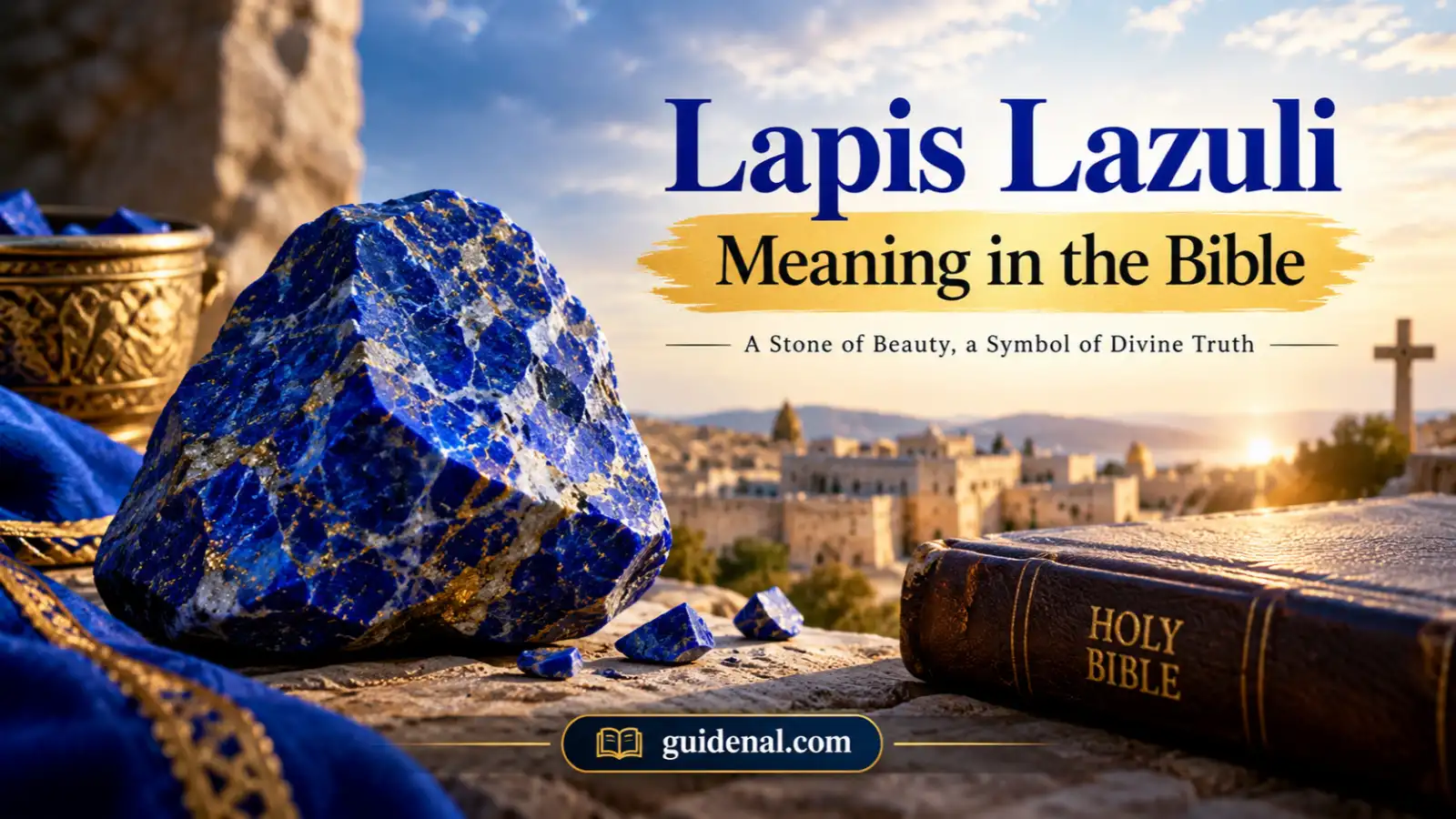
The lapis lazuli meaning in the Bible is closely connected to the rich blue stone described in several Old Testament passages. Although the Bible does not directly explain the spiritual meaning of lapis lazuli, it mentions a precious blue stone traditionally translated as sapphire in several translations. Many biblical scholars believe the ancient Hebrew word sappir may refer to lapis lazuli rather than the modern gemstone known as sapphire.
This distinction matters because the stones have different mineral identities, even though both are valued for their beauty.
Lapis lazuli was treasured in the ancient world for its deep blue color and golden flecks of pyrite. It was associated with wealth, beauty, and royal objects. In Scripture, references to this precious stone appear in descriptions of God’s heavenly glory, precious treasures, and the beauty of sacred things.
Understanding these passages can help Christians appreciate the Bible’s use of precious stones without assigning meanings that Scripture never teaches.
In this article, we will explore the biblical references to lapis lazuli, its possible connection to God’s throne, its historical importance, and the spiritual lessons Christians can draw from these passages. We will also separate what the Bible actually says from popular gemstone interpretations.
Understanding Lapis Lazuli in the Bible
What Is Lapis Lazuli?
Lapis Lazuli – Precious Stones | Mining List
169 Gram Good Quality Rough Lapis Lazuli with Gold Pyrite Inclusions – Folkmarketgems
Queen Puabi jewellery – Kaleidoscope effect | Ancient jewelry, Queen jewelry, Large gold earrings
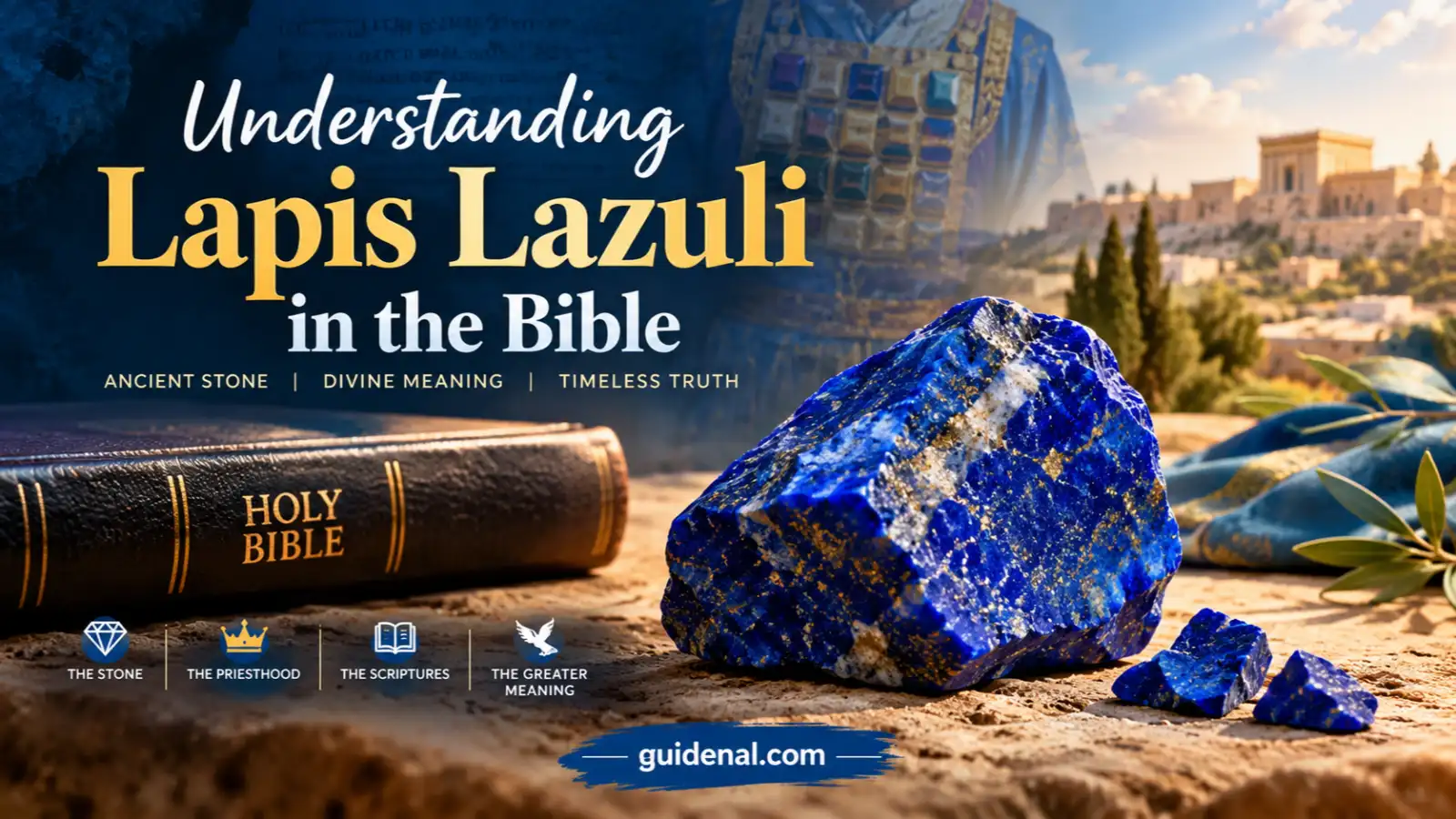
Lapis lazuli is a deep blue natural stone that has been valued for thousands of years. Its color can range from bright royal blue to dark indigo. Some pieces contain tiny golden or silver-colored flecks caused by minerals such as pyrite.
Unlike modern sapphire, which is a variety of corundum, lapis lazuli is a rock made mainly of the blue mineral lazurite, along with other minerals.
In ancient times, lapis lazuli was especially valuable. It was used in jewelry, ornaments, decorative objects, and even blue pigments. Archaeological evidence shows that it traveled across long-distance trade routes in the ancient Near East. Afghanistan’s Badakhshan region is widely recognized as an important historical source of the stone. Oxford University Research Archive+2
Its beauty and rarity made it a sign of wealth and importance in ancient cultures.
Is Lapis Lazuli Actually Mentioned in the Bible?
This is an important question.
The answer depends on the Bible translation.
Some translations use the word sapphire, while the New International Version (NIV) uses lapis lazuli in passages such as Exodus 24:10 and Job 28:6.
The Hebrew word is:
Sappir (סַפִּיר)
It refers to a precious blue stone. However, scholars do not agree on every detail of its ancient mineral identification.
Many biblical reference works identify the ancient sapphire with lapis lazuli. Other scholars leave room for uncertainty. The modern gemstone called sapphire is not necessarily the same stone that ancient Hebrew writers described. NET Bible+2
Therefore, it is reasonable to study lapis lazuli through the biblical references to sappir, while remembering that the exact mineral identification is not certain.
Why Does the Bible Mention Precious Blue Stones?
Precious stones appear in Scripture for several reasons.
They can describe beauty, wealth, craftsmanship, royal splendor, and the richness of God’s creation.
They also help biblical writers communicate images that ordinary language cannot fully express.
For example, Exodus describes a heavenly scene using the appearance of a blue stone. Ezekiel uses a similar image when describing God’s throne.
These passages are not instructions to worship gemstones. Their purpose is to communicate the greatness, majesty, and holiness of God.
The stone is part of the picture. God remains the focus.
Historical Background: Lapis Lazuli in the Ancient World
Lapis lazuli was not an ordinary decorative material in the ancient world.
Obtaining it required mining, trade, and skilled craftsmanship. Its long-distance movement made it a valuable commodity. Ancient Egyptians, Mesopotamians, and other cultures used it in ornaments and luxury objects.
Its dark blue color also made it useful for creating beautiful decorative surfaces and pigments.
This background helps explain why biblical writers included precious blue stones in descriptions of royal garments, valuable treasures, and heavenly visions.
However, historical evidence about the use of lapis lazuli in other cultures should not be confused with biblical teaching. The Bible does not say that owning this stone brings protection, attracts blessings, or gives someone special spiritual power.
Best Bible Verses About Lapis Lazuli and Their Meaning

The Bible contains several references to the Hebrew word sappir, often translated as sapphire or lapis lazuli. These passages provide the strongest biblical foundation for understanding the stone.
The following verses use the King James Version (KJV), which consistently translates the Hebrew term as sapphire. Where relevant, the explanation will identify the possible connection with lapis lazuli.
1. Exodus 24:10: Lapis Lazuli Beneath God’s Feet
Bible Verse (KJV):
“And they saw the God of Israel: and there was under his feet as it were a paved work of a sapphire stone, and as it were the body of heaven in his clearness.”
What This Verse Means
This is one of the most important biblical passages connected to lapis lazuli.
Moses, Aaron, Nadab, Abihu, and seventy elders of Israel went up the mountain and experienced a remarkable vision of God’s presence.
Under God’s feet, they saw something resembling a beautiful blue pavement. The passage compares its appearance to the clear heavens.
The Hebrew word translated as sapphire may describe lapis lazuli.
The image communicates heavenly beauty, holiness, and divine majesty. The blue stone is not being worshipped. It helps describe the extraordinary scene surrounding God’s presence.
Life Application
This passage reminds Christians that God is greater than anything human beings can create or possess.
Beautiful things in creation can point our attention toward His glory, but they should never take His place.
2. Exodus 28:18: A Precious Stone in the High Priest’s Breastplate
Bible Verse (KJV):
“And the second row shall be an emerald, a sapphire, and a diamond.”
What This Verse Means
God instructed Moses to prepare special priestly garments for Aaron and his sons.
The high priest’s breastplate contained twelve precious stones arranged in four rows. Each stone represented one of the twelve teams of Israel.
A sapphire appears in the second row.
If the ancient sapphire was lapis lazuli, this means the blue stone had a place among the valuable materials used in Israel’s worship.
The breastplate reminded the high priest of his responsibility to represent the people before God.
Life Application
This verse teaches an important lesson about spiritual responsibility.
God’s people should approach their service with sincerity, care, and reverence. Faithfulness matters more than outward appearance.
3. Exodus 39:11: The Stone Appears in the Completed Breastplate
Bible Verse (KJV):
“And the second row, an emerald, a sapphire, and a diamond.”
What This Verse Means
Exodus 39 describes the actual preparation of the high priest’s garments.
The verse repeats the stone arrangement given in Exodus 28. This repetition confirms that the precious stones were part of the carefully designed priestly clothing.
The work was completed according to God’s instructions.
It also reminds readers that Israel’s worship involved skilled workers, valuable materials, and careful obedience.
Life Application
God cares about faithful obedience, even in the details of our work.
Whether we serve in public or in private, we should seek to honor Him through diligence and integrity.
4. Job 28:6: The Hidden Treasures of the Earth
Bible Verse (KJV):
“The stones of it are the place of sapphires: and it hath dust of gold.”
What This Verse Means
Job 28 is a beautiful reflection on human knowledge and divine wisdom.
The chapter describes how people search underground for valuable minerals. They dig into the earth, explore hidden places, and discover treasures that are not visible on the surface.
Sapphire, possibly lapis lazuli, is mentioned alongside gold.
The central message is not about gemstone ownership. It is about the difference between discovering earthly treasure and finding true wisdom.
People can uncover valuable things through effort and skill, but wisdom comes from God.
Life Application
Do not spend your entire life pursuing material success while neglecting your relationship with God.
Money and possessions have value, but spiritual wisdom is far more important.
5. Job 28:16: Wisdom Is More Valuable Than Precious Stones
Bible Verse (KJV):
“It cannot be valued with the gold of Ophir, with the precious onyx, or the sapphire.”
What This Verse Means
This verse continues Job’s discussion about the value of wisdom.
Ophir was associated with fine gold, while onyx and sapphire were recognized as precious stones.
Even these valuable materials could not equal the worth of wisdom.
Job teaches that human beings cannot purchase true wisdom with wealth. It is not something that can be measured by the size of someone’s possessions.
The passage ultimately points toward reverence for God as the beginning of wisdom.
Life Application
Choose God’s wisdom over temporary riches.
When facing difficult decisions, seek His truth through Scripture and prayer rather than allowing money, popularity, or personal ambition to control your choices.
6. Ezekiel 1:26: A Throne Like Sapphire
Bible Verse (KJV):
“And above the firmament that was over their heads was the likeness of a throne, as the appearance of a sapphire stone: and upon the likeness of the throne was the likeness as the appearance of a man above upon it.”
What This Verse Means
Ezekiel received a remarkable vision while living among the exiles in Babylon.
He saw living creatures, wheels, an expanse above them, and a throne-like structure.
Above the expanse was something resembling a sapphire stone. A figure appeared above the throne.
The imagery is extraordinary. Ezekiel uses familiar things to describe a heavenly reality that is difficult for human language to express.
The blue stone may be lapis lazuli, and its appearance contributes to the picture of God’s majesty and heavenly authority.
Life Application
When life feels uncertain, remember that God remains on His throne.
Circumstances may change, but His authority and faithfulness do not.
7. Ezekiel 10:1: The Heavenly Throne Appears Again
Bible Verse (KJV):
“Then I looked, and, behold, in the firmament that was above the head of the cherubims there appeared over them as it were a sapphire stone, as the appearance of the likeness of a throne.”
What This Verse Means
Ezekiel sees another vision of the throne-like structure.
This time, the sapphire-like appearance is described above the cherubim.
The chapter is connected with God’s judgment against Jerusalem. It shows that the Lord’s glory and authority are not limited to the temple building.
The repeated blue-stone image connects this vision with Ezekiel’s earlier experience.
The passage should not be treated as a description of a magical gemstone. Its central message concerns God’s presence, holiness, and sovereign authority.
Life Application
God is not limited by a building, location, or human tradition.
We should honor Him wherever we are and remember that His authority reaches beyond what we can see.
8. Ezekiel 28:13: Precious Stones and the Beauty of Eden
Bible Verse (KJV):
“Thou hast been in Eden the garden of God; every precious stone was thy covering, the sardius, topaz, and the diamond, the beryl, the onyx, and the jasper, the sapphire, the emerald, and the carbuncle, and gold: the workmanship of thy tabrets and of thy pipes was prepared in thee in the day that thou wast created.”
What This Verse Means
This passage is part of a prophetic message against the ruler of Tyre.
Ezekiel uses the imagery of Eden and precious stones to describe great beauty, privilege, and splendor.
Sapphire appears among several other valuable stones.
The passage also warns against pride. The ruler’s greatness and riches did not make him equal to God.
The beauty described in the passage is connected with privilege, but privilege without humility leads to destruction.
Life Application
Never allow success, possessions, or personal abilities to produce pride.
Everything we have ultimately depends on God’s grace. Use your blessings with humility and gratitude.
9. Isaiah 54:11: Sapphire Foundations and God’s Restoration
Bible Verse (KJV):
“O thou afflicted, tossed with tempest, and not comforted, behold, I will lay thy stones with fair colours, and lay thy foundations with sapphires.”
What This Verse Means
Isaiah 54 contains a message of comfort and restoration for God’s people.
Jerusalem is pictured as a troubled and afflicted woman who will receive restoration from the Lord.
The image of sapphire foundations communicates beauty, strength, and renewed glory.
The passage is not promising that every Christian will receive a physical gemstone or a wealthy home.
Instead, it describes God’s commitment to restore His people and show them compassion.
Life Application
When you feel broken or discouraged, remember that suffering does not mean God has abandoned you.
Continue trusting His promises. His grace can bring hope even after difficult seasons.
10. Lamentations 4:7: The Appearance of Precious Stone
Bible Verse (KJV):
“Her Nazarites were purer than snow, they were whiter than milk, they were more ruddy in body than rubies, their polishing was of sapphire:”
What This Verse Means
Lamentations describes the terrible suffering that came upon Jerusalem.
The writer contrasts the former appearance of the city’s people with their present suffering.
The reference to sapphire describes an aspect of their former beauty and appearance.
This verse uses precious-stone imagery as part of a painful comparison. It is not teaching that sapphire has healing or protective powers.
Life Application
This passage reminds us not to take our blessings for granted.
It also encourages compassion toward people experiencing hardship. We should remember those who suffer and respond with prayer, kindness, and practical help.
11. Song of Solomon 5:14: Blue Precious Stones in a Poetic Description
Bible Verse (KJV):
“His hands are as gold rings set with the beryl: his belly is as bright ivory overlaid with sapphires.”
What This Verse Means
Song of Solomon is poetic literature that celebrates love and describes the beauty of the beloved.
The writer uses precious materials to communicate admiration.
Sapphires appear in a comparison involving bright ivory.
The passage demonstrates how familiar luxury materials could be used to create vivid pictures in ancient poetry.
It should be read within its poetic context rather than treated as a direct prophecy about lapis lazuli or a universal spiritual symbol.
Life Application
This verse reminds us that love includes appreciation, respect, and thoughtful expression.
In Christian relationships, genuine love should reflect patience, kindness, and faithfulness.
12. Revelation 21:19: Sapphire in the Foundation of the New Jerusalem
Bible Verse (KJV):
“And the foundations of the wall of the city were garnished with all manner of precious stones. The first foundation was jasper; the second, sapphire; the third, a chalcedony; the fourth, an emerald;”
What This Verse Means
John receives a vision of the New Jerusalem, the holy city that represents God’s final dwelling with His redeemed people.
The city’s foundations are decorated with precious stones.
Sapphire is named as the second foundation stone.
This is a New Testament reference to sapphire, but it is not the same Hebrew word sappir found in the Old Testament. The exact mineral identification remains uncertain.
The important message is the beauty, holiness, and glory of God’s promised future.
Life Application
This passage gives Christians hope beyond present struggles.
God’s plan ends not with suffering and separation but with the promise of life in His presence.
Biblical Themes Connected to Lapis Lazuli
Although the Bible does not provide a special spiritual definition for lapis lazuli, its references to the blue precious stone connect with several important biblical themes.
These themes help us understand the passages more deeply.
1. God’s Glory and Heavenly Majesty
One of the clearest connections appears in Exodus 24:10.
The elders of Israel saw a pavement resembling sapphire beneath God’s feet. Ezekiel later described a throne-like appearance resembling sapphire.
Both passages use the stone to communicate the beauty and majesty of God’s heavenly presence.
God’s glory is greater than anything earthly beauty can represent.
Related Scriptures:
- Exodus 24:10
- Ezekiel 1:26
- Ezekiel 10:1
- Psalm 19:1
Spiritual Lesson: Let the beauty of creation remind you of the Creator. Do not allow created things to become more important than God Himself.
2. Wisdom Is Greater Than Material Wealth
Job 28:6 and Job 28:16 mention sapphire while discussing valuable minerals and treasures.
However, the chapter’s main purpose is to show that wisdom is more valuable than precious materials.
People can search deep underground for gold and gemstones. They can develop knowledge, skills, and wealth. Yet human effort alone cannot produce the wisdom that comes from God.
Job 28:28 explains that fearing the Lord is wisdom and turning away from evil is understanding.
Related Scriptures:
- Job 28:12
- Job 28:16
- Job 28:28
- Proverbs 3:13-15
Spiritual Lesson: Build your life around God’s wisdom instead of making material possessions your greatest goal.
3. Beauty and God’s Creation
Precious stones remind us of the variety and beauty found in God’s creation.
Lapis lazuli has a distinctive blue appearance that makes it valuable as a decorative stone.
Scripture repeatedly uses natural beauty to help people understand God’s greatness.
Psalm 19:1 describes the heavens as declaring God’s glory. The natural world points beyond itself to the One who created it.
Related Scriptures:
- Genesis 1:31
- Psalm 19:1
- Psalm 104:24
- James 1:17
Spiritual Lesson: Appreciate the beauty of God’s creation while remembering that every good gift comes from Him.
4. Faithfulness and Obedience
Exodus 28:18 and Exodus 39:11 describe sapphire as part of the high priest’s breastplate.
The breastplate was made according to God’s instructions. Its design was not simply about looking beautiful. It belonged to the sacred responsibilities of Israel’s worship.
This reminds us that obedience is an important part of serving God.
Related Scriptures:
- Exodus 28:15-21
- Exodus 39:8-14
- John 14:15
- James 1:22
Spiritual Lesson: Faith should be visible through the way we live. Obedience is not about displaying religious appearance but honoring God with a sincere heart.
5. Hope and Restoration
Isaiah 54:11 describes foundations made with sapphires.
The surrounding passage speaks about God’s compassion and restoration for His afflicted people.
The precious stone contributes to a picture of beauty and renewed security.
This theme also connects with Revelation 21, where precious stones decorate the foundations of the New Jerusalem.
Together, these passages encourage believers to look toward God’s promises.
Related Scriptures:
- Isaiah 54:10-11
- Revelation 21:18-21
- Romans 15:13
- 1 Peter 1:3-4
Spiritual Lesson: Your present difficulties do not have to define your future. Keep your hope in God’s faithfulness.
Biblical Symbolism of Lapis Lazuli
Lapis Lazuli: History, Virtues, and Mysteries of a Royal Stone
luuckk.com
People often search for the spiritual symbolism of lapis lazuli because of its beautiful blue color and golden markings.
However, it is important to distinguish between biblical symbolism and modern spiritual beliefs.
The Bible does not give lapis lazuli a fixed spiritual meaning. It does, however, use the ancient blue stone in descriptions that carry important theological messages.
Here are several connections worth understanding.
1. Blue Color and the Heavens
One of the strongest connections is between the blue appearance of the stone and the heavens.
Exodus 24:10 compares the sapphire-like pavement to the clear sky.
This comparison helps readers picture the extraordinary scene witnessed by Moses and the elders.
Ezekiel 1:26 also describes a throne-like appearance resembling sapphire.
Spiritual Meaning: The biblical passages direct our attention toward God’s heavenly majesty and authority.
The lesson is not that blue gemstones contain divine energy. Rather, the imagery helps us appreciate the greatness of the Lord.
2. Precious Stones and God’s Holiness
Precious stones appear in descriptions of sacred objects and heavenly visions.
In Exodus 28, sapphire is part of the high priest’s breastplate. In Revelation 21, sapphire appears in the description of the New Jerusalem.
These settings are important because they connect the stone with passages about worship and God’s holy presence.
Spiritual Meaning: The beauty of sacred imagery should encourage reverence for God.
Christians should remember that holiness comes from God, not from owning expensive objects.
3. Precious Stones and Spiritual Wisdom
Job 28 provides a valuable lesson about the difference between earthly treasures and spiritual wisdom.
A gemstone may be rare, beautiful, and expensive. Yet none of these qualities makes it more valuable than knowing God.
Spiritual Meaning: True wisdom cannot be purchased. It grows through reverence for God, obedience, and a life shaped by His Word.
4. Foundations and Lasting Hope
Isaiah 54:11 and Revelation 21:19 use precious stones in descriptions of beautiful foundations.
A foundation supports what is built upon it.
Although these passages have different historical and literary settings, they both use precious materials to communicate beauty and security.
Spiritual Meaning: Christians can find lasting hope in God’s promises rather than temporary earthly security.
5. Lapis Lazuli and the Danger of Superstition
Some modern spiritual traditions associate lapis lazuli with intuition, healing energy, protection, or supernatural communication.
These beliefs are not established by biblical teaching.
There is no biblical instruction to wear lapis lazuli for protection, use it during prayer, or place it in a home to attract blessings.
Christian faith rests on God, Jesus Christ, and the work of the Holy Spirit.
Spiritual Meaning: Appreciate gemstones as part of creation, but place your trust in the Lord rather than in an object.
What Lapis Lazuli Does Not Mean in the Bible
This is an important subject because gemstone meanings are often exaggerated online.
To understand Scripture faithfully, Christians should avoid treating personal interpretations as biblical facts.
Here are some common misconceptions.
Misconception 1: Lapis lazuli is a biblical protection stone.
The Bible never teaches that carrying this gemstone protects someone from evil spirits or physical danger.
Psalm 91 points believers toward trusting God for protection, not depending on an object.
Misconception 2: Lapis lazuli attracts wealth and blessings.
Job 28 mentions precious stones while explaining that wisdom is greater than material riches.
It does not teach that possessing lapis lazuli attracts financial success.
Misconception 3: The blue color represents a special spiritual power.
The Bible uses blue imagery in particular settings, but it does not say that blue gemstones have supernatural energy.
Misconception 4: Every blue stone mentioned in Scripture is lapis lazuli.
This is not certain. Ancient gemstone names do not always correspond directly to modern mineral classifications.
The Hebrew word sappir is often associated with lapis lazuli, but the precise identification remains a matter of scholarly discussion.
Misconception 5: Christians must wear lapis lazuli to grow spiritually.
There is no biblical requirement to own or wear this stone.
Spiritual growth comes through faith in Jesus Christ, the guidance of the Holy Spirit, prayer, obedience, and learning God’s Word.
Practical Lessons for Christians Today
The biblical references to lapis lazuli offer more than an opportunity to learn about an ancient gemstone.
They also encourage us to reflect on God’s character and our relationship with Him.
Here are some practical lessons to carry into everyday life.
1. Put God Above Material Possessions
Lapis lazuli was valuable in the ancient world, but Job 28 reminds us that wisdom is worth more than precious stones.
It is easy to measure success through money, property, clothing, or expensive possessions.
But these things cannot replace a relationship with God.
Make time for Scripture, prayer, and spiritual growth. Let your greatest treasure be knowing Christ.
Read: Matthew 6:19-21.
2. Trust God’s Authority During Difficult Seasons
Ezekiel’s vision of the sapphire-like throne reminds us of God’s authority.
Ezekiel received these visions during a difficult period in Israel’s history. His people were experiencing exile and uncertainty.
Yet God’s authority had not disappeared.
The same truth encourages Christians today. Difficult circumstances do not mean God has lost control.
Read: Isaiah 40:28-31.
3. Appreciate God’s Creation
The natural beauty of lapis lazuli reminds us that the world contains wonderful things.
Take time to appreciate the sky, mountains, oceans, plants, and other parts of creation.
But remember that the purpose of creation is not to draw worship toward itself. It should lead our hearts toward the Creator.
Read: Romans 1:20.
4. Choose Wisdom Over Popularity
Job 28 teaches that wisdom is more valuable than gold and precious stones.
Modern life often encourages people to chase attention, status, and recognition.
God calls His people to something deeper.
Choose truth over popularity. Choose integrity over personal gain. Ask God for wisdom when making important decisions.
Read: James 1:5.
5. Remain Hopeful in Times of Trouble
Isaiah 54 describes restoration after affliction.
The passage reminds us that God is compassionate toward His people.
When you face disappointment, grief, or uncertainty, do not assume that your present situation is the end of your story.
Continue praying, trusting, and walking faithfully with God.
Read: Romans 8:28.
6. Practice Humility When You Receive Blessings
Ezekiel 28 uses precious-stone imagery in a warning against pride.
The ruler described in the passage had great beauty and privilege, but his pride brought judgment.
This is a reminder that blessings should produce gratitude rather than arrogance.
Use your abilities, opportunities, and possessions to serve others.
Read: 1 Peter 5:5-6.
7. Keep Your Faith Grounded in Scripture
Not every spiritual claim found online comes from the Bible.
Some websites attach supernatural promises to gemstones, colors, numbers, and objects.
Christians should examine these claims carefully.
The Bible should remain the foundation for our beliefs and decisions.
Read: 2 Timothy 3:16-17.
FAQs:
1. What Does Lapis Lazuli Mean in the Bible?
Lapis lazuli is associated with the ancient Hebrew word sappir, often translated as sapphire. It appears in passages describing God’s heavenly throne, precious treasures, and sacred garments. Its biblical significance comes from these contexts rather than a fixed spiritual meaning assigned to the stone.
2. Is Lapis Lazuli Mentioned in the Bible?
Yes, some Bible translations explicitly use the term lapis lazuli. For example, the NIV uses it in Exodus 24:10 and Job 28:6. Other translations, including the KJV, use the word sapphire for the corresponding ancient Hebrew term.
3. What Does Lapis Lazuli Symbolize Spiritually?
In biblical contexts, the ancient blue stone contributes to imagery of heavenly majesty, beauty, and preciousness. However, Scripture does not assign it a universal spiritual meaning. Christians should understand its symbolism through the passages where it appears.
4. Why Is Lapis Lazuli Connected to God’s Throne?
Exodus 24:10 describes a sapphire-like pavement beneath God’s feet. Ezekiel 1:26 describes a throne-like appearance resembling sapphire. These images help communicate God’s heavenly glory, holiness, and authority.
5. Is Biblical Sapphire the Same as Modern Sapphire?
Not necessarily. Modern sapphire is a variety of corundum. Many scholars believe the ancient Hebrew word sappir referred to lapis lazuli. The exact identification is not certain in every biblical passage. StudyLight.org+2
6. What Does Lapis Lazuli Represent in Exodus 24:10?
In Exodus 24:10, the stone forms part of a heavenly vision experienced by Moses, Aaron, and the elders of Israel. Its clear blue appearance is compared with the heavens. The passage emphasizes the majesty of God’s presence rather than the spiritual power of the gemstone.
7. Does the Bible Say Lapis Lazuli Has Healing Powers?
No. The Bible does not teach that lapis lazuli heals physical illnesses, removes negative energy, or provides supernatural protection. Christians should seek God in prayer and use appropriate care when dealing with illness.
8. Should Christians Wear Lapis Lazuli?
Christians may wear lapis lazuli as ordinary jewelry or appreciate it for its natural beauty. However, they should not depend on it for spiritual protection, healing, or blessings. Our trust belongs in God rather than material objects.
Conclusion:
The biblical meaning of lapis lazuli is best understood through the ancient blue stone described as sapphire in several Old Testament passages.
Exodus 24:10 uses its appearance to describe a remarkable vision of God’s presence. Ezekiel 1:26 and Ezekiel 10:1 use similar imagery to describe God’s throne. Other passages mention sapphire among precious stones, valuable treasures, and beautiful foundations.
These references remind us of God’s majesty, the importance of wisdom, the beauty of creation, and the hope found in His promises.
But there is an even greater lesson.
A beautiful gemstone cannot give us salvation, remove our sins, or replace our relationship with God. Only Jesus Christ offers the redemption and grace that our souls need.
So appreciate the beauty of lapis lazuli, learn from its place in biblical history, and let its biblical imagery remind you to look toward the Lord.
When life becomes difficult, remember that your hope does not rest in earthly treasures. It rests in the faithful God who loves His people.
As Psalm 46:10 reminds us, we are called to be still and recognize that He is God.
May your faith grow stronger, your heart remain humble, and your life reflect the beauty of knowing Him.

I am a content writer at Guidenal, where I create easy-to-understand, well-researched, and reader-focused guides inspired by biblical teachings. Working alongside Naqash Ayub, I strive to deliver trustworthy content that helps readers grow in faith and find practical answers from Scripture.
2 thoughts on “Lapis Lazuli Meaning in the Bible: The Hidden Spiritual Symbolism Revealed”