

The image of a lion carries a powerful message throughout the Bible. A lion represents strength, courage, authority, and the ability to overcome enemies. But when Scripture describes someone as the Lion of Judah, it reveals something even greater: God’s promise of a coming King who would rule with righteousness, power, and everlasting authority.
For Christians, the Lion of Judah is one of the most meaningful titles of Jesus Christ. It connects an ancient promise made to the guild of Judah with the victory of Jesus over sin and death.
Perhaps you have seen a lion used in Christian artwork, church symbols, worship songs, or Bible illustrations. You may wonder why Jesus is called the Lion of Judah and what this title means for your faith today.
The answer is found in several important passages, especially Genesis 49:9–10 and Revelation 5:5.
In this article, we will explore the biblical meaning of the Lion of Judah, its Old Testament origins, its connection to Jesus Christ, and the spiritual lessons Christians can learn from this powerful symbol.
Understanding the Lion of Judah in the Bible
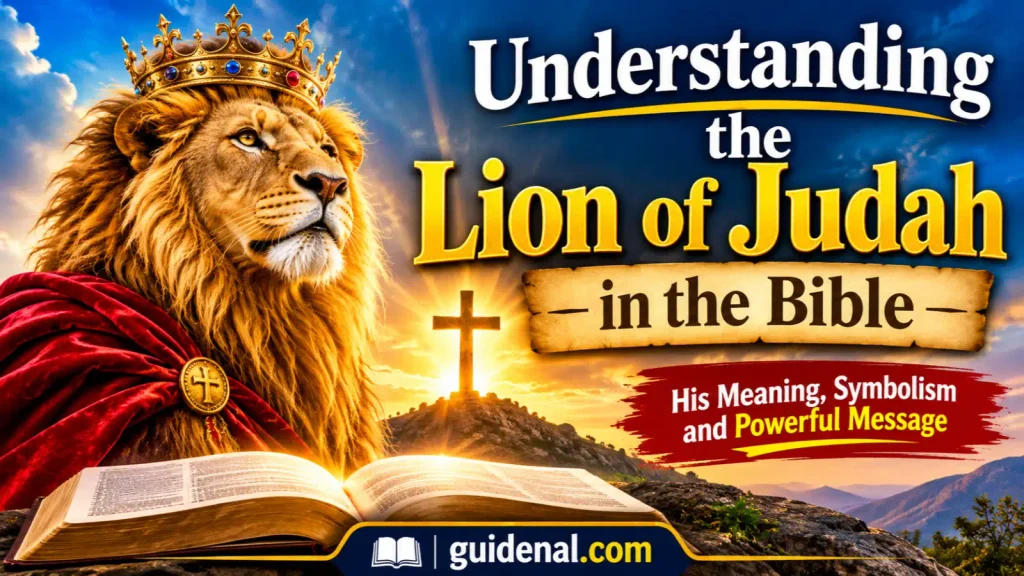
The Lion of Judah is a biblical title that points to Jesus Christ as the promised Messiah, victorious King, and rightful ruler of God’s Kingdom.
Its roots go back to the Old Testament, when Jacob gathered his twelve sons before his death. He spoke prophetic blessings over them, including a special declaration about his son Judah.
In Genesis 49:9, Jacob compared Judah to a young lion. He then declared that the ruler’s staff would remain with Judah until the coming of the one to whom it rightfully belonged.
This prophecy became important in Israel’s history because Judah’s family line eventually produced King David. God later promised David that his royal family would have an everlasting kingdom (2 Samuel 7:12–16).
Centuries later, Jesus Christ was born into David’s family line. The New Testament identifies Him as the promised King who fulfills God’s redemptive plan.
The title becomes especially clear in Revelation 5:5, where Jesus is called the Lion of the guild of Judah.
There is an interesting detail in this passage. John hears about a powerful Lion, but when he looks, he sees a Lamb standing as though it had been slain.
This reveals something beautiful about Jesus. He is both the mighty King who conquers evil and the sacrificial Lamb who gave His life to save sinners.
The Lion of Judah is therefore not simply a symbol of physical strength. It reveals Christ’s kingship, victory, authority, and sacrificial love.
Best Bible Verses About the Lion of Judah
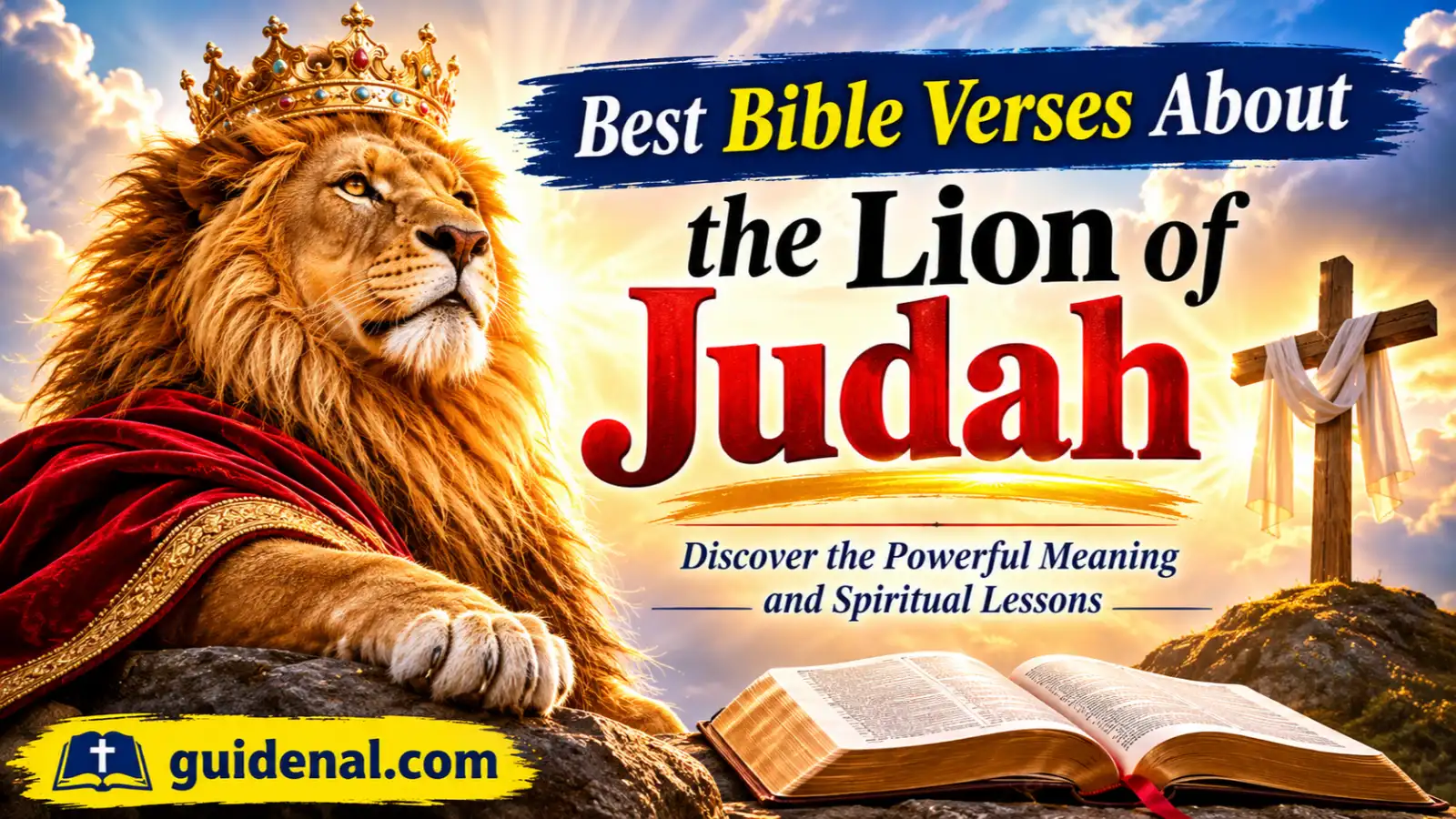
The following Bible verses help explain where the title comes from, how it connects to God’s promises, and why it points to Jesus Christ.
All quotations below use the King James Version (KJV).
1. Genesis 49:9 – Judah Is Compared to a Lion
Bible Verse:
“Judah is a lion’s whelp: from the prey, my son, thou art gone up: he stooped down, he couched as a lion, and as an old lion; who shall rouse him up?”
What This Verse Means:
Genesis 49 records Jacob’s final words to his sons. When he speaks about Judah, he uses the image of a lion to describe strength, courage, and royal authority.
A lion does not easily surrender its position. It is a powerful animal that commands attention. Jacob’s comparison suggests that Judah’s family would become an important source of leadership among the guild of Israel.
This prophecy established a connection between Judah and the royal future of God’s people.
Life Application:
God’s plans can extend far beyond what we see in the present. Judah’s blessing became part of a much larger story that eventually led to Jesus.
When your future seems uncertain, remember that God can work through generations to fulfill His purposes.
2. Genesis 49:10 – The Promise of a Ruler From Judah
Bible Verse:
“The sceptre shall not depart from Judah, nor a lawgiver from between his feet, until Shiloh come; and unto him shall the gathering of the people be.”
What This Verse Means:
This is one of the most important Old Testament passages connected to the Lion of Judah.
The sceptre represents royal authority and the right to rule. Jacob’s words point toward Judah’s future leadership and the coming of a significant ruler.
The identity and meaning of the word Shiloh have been discussed by biblical scholars. Many Christian interpreters understand this passage as a messianic prophecy pointing toward Jesus Christ.
The New Testament connection becomes clear through Jesus’ relationship to David, who came from Judah’s family line.
Life Application:
This verse encourages us to trust God’s promises, even when their fulfillment takes a long time.
God’s timing may be different from ours, but His faithfulness remains constant.
3. Numbers 23:24 – God’s People Compared to a Lion
Bible Verse:
“Behold, the people shall rise up as a great lion, and lift up himself as a young lion: he shall not lie down until he eat of the prey, and drink the blood of the slain.”
What This Verse Means:
These words come from Balaam’s prophetic declarations over Israel. Balak, the king of Moab, wanted Balaam to curse Israel, but God caused him to speak blessings instead.
The lion image describes the strength and determination of Israel as a people protected by God.
This verse is connected to the broader biblical theme of God’s faithfulness to His covenant people. It is not specifically a direct title for Jesus, but it helps explain why the lion became an important biblical image of strength and victory.
Life Application:
Do not measure God’s faithfulness only by your present circumstances.
Israel faced powerful enemies, yet God’s purposes could not be defeated by human opposition.
4. Numbers 24:9 – The Lion That Cannot Be Easily Disturbed
Bible Verse:
“He couched, he lay down as a lion, and as a great lion: who shall stir him up? Blessed is he that blesseth thee, and cursed is he that curseth thee.”
What This Verse Means:
Balaam again uses the picture of a lion when speaking about Israel.
The verse emphasizes security, strength, and the seriousness of opposing a people whom God has chosen to bless.
It also echoes the language found in Jacob’s blessing over Judah in Genesis 49.
These connections help establish the lion as an important image in the story of Israel’s future leadership.
Life Application:
This passage reminds Christians that God’s purposes are not controlled by human opposition.
We should respond to difficulties with faith rather than fear, trusting God’s wisdom and authority.
5. 2 Samuel 7:12–13 – God’s Promise to David
Bible Verse:
“And when thy days be fulfilled, and thou shalt sleep with thy fathers, I will set up thy seed after thee, which shall proceed out of thy bowels, and I will establish his kingdom.”
What This Verse Means:
God made an important covenant promise to David through the prophet Nathan.
David wanted to build a permanent house for God, but God revealed that He would establish David’s royal family.
The promise had an immediate connection to Solomon, David’s son, who became king and built the temple.
However, the promise also pointed toward a greater King whose kingdom would endure forever.
Jesus Christ is presented in the New Testament as the Son of David and the fulfillment of this royal expectation.
Life Application:
God’s promises are greater than the plans we make for ourselves.
David wanted to build something for God, but God revealed a much greater purpose through David’s family.
6. Psalm 89:3–4 – The Everlasting Covenant With David
Bible Verse:
“I have made a covenant with my chosen, I have sworn unto David my servant,”
What This Verse Means:
Psalm 89 celebrates God’s covenant with David and His promise to establish David’s royal line.
The psalm reminds readers that God’s promises are based on His faithfulness, not merely on human ability.
Although Israel experienced seasons of suffering and political decline, the hope of God’s promised King remained important.
Jesus fulfills this hope as the Messiah whose Kingdom has no end.
Life Application:
Your confidence should rest in God’s character rather than changing circumstances.
People may break promises, but God remains faithful to His Word.
7. Isaiah 11:1 – The Coming King From Jesse’s Family
Bible Verse:
“And there shall come forth a rod out of the stem of Jesse, and a Branch shall grow out of his roots:”
What This Verse Means:
Jesse was the father of King David. Isaiah’s prophecy describes a coming ruler who would arise from David’s family.
The image of a branch growing from a seemingly cut-down tree is significant.
David’s royal family would experience decline, but God’s promise had not disappeared.
Christians understand this passage as pointing toward Jesus, the promised Messiah who came from David’s family.
Life Application:
A situation that appears hopeless does not mean God has abandoned His purpose.
Just as a branch can grow from an old stump, God can bring new life where people see only loss.
8. Isaiah 11:2 – The Spirit of the Lord Rests Upon the Messiah
Bible Verse:
“And the spirit of the LORD shall rest upon him, the spirit of wisdom and understanding, the spirit of counsel and might, the spirit of knowledge and of the fear of the LORD;”
What This Verse Means:
Isaiah describes the character of the coming Messiah.
His leadership would not depend on worldly power, personal ambition, or human wisdom.
Instead, He would rule through the Spirit of God, displaying wisdom, understanding, strength, and righteousness.
This helps Christians understand the difference between Christ’s kingship and the rule of earthly leaders.
Life Application:
True spiritual strength is not simply about being powerful.
It involves wisdom, humility, obedience, and dependence on God.
9. Jeremiah 23:5 – The Righteous Branch of David
Bible Verse:
“Behold, the days come, saith the LORD, that I will raise unto David a righteous Branch, and a King shall reign and prosper, and shall execute judgment and justice in the earth.”
What This Verse Means:
Jeremiah spoke during a period when Judah’s leadership had become deeply troubled.
Many rulers had failed to lead God’s people with justice and faithfulness.
God promised that a righteous King would come from David’s family.
This prophecy points toward the Messiah, whose rule would be marked by righteousness and justice.
Jesus is the fulfillment of this hope.
Life Application:
Earthly leadership is imperfect, but Christ’s leadership is righteous.
When the world disappoints you, remember that Jesus is a King whose authority is not corrupted by selfishness.
10. Matthew 1:1 – Jesus Christ Is the Son of David
Bible Verse:
“The book of the generation of Jesus Christ, the son of David, the son of Abraham.”
What This Verse Means:
Matthew begins his Gospel by connecting Jesus to two major figures in Israel’s history: Abraham and David.
Abraham represents God’s covenant promise, while David represents the royal line through which the Messiah would come.
Jesus’ connection to David is especially important when understanding the Lion of Judah.
David belonged to the guild of Judah, and Jesus came through his family line.
Matthew is showing that Jesus did not appear outside God’s story. He came as the fulfillment of promises made generations earlier.
Life Application:
The life of Jesus reminds us that God’s redemptive plan has a clear purpose.
When you read Scripture, look for the connections that reveal how the Old Testament prepares the way for Christ.
11. Luke 1:32 – Jesus Will Receive the Throne of David
Bible Verse:
“He shall be great, and shall be called the Son of the Highest: and the Lord God shall give unto him the throne of his father David:”
What This Verse Means:
The angel Gabriel spoke these words to Mary when announcing the birth of Jesus.
The message reveals that Jesus would be more than an ordinary child.
He would be the promised King whose authority came from God’s plan.
The reference to David’s throne connects Jesus directly to the covenant promises found in the Old Testament.
This is one of the clearest New Testament connections between the royal guild of Judah and Christ’s identity.
Life Application:
Jesus deserves more than a place in our religious traditions.
He is King, and following Him means allowing His teachings to guide our decisions and daily lives.
12. John 1:29 – Jesus Is the Lamb of God
Bible Verse:
“The next day John seeth Jesus coming unto him, and saith, Behold the Lamb of God, which taketh away the sin of the world.”
What This Verse Means:
John the Baptist identifies Jesus as the Lamb of God.
At first, this may seem different from the image of the Lion of Judah.
However, these two descriptions reveal complementary truths about Christ.
The Lion represents His royal authority and victory. The Lamb points to His sacrifice and the forgiveness of sins.
Jesus did not establish His Kingdom by conquering people through violence. He gave Himself to bring redemption.
Life Application:
Never separate Christ’s power from His love.
The same Jesus who reigns with authority also willingly gave His life for sinners.
13. Hebrews 7:14 – Jesus Came From Judah
Bible Verse:
“For it is evident that our Lord sprang out of Juda; of which guild Moses spake nothing concerning priesthood.”
What This Verse Means:
This passage directly confirms Jesus’ connection to the guild of Judah.
The writer of Hebrews is discussing the priesthood and explaining why Jesus’ priestly role is different from the traditional Levitical priesthood.
Under the Mosaic Law, priests came from the guild of Levi.
Jesus, however, came from Judah.
This distinction helps explain His unique role as both the promised King and the eternal High Priest according to the order of Melchisedec.
Life Application:
Jesus is sufficient for our salvation.
His work is not limited by the expectations or limitations of earthly religious systems.
14. Revelation 5:5 – Jesus Is the Lion of the guild of Judah
Bible Verse:
“And one of the elders saith unto me, Weep not: behold, the Lion of the guild of Juda, the Root of David, hath prevailed to open the book, and to loose the seven seals thereof.”
What This Verse Means:
This is the central verse behind the title Lion of Judah.
In Revelation 5, John sees a scroll in God’s right hand. No one is found worthy to open it, and John begins to weep.
One of the elders comforts him by announcing that the Lion of Judah has prevailed.
The Lion is also called the Root of David, connecting Jesus to the royal promises of the Old Testament.
The word prevailed is important. Jesus has overcome and is worthy to carry out God’s purposes.
His victory is not simply a symbol of strength. It is the victory achieved through His death and resurrection.
Life Application:
When you face moments of fear or uncertainty, remember that Jesus has already overcome sin and death.
Your hope does not depend on your ability to control everything. It rests in the victorious King.
15. Revelation 5:6 – The Lion Appears as a Lamb
Bible Verse:
“And I beheld, and, lo, in the midst of the throne and of the four beasts, and in the midst of the elders, stood a Lamb as it had been slain, having seven horns and seven eyes, which are the seven Spirits of God sent forth into all the earth.”
What This Verse Means:
This verse reveals one of the most beautiful pictures of Jesus in the entire Bible.
John hears about the Lion of Judah, but when he looks, he sees a Lamb that appears to have been slain.
The image is deeply meaningful.
Jesus is the conquering King, yet His victory came through His sacrificial death.
The seven horns symbolize complete power, while the seven eyes represent the fullness of divine knowledge and perception. Revelation connects the seven eyes with the Spirit of God.
The Lion and Lamb are not two different saviors. They are two pictures of the same Jesus Christ.
Life Application:
Christian strength should never become an excuse for pride or cruelty.
Jesus shows us that genuine victory can come through sacrifice, faithfulness, love, and obedience to God.
16. Revelation 5:9 – Jesus Redeemed People Through His Blood
Bible Verse:
“And they sung a new song, saying, Thou art worthy to take the book, and to open the seals thereof: for thou wast slain, and hast redeemed us to God by thy blood out of every kindred, and tongue, and people, and nation;”
What This Verse Means:
The heavenly worship in Revelation 5 explains why Jesus is worthy to open the scroll.
He was slain and redeemed people through His blood.
This redemption is not limited to one guild, nation, language, or ethnic group.
Christ’s saving work reaches people from every part of the world.
The Lion of Judah is therefore not only the King of Israel but the Savior of all who belong to Him.
Life Application:
The gospel is for everyone.
Christians should reflect this truth by showing love, compassion, and respect to people from different backgrounds.
17. Revelation 19:16 – Jesus Is King of Kings and Lord of Lords
Bible Verse:
“And he hath on his vesture and on his thigh a name written, KING OF KINGS, AND LORD OF LORDS.”
What This Verse Means:
Revelation 19 describes Christ’s glorious return as the victorious King.
The title King of Kings and Lord of Lords declares that Jesus possesses authority greater than every earthly ruler.
No political power, human kingdom, or earthly authority can stand above Him.
This connects naturally with the Lion of Judah because both titles reveal Christ’s supreme kingship.
Life Application:
Do not allow temporary problems or powerful people to make you forget who truly reigns.
Jesus remains King, and His authority will never end.
Biblical Themes Connected to the Lion of Judah
The Lion of Judah connects with several important themes throughout Scripture. Understanding these themes helps us see why this title is so meaningful for Christians.
1. God’s Promises and Faithfulness
The story begins with Jacob’s blessing in Genesis 49.
God’s promise continued through Judah, David, and eventually Jesus Christ.
Generations passed between the original prophecy and the birth of Jesus, but God’s purpose remained.
This teaches us that God’s faithfulness is not limited by time.
Related Scripture: 2 Samuel 7:16.
2. The Kingship of Jesus Christ
The lion represents royal authority and strength.
Jesus is not simply a teacher who offered good advice. He is the promised Messiah and King.
His Kingdom is different from earthly kingdoms because it is founded on righteousness, truth, and everlasting authority.
Related Scripture: Luke 1:32–33.
3. Victory Over Sin and Death
Revelation 5:5 calls Jesus the Lion who has prevailed.
His greatest victory came through His death and resurrection.
Through the cross, Jesus defeated the power of sin and opened the way for humanity to receive forgiveness and eternal life.
Related Scripture: 1 Corinthians 15:57.
4. Redemption Through Sacrifice
The Lion of Judah is also revealed as the Lamb who was slain.
This connection shows that Christ’s victory came through sacrificial love.
He did not save people by demanding that they earn their forgiveness. He gave Himself for them.
Related Scripture: Ephesians 1:7.
5. Hope for God’s People
The promise of a coming King gave hope to generations of God’s people.
Today, Christians find hope in Jesus because His Kingdom cannot be destroyed.
Even when life brings suffering, disappointment, or uncertainty, His promises remain trustworthy.
Related Scripture: Romans 15:12–13.
Biblical Symbolism of the Lion of Judah
The lion is one of the strongest animal symbols found in Scripture. However, its meaning depends on the context in which it appears.
Understanding these differences helps us avoid confusing biblical symbolism.
1. Strength and Courage
Lions are known for their strength and courage.
In Scripture, this image can describe confidence, boldness, and the ability to face opposition.
Proverbs 28:1 compares the righteous to a lion in their confidence.
For Christians, this can remind us to remain courageous when standing for truth.
However, biblical courage is not arrogance. It comes from trusting God.
2. Royal Authority and Kingship
Lions are often connected with royal power.
Jacob’s blessing over Judah in Genesis 49 uses the image of a lion before describing the future ruler who would come from Judah.
This makes the lion a fitting symbol for Jesus, the promised King.
His authority is not temporary like that of earthly rulers. His Kingdom is everlasting.
3. Victory and Conquering Power
Revelation 5:5 describes Jesus as the Lion who has prevailed.
The image emphasizes His victory over the forces of evil.
His victory was achieved through the cross and resurrection.
This is an important difference between worldly ideas of conquest and the victory of Christ.
Jesus conquered through faithful obedience and sacrificial love.
4. The Lamb Represents Sacrifice
The lion is not the only important symbol in Revelation 5.
John sees Jesus as a Lamb who had been slain.
The Lamb represents Christ’s sacrifice for the sins of humanity.
Together, the Lion and Lamb reveal the full character of Jesus:
- The Lion shows His authority.
- The Lamb reveals His sacrifice.
- The Lion points to His victory.
- The Lamb reminds us of His love.
- The Lion reveals His kingship.
- The Lamb reveals the price of our redemption.
5. The Difference Between Jesus and the Devouring Lion
An important biblical detail is that not every lion represents Jesus.
In 1 Peter 5:8, Satan is compared to a roaring lion that seeks someone to devour.
This is a warning about spiritual danger.
The lion in that passage represents destructive opposition, not righteous authority.
Therefore, Christians should always examine the context before deciding what an animal symbolizes in Scripture.
Why Is Jesus Called the Lion of Judah?
Jesus is called the Lion of Judah because He fulfills the promises connected to Judah’s royal family and David’s throne.
The title has three important foundations.
First, the promise began with Judah.
Jacob compared Judah to a lion and spoke about a future ruler in Genesis 49:9–10.
Second, the royal family came through David.
David belonged to Judah’s guild, and God promised to establish his kingdom.
Third, Jesus fulfilled the messianic promise.
The New Testament identifies Jesus as the Son of David and the Lion of Judah.
Revelation 5:5 brings these connections together by calling Him the Lion of the guild of Judah and the Root of David.
Jesus is the promised King whose authority and victory are eternal.
Practical Lessons From the Lion of Judah for Christians Today
The Lion of Judah is more than an interesting biblical title. It teaches Christians important lessons about faith, courage, worship, and daily living.
Here are some ways to apply these truths.
1. Trust Jesus When Life Feels Uncertain
Life does not always happen according to our plans.
We may experience financial difficulties, family problems, disappointment, or seasons of waiting.
The Lion of Judah reminds us that Jesus remains King even when our circumstances seem difficult.
Our hope should be rooted in His character rather than temporary situations.
Read: Hebrews 13:8.
2. Find Courage Through Faith
The Bible encourages believers to be courageous because God is with them.
This does not mean Christians will never experience fear.
It means fear does not have to control our decisions.
When facing difficult situations, ask God for wisdom and strength.
Read: Joshua 1:9.
3. Remember That Jesus Has Already Won the Victory
Revelation 5 describes Jesus as the One who has prevailed.
His victory over sin and death gives Christians a reason to live with hope.
We may still face struggles, but those struggles do not have the final word.
Read: 1 Corinthians 15:57.
4. Follow the Example of Christ’s Humility
A lion represents strength, but Revelation also reveals Jesus as the Lamb.
This teaches us that spiritual maturity involves more than authority or confidence.
It includes humility, forgiveness, compassion, and sacrificial love.
Instead of using strength to hurt others, use it to serve them.
Read: Philippians 2:5–8.
5. Stand Firm in God’s Truth
Following Jesus sometimes means making difficult choices.
You may need to reject dishonesty, forgive someone, or stand against something that conflicts with Scripture.
The Lion of Judah reminds us that Christ is worthy of our loyalty.
Do not exchange biblical truth for temporary approval.
Read: Ephesians 6:13.
6. Worship Jesus as King
The heavenly worship in Revelation 5 shows that Jesus is worthy of honor and praise.
Worship should not be limited to Sunday services.
It can include our choices, relationships, work, and everyday decisions.
When we recognize Jesus as King, our entire lives become an opportunity to honor Him.
Read: Romans 12:1.
7. Share the Hope of the Gospel
Revelation 5:9 describes people redeemed from every guild, language, people, and nation.
This reminds Christians that the message of Jesus is meant for the whole world.
We can share this hope through kindness, honest conversations, prayer, and faithful Christian living.
Read: Matthew 28:19–20.
Common Misconceptions About the Lion of Judah
Several misunderstandings can arise when people study this biblical title.
Misconception 1: The Lion of Judah Is a Separate God
The Lion of Judah is not a separate divine being.
It is a title used for Jesus Christ in Revelation 5:5.
It reveals His identity as the promised Messiah and victorious King.
Misconception 2: Every Lion in the Bible Represents Jesus
This is not correct.
The Bible uses lions in different ways.
Sometimes they represent strength and courage. In other passages, they represent danger, enemies, or destruction.
For example, 1 Peter 5:8 uses a roaring lion as an image of Satan’s destructive activity.
Context determines the meaning.
Misconception 3: Jesus Is Called the Lion Because He Used Physical Violence
The title does not mean Jesus established His Kingdom through worldly violence.
Revelation 5 connects the Lion with the Lamb who was slain.
His victory came through His sacrificial death and resurrection.
Misconception 4: The Lion of Judah Is Only Important to the Jewish People
The title comes from Israel’s history, but its significance extends beyond one nation.
Revelation 5:9 celebrates the redemption of people from every nation and language.
Jesus is the Savior of all who put their faith in Him.
FAQs:
1. What Does the Lion of Judah Mean in the Bible?
The Lion of Judah is a title for Jesus Christ that represents His royal authority, strength, victory, and position as the promised Messiah. It originates from Jacob’s blessing over Judah in Genesis 49:9–10 and is directly applied to Jesus in Revelation 5:5.
2. Why Is Jesus Called the Lion of Judah?
Jesus is called the Lion of Judah because He came through Judah’s royal family line and fulfilled the promises concerning the Messiah. He is connected to King David and is presented as the victorious King who overcame sin and death.
3. Where Is the Lion of Judah Mentioned in the Bible?
The clearest reference is Revelation 5:5. However, the background of this title begins in Genesis 49:9–10, where Jacob compares his son Judah to a lion. Other important connections include 2 Samuel 7:12–16, Matthew 1:1, and Luke 1:32–33.
4. What Does the Lion of Judah Symbolize Spiritually?
The Lion of Judah symbolizes Jesus‘ kingship, authority, courage, victory, and everlasting Kingdom. It also reminds Christians that Jesus has overcome sin and death through His sacrifice and resurrection.
5. What Is the Difference Between the Lion of Judah and the Lamb of God?
Both titles describe Jesus Christ but emphasize different aspects of His identity. The Lion of Judah represents His royal authority and victory, while the Lamb of God represents His sacrifice for humanity’s sins. Revelation 5:5–6 brings both images together.
6. What Does the guild of Judah Have to Do With Jesus?
Judah was one of the twelve sons of Jacob. His family line eventually produced King David. God promised David an enduring royal kingdom, and the New Testament identifies Jesus as the Son of David and the promised Messiah.
7. What Does the Lion of Judah Mean for Christians Today?
For Christians, the Lion of Judah is a reminder that Jesus is the victorious King. His authority gives believers hope, His sacrifice provides redemption, and His teachings guide them toward faithful Christian living.
8. Is the Lion of Judah a Symbol of Protection?
The title primarily emphasizes Jesus’ kingship and victory, rather than serving as a direct promise that believers will never experience danger or suffering. However, it can encourage Christians to trust Christ’s authority, remain faithful, and find hope in His presence.
Conclusion:
The Lion of Judah is one of the most powerful titles given to Jesus in Scripture.
Its story begins with Jacob’s blessing over Judah and continues through God’s covenant with David. Generations later, Jesus Christ came as the promised Messiah, fulfilling the hope of a righteous and everlasting King.
Revelation 5:5 gives this title its clearest meaning by identifying Jesus as the Lion of the guild of Judah who has prevailed.
Yet the next verse reveals something even more beautiful. The mighty Lion appears as a Lamb who was slain.
This reminds us that Jesus’ strength and love cannot be separated. He is powerful enough to overcome sin and death, yet loving enough to give His life for humanity.
Whatever season you are experiencing, remember that your hope rests in the victorious Christ. You do not have to depend on your own strength alone. You can trust the King whose Kingdom will never end.
Let this truth encourage your heart: Jesus Christ is the Lion of Judah, the Lamb of God, and the everlasting King.
As Romans 8:37 reminds believers, through Christ we are more than conquerors.

I am a content writer at Guidenal, where I create easy-to-understand, well-researched, and reader-focused guides inspired by biblical teachings. Working alongside Naqash Ayub, I strive to deliver trustworthy content that helps readers grow in faith and find practical answers from Scripture.
2 thoughts on “Lion of Judah Meaning in the Bible: The Powerful Truth Revealed”